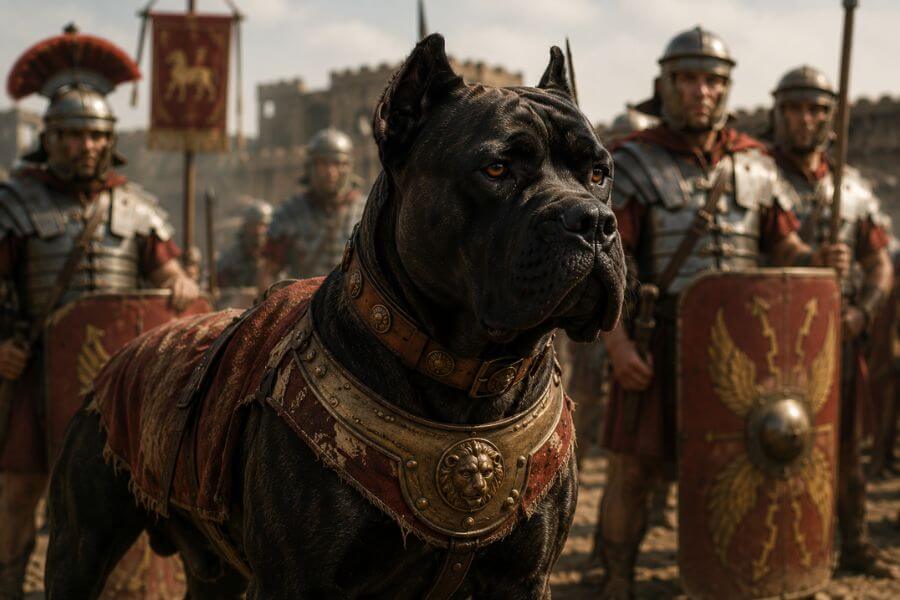
Quick Summary Table
| Milestone Number | Historical Era or Event | Main Role of the Cane Corso |
| 1 | Ancient Greek Roots (Molossus) | The foundation breed for heavy guard dogs |
| 2 | The Roman Conquest of Greece | Roman soldiers adopt the dogs for military use |
| 3 | Battleground Gladiators (Pugnax) | Charging enemy lines with armor and buckets of oil |
| 4 | Arena Entertainment Games | Fighting lions, bears, and gladiators in Rome |
| 5 | Post-War Farm Protectors | Guarding livestock and hunting wild boars in Italy |
| 6 | The Great Feudal Estate Guardians | Protecting large southern Italian castles and lands |
| 7 | The Dawn of Modern Mechanized Farming | The decline of the breed due to modern tractors |
| 8 | The Devastation of World War II | Near extinction of the breed across rural Italy |
| 9 | The 1970s Italian Rescue Mission | Dr. Paolo Breber starts the breed recovery program |
| 10 | The First Breed Standard in 1980 | Dr. Antonio Morsiani writes the official physical rules |
| 11 | International Global Recognition | The breed gets official acceptance by world clubs |
| 12 | The Modern Guard and Family Dog | The transition to a popular global household protector |
How We Ranked These
To choose and order the most important steps in the history of this great breed, we looked at how each event changed the dog. Here are the key factors we used to rank these moments:
- Impact on Survival: How close the event came to making the breed disappear forever or how it saved them from extinction.
- Role Transformation: How much the dog changed its actual job, like moving from a fierce war machine to a quiet farm helper.
- Physical Evolution: How selective breeding during that specific time changed the size, strength, and look of the dog.
- Global Recognition: How the event helped the dog move from a hidden Italian secret to a famous pet across the world.
1. The Molossus Ancestry in Ancient Greece
Your journey into the history of the Cane Corso starts long before the Roman Empire became powerful. To find the true roots of this large dog, you have to look at ancient Greece, specifically a region called Epirus. The people living there were known as the Molossians. They bred a massive, heavy-boned dog called the Molossus.
These dogs were famous for their incredible courage, thick necks, and intense loyalty to their masters. They were not modern Cane Corsos yet, but they carried the genetic building blocks that would later create them. Ancient kings and shepherds used these dogs to protect sheep from large wolves and mountain bears.
When you look at old Greek statues, you can see the power of these animals. They had wide heads and strong jaws that could hold down large prey. This physical strength made them famous across the ancient Mediterranean Sea. Travelers wrote stories about the giant dogs of Greece that feared nothing. It was this reputation that caught the eye of a rising power across the water: Rome.
2. The Roman Conquest and Adoption
As the Roman army marched across the known world, they entered Greece. Roman soldiers were experts at taking the best ideas from the cultures they conquered. When they saw the Molossus dogs in action, they immediately knew they needed these animals for their own empire.
The Romans took many of these giant dogs back to Italy. Once the dogs arrived in Rome, breeders began to mix them with local Italian guard dogs. This careful breeding created a slightly faster, more agile animal than the heavy Greek Molossus. The Romans called this new creation the Canis Pugnax, which translates to the fighting dog of Rome.
This moment changed the destiny of the breed. It moved the dogs from quiet hillsides into the heart of the most powerful military machine in the world. The Roman breeders wanted a dog that could run long distances, tolerate intense heat, and attack on command. This mix of Greek power and Italian speed formed the direct ancestor of the modern Cane Corso.
3. The Roman War Machine and Battleground Glory
Imagine standing on an ancient battlefield with thousands of soldiers. Next to the Roman legionnaires stood the Canis Pugnax, ready for war. The Romans did not just use these dogs to guard their camps at night. They trained them to be active participants in bloody battles against fierce enemy tribes.
To make them even more dangerous, the Romans designed special armor for the dogs. They strapped iron collars with sharp spikes around their necks to protect them from enemy swords. Sometimes, they even attached lightweight metal plates to the backs of the dogs. The most terrifying tactic involved fastening buckets of burning oil to the armor. These dogs, known as piriferi or fire-bearers, would charge directly into the enemy lines.
When the dogs ran at full speed into the opposing army, they caused massive panic. They bit the legs of horses, knocked down foot soldiers, and spread fire everywhere. The psychological impact of seeing a giant, armored dog charging through smoke was enough to break the spirit of many armies. Through these brutal battles, the dog developed an incredibly strong work ethic and an ability to stay calm during chaotic situations.
4. The Colosseum and Arena Games
When the Roman wars ended, the soldiers returned home, and they brought their battle dogs with them. The citizens of Rome loved violent entertainment, and the Canis Pugnax became a major star in the ancient arenas, including the famous Colosseum.
In the arena, the dogs had to fight against a wide variety of deadly opponents. Roman emperors imported exotic animals from the farthest corners of the empire, including African lions, wild bears, and massive gladiators. The dogs were grouped together to bring down these large beasts to entertain the screaming crowds.
This brutal environment acted as a harsh form of natural selection. Only the strongest, smartest, and fastest dogs survived the arena games. The Romans valued dogs that showed no fear, even when facing an animal twice their size. This era fixed the fearless nature of the breed into its DNA. The dog learned how to use its heavy weight to pin down large targets, a trait that you can still see in the breed today.
5. The Transition to Italian Farm Life
Every great empire eventually falls, and when Rome collapsed, the grand military roles for the Canis Pugnax vanished. The dogs had to adapt to a completely new way of life to survive. They moved out of the burning war arenas and into the quiet countryside of southern Italy, particularly in regions like Puglia, Campania, and Molise.
The rural people of Italy needed an all-around helper, and the dog proved to be incredibly versatile. The name “Cane Corso” likely comes from this era. It is believed to come from the Latin word Cohors, which means protector or guardian of the courtyard. Instead of fighting soldiers, the dogs now protected small family farms from thieves and stray animals.
The dogs also became essential tools for southern Italian farmers who raised semi-wild cattle and pigs. If a large bull tried to escape or attack a farmer, the Cane Corso would rush forward, bite the nose or ear of the animal, and hold it completely still until the farmer could tie it up. This job required extreme control and intelligence, preventing the dog from killing the valuable livestock while still using enough force to control them.
6. The Protector of Feudal Estates
During the Middle Ages and the feudal era in Italy, land ownership changed. Wealthy lords built massive estates and castles across the southern countryside. They needed reliable security systems to protect their wealth, crops, and animals from gangs of bandits who roamed the hills.
The Cane Corso became the ultimate status symbol and security guard for these large estates. They stayed near the gates and high stone walls during the night. Their deep, echoing bark was enough to warn intruders to stay away. Because the dogs were so loyal to their specific human families, they were trusted to roam the private grounds where children played.
At the same time, the breed excelled at hunting dangerous big game. Southern Italy was full of wild boars, which were fast, strong, and possessed sharp tusks that could easily kill a human. A single Cane Corso could track a boar through thick brush, chase it down, and hold it in place. This capability provided meat for the estate and protected the farm fields from being destroyed by wild animals.
7. The Rise of Modern Mechanized Farming
For centuries, the relationship between the Italian farmer and the Cane Corso remained unchanged. However, the arrival of the industrial age and modern agricultural technology in the nineteenth and early twentieth centuries brought a massive threat to the breed.
As farmers started buying mechanical tractors, modern fencing, and automatic machinery, the traditional jobs of the dog began to disappear. Farmers no longer needed a powerful dog to round up wild cattle because modern fields were securely fenced. They did not need a giant protector against wild animals because large predators like wolves had been hunted out of the region.
The population of the Cane Corso began to drop rapidly. They were expensive to feed, and poor rural families could no longer justify keeping a massive dog that did not have a daily job. The breed became a rare sight, kept only by a few traditional families in isolated areas of southern Italy who refused to change their old ways of life.
8. The Near Extinction during World War II
The mid-twentieth century was a dark time for the entire world, and it almost meant the absolute end for the Cane Corso. World War II devastated the Italian countryside. Fields were turned into battlegrounds, villages were bombed, and a severe food shortage spread across the nation.
During the war, people struggled to find enough food to feed their children. In these desperate conditions, maintaining a dog that weighed over one hundred pounds was nearly impossible. Many dogs died from starvation, while others were killed during the heavy fighting that swept through the southern Italian towns.
By the time the war ended in 1945, the Cane Corso was on the brink of total extinction. The few surviving dogs were scattered across remote farms in the deepest parts of Puglia. They were disconnected from each other, and the world had completely forgotten that the ancient war dog of Rome still existed.
9. The 1970s Italian Rescue Mission
In the mid-1970s, a small group of Italian dog lovers and scientists realized that a valuable piece of their national history was about to disappear forever. A man named Dr. Paolo Breber was driving through southern Italy when he spotted a unique dog that matched old historical paintings of the Roman war dog.
Dr. Breber began writing articles about these animals, warning the public that the ancient breed was dying out. His words caught the attention of other enthusiasts. Together, they traveled to isolated farms, knocked on doors, and convinced local old farmers to let them buy or breed the last remaining true examples of the Cane Corso.
This rescue mission was incredibly difficult. The gene pool was tiny, and the researchers had to be very careful to select only the healthiest dogs that showed the correct historical traits. They created a small breeding program to slowly increase the number of puppies. This passionate group of people saved the breed from the brink of total silence.
10. The First Breed Standard in 1980
As the number of dogs slowly grew, the rescuers realized they needed a formal plan to ensure the dog retained its historical identity. In 1980, a famous dog expert named Dr. Antonio Morsiani wrote the very first official breed standard for the Cane Corso.
A breed standard is a detailed written document that describes exactly how the perfect dog should look, move, and behave. Dr. Morsiani measured dozens of the rescued dogs to determine the ideal height, weight, head shape, and jaw structure. He wanted to make sure the dog kept its historic athletic build, short coat, and strong muscles rather than turning into a soft, oversized show pet.
The creation of this standard allowed breeders across Italy to work together with a single goal. It stopped people from mixing the Cane Corso with other large breeds, which would have ruined the unique Roman bloodline. This document turned the scattered farm dogs into an officially recognized, uniform dog breed.
11. International Global Recognition
Once the breed was stable and uniform inside Italy, it was time for the dog to step onto the world stage. In the late 1980s and 1990s, the first examples of the breed were exported to the United States and other European nations.
International dog organizations began to take notice of this powerful animal. The Fédération Cynologique Internationale, which is the largest global canine organization, gave the breed official provisional recognition in 1996. Years later, after seeing the continued growth and health of the dogs, the American Kennel Club officially welcomed the breed into its working group in 2010.
This international recognition opened the floodgates. Dog lovers around the globe discovered the incredible history of the Roman war dog. The breed moved from being a regional Italian secret to a globally respected protector. This step guaranteed that the breed would never face the threat of extinction again.
12. The Modern Guard and Family Dog
Today, the Cane Corso has completed its long journey from the ancient battlefields to the modern living room. It is now one of the most popular large dog breeds in the Western world, valued for its unique combination of power and deep affection for its owners.
Your modern Cane Corso no longer has to fight lions or carry burning oil, but it still possesses the same protective instincts as its ancestors. It forms a tight, unbreakable bond with its human family. The dog is naturally quiet and observant, preferring to watch a situation closely before deciding to act.
Living with this breed requires a strong understanding of its history. They are not soft pets for lazy owners; they are working dogs that need mental stimulation, daily physical exercise, and clear leadership. When raised correctly, the modern Cane Corso stands as a living testament to thousands of years of survival, loyalty, and strength.
Frequently Asked Questions
Did Roman soldiers ever use the ears of the Cane Corso to help them spot enemy soldiers at night?
No, the ears were not used for spotting enemies, but they were historically cropped for safety reasons. In ancient times, long floppy ears were an easy target for wild boars, lions, or enemy soldiers to grab onto during a fight. By cutting the ears short, the Romans left nothing for an opponent to hold or tear, which protected the dog from bleeding out during combat.
How did the ancient Romans feed these massive dogs when meat was hard to find during long war campaigns?
During long military marches, the Roman army could not always provide fresh meat for hundreds of war dogs. The dogs typically ate a mix of coarse barley flour porridge, stale bread crusts, and animal fat byproducts left over from the soldiers’ meals. When the army camped near forests or enemy territory, the dogs were also expected to hunt wild game or forage for food themselves.
Why did the ancient Romans prefer dark colored coats over light colored coats for their war dogs?
Roman military leaders favored black, dark gray, or brindled coats for their battleground dogs because of the tactical advantages during night operations. A dark colored dog was nearly invisible in the dark, allowing them to surprise enemy scouts who tried to sneak into the Roman camps. Darker coats also hid blood and wounds better, which helped keep morale high among the human soldiers during brutal daytime fights.
Was the Cane Corso ever used by the Romans to pull small medical carts on the battlefield?
There is no historical evidence that the dogs pulled medical carts for wounded soldiers, as the Romans used horses, mules, and oxen for heavy pulling tasks. The physical structure of the Cane Corso was optimized for speed, agility, and biting power rather than continuous heavy pulling. Their main non-combat job on the battlefield was guarding the supply wagons and perimeter lines from thieves.
Did the ancient Roman doctors use the saliva of these dogs to treat wounded soldiers?
While the Romans believed that animal saliva had some healing properties, war dogs were not used as official medical treatments. However, because the dogs would naturally lick their own minor wounds or those of their handlers, a myth grew that the dog had a magical touch. In reality, the physical presence of the loyal dog provided emotional comfort to injured soldiers, which helped them recover faster in military hospitals.