Summary of the Best Training Methods
| Method Number | Training Method Name | Primary Focus | Success Rate | Time to See Results |
| 1 | The Four on the Floor Rule | Reward positive behavior | High | 1 to 2 weeks |
| 2 | The Turn and Ignore Method | Remove attention for jumping | Medium to High | 2 to 3 weeks |
| 3 | The Place Command | Teach a go-to spot | Very High | 2 to 4 weeks |
| 4 | The Sit for Greetings Technique | Build a new polite habit | High | 2 to 3 weeks |
| 5 | The Leash Control Strategy | Physical management during training | Very High | Immediate control |
How We Ranked These Training Methods
To find the most effective ways to stop your large dog from jumping, we looked at how real owners and trainers solve this problem. Big dogs need special care because their size can accidentally hurt people. We picked these five choices based on specific key factors that make a training plan work well at home.
- Safety First: We chose methods that keep both your guests and your large dog safe during the greeting process.
- Ease of Use: The steps are simple to follow so you and your family can do them every single day without confusion.
- Positive Reinforcement: We focus on rewarding good choices rather than using fear or pain to change behavior.
- Long-term Success: These strategies fix the deep root of the jumping problem instead of just hiding it for a few minutes.
- Clear Communication: Each method helps you give your dog a clear message about what you want them to do instead of jumping.
1. The Four on the Floor Rule
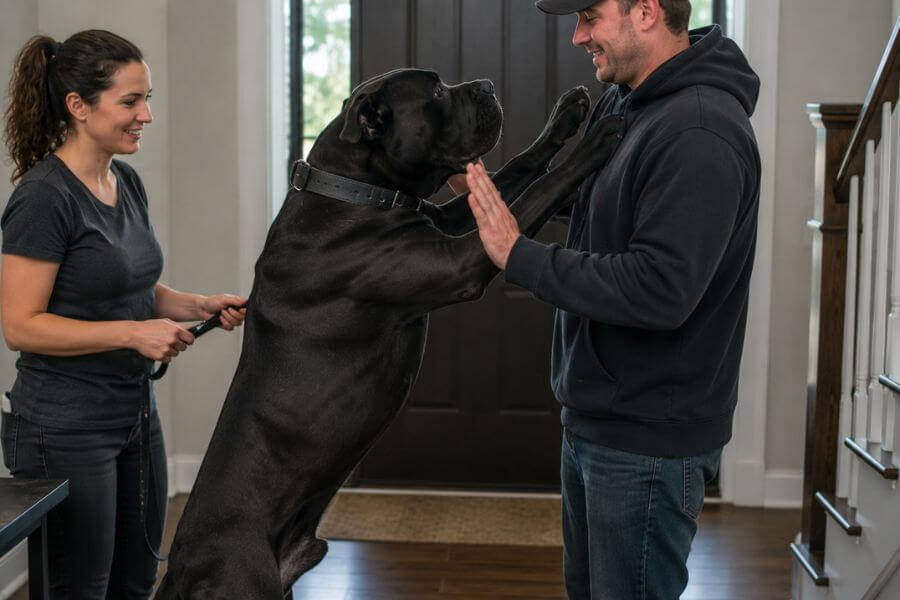
The first and most important step to change your dog’s greeting behavior is to teach them that good things only happen when all four of their paws stay firmly on the ground. Dogs often jump because they are excited to see people and want to get closer to their faces. When you or your guests touch a jumping dog, even to push them away, the dog thinks this is a fun game or a reward.
To use this method, you must become very observant. Watch your dog closely when a guest walks through the door. The very second your dog has all four paws on the floor, you must give them a high-value treat and lots of praise. High-value treats are special snacks like small pieces of chicken or cheese that your dog does not get during normal times.
If your dog lifts their front paws even an inch off the ground, the rewards must stop instantly. You must turn your eyes away and look at the ceiling. Do not speak to your dog and do not touch them. This shows your massive companion that their action makes the rewards disappear.
You need to practice this with your family members first before you try it with real guests. Have a family member walk into the room. If the dog stays grounded, feed them a snack every few seconds. This teaches the dog that staying down is a continuous job that pays well. Once your dog understands that four paws on the floor equals delicious snacks, they will choose to stay down when new people arrive.
Consistency is the secret to this rule. If one person allows your dog to jump on them just for fun, the dog will keep trying it with everyone else. Ensure that every single person who lives in your home follows this exact rule every single day.
2. The Turn and Ignore Method
This method works by removing the one thing your dog wants most when they jump: your direct attention. When a giant dog jumps on a guest, the human response is usually to yell, wave hands, or push the dog down. To a large, high-energy dog, this feels like an exciting wrestling match. They do not view your negative reaction as a punishment; they view it as entertainment.
To use the turn and ignore method properly, your guests must act like stone statues. When your dog jumps up, the person being jumped on must immediately turn their back to the dog. Cross your arms over your chest so your hands are not available for the dog to lick or play with. Look away from the dog completely. Do not say words like no, stop, or down.
By turning around, you remove the target. The dog can no longer look into your eyes or touch your front side. They are left leaning against a cold back. Most dogs will feel confused by this sudden lack of attention and will drop back down to the ground.
The moment the dog drops their feet back to the floor, you must turn back around and greet them warmly. If they try to jump again the moment you turn back, you must immediately spin around and ignore them again. This creates a clear cause-and-effect relationship in your dog’s mind. Jumping makes humans turn into boring statues, while staying on the ground makes humans friendly and fun.
This method requires patience because large dogs might try harder before they finally give up. This is called a behavior burst, where the dog thinks they just need to jump higher or harder to get a reaction. Stay strong and stay still. Tell your guests before they enter your home exactly how to behave so they are prepared to ignore the dog safely.
3. The Place Command
Teaching your dog to go to a specific place when guests arrive is an excellent way to prevent jumping before it even starts. This method gives your dog a specific job to do, which channels their excitement into a calm action. It is much easier to tell a dog what to do rather than just telling them what not to do.
First, pick a specific spot like a raised dog bed, a special rug, or a mat that sits a safe distance away from the front door. This spot will be your dog’s official place. Start training this when your house is completely quiet and there are no guests around. Walk your dog over to the mat, say the word place, and give them a treat the moment they step onto it.
Repeat this many times until your dog runs to the mat happily when they hear the word. Next, teach them to stay on the mat for longer periods. Give them a treat after three seconds, then five seconds, then ten seconds. If they step off the mat, gently guide them back without getting angry and start the count again.
Once your dog can stay on their mat for a few minutes, introduce the challenge of the front door. Knock on a wall or ring your doorbell, then immediately command your dog to go to their place. Reward them heavily for staying there despite the noise. The doorbell should become a green light that tells your dog to run to their mat, not to the front door.
When a real guest arrives, send your dog to their place before you open the door. Keep your dog on the mat until the guest has entered, put away their bags, and sat down. Once the guest is settled and the initial wave of excitement has passed, you can release your dog to say a calm hello.
4. The Sit for Greetings Technique
A dog cannot jump up if they are already sitting down. This simple physical fact makes the sit command one of the best tools to stop jumping behavior. By teaching your dog that they must sit to receive affection, you replace an unwanted habit with a polite greeting ritual.
Before you use this with guests, your dog must have a rock-solid sit command. They should be able to sit quickly when you ask, even if there are distractions around. To start the greeting practice, hold a treat in your hand and stand near your dog. Ask them to sit. As you lean down to pet them, if they stand up, immediately lift your hands and step back.
Repeat this until your dog realizes that your hands will only touch them if their rear end stays connected to the floor. Next, practice this with a helper. Have a friend walk toward your dog slowly. Ask your dog to sit. If your dog stays sitting, the friend can walk all the way over, bend down, and give the dog a gentle scratch behind the ears.
If your dog gets excited and stands up as the friend approaches, the friend must stop walking instantly, turn around, and take two steps backward. The friend becomes approachable only when the dog is sitting. This teaches your dog that their posture controls the movement of the human. If they want the person to come closer, they must keep their seat.
This technique is highly effective because it changes the dog’s internal state. Sitting down naturally helps a dog calm their mind, while standing and dancing on two legs increases their excitement levels. It creates a polite habit that will last for the rest of your dog’s life.
5. The Leash Control Strategy
When you are in the middle of training a large and powerful dog, you cannot afford to let them make mistakes that could knock a guest down. The leash control strategy is a management tool that keeps everyone safe while your dog is still learning the other rules on this list. It gives you physical control without requiring you to use brute force.
Whenever you expect guests to arrive at your home, put your dog on a standard six-foot leash before you open the door. Do not use a retractable or extendable leash, as these do not give you enough control. Step on the leash with your foot, leaving just enough slack so your dog can stand up comfortably, sit down, or lie down.
However, make sure the leash is short enough under your foot that if your dog tries to launch themselves into the air to jump, the leash stops them automatically before their paws can touch your guest. This prevents your dog from practicing the bad behavior. Every time a dog successfully jumps on someone, they learn that jumping is possible, which strengthens the bad habit.
With the leash secured under your foot, open the door and welcome your guest. Your dog will likely try to jump, but they will hit the limit of the leash and stay grounded. Do not pull or jerk the leash yourself; let your foot hold the line. This allows the leash to act as a neutral boundary rather than a human punishment.
While your dog is held safely by the leash, you can wait for them to calm down. Once they stop pulling and choose to sit or stand quietly, you can praise them and let the guest offer a treat from a safe distance. This method ensures total safety and peace of mind during the training process.
Frequently Asked Questions
What should I do if my dog accidentally scratches a guest while we are still practicing these methods?
If your dog makes a mistake and scratches a guest, you must remove the dog from the room immediately without yelling. Put them in a quiet area like their crate or a separate room behind a baby gate so they can calm down. Apologize to your guest and tend to the scratch right away. This sudden removal from the social action tells your dog that rough behavior leads to a total end to the fun, while keeping your guests safe from further incidents.
Can I use a vibrating or noise-making collar to stop my large dog from jumping on people?
It is much better to avoid using electronic or noise devices because they can confuse your dog or make them afraid of your guests. If a dog feels a strange vibration or hears a loud, scary noise every time a guest walks through the door, they might connect that bad feeling to the guest. This can cause your dog to become fearful or aggressive toward visitors, which is a much bigger problem than jumping. Stick to positive rewards and clear physical boundaries instead.
How long does it usually take for a fully grown dog to completely stop jumping on visitors?
The time it takes depends on how consistent you are with the rules, but most owners see a big improvement within two to four weeks. If your dog has been jumping on people for several years, it will take a bit longer to break that deeply set habit than it would for a young puppy. You can speed up the process by hosting practice sessions with friends who agree to follow your training steps exactly, allowing your dog to learn the new rules in a short period.
Why does my dog only jump on certain guests but stays completely calm around others?
Dogs are excellent judges of human body language and will test the rules with different people. If you have a friend who speaks in a high-pitched voice, moves excitement-filled hands around, or secretly lets the dog jump because they like it, your dog will target that specific person. Dogs will quickly learn who enforces the rules and who does not. This is why it is vital to educate your friends before they enter your home so they do not accidentally undo your hard work.
Should I give my dog a toy to hold in their mouth when people come over to help stop the jumping?
Yes, giving your dog a large toy or a favorite chew can be a fantastic way to prevent jumping. Many dogs jump because they have a lot of nervous energy and excitement inside their bodies. Carrying a toy gives them a safe outlet for that energy and occupies their mouth, which also prevents accidental nipping or licking. Many dogs will happily parade around with their toy in their mouth, showing it off to your guests while keeping all four of their paws flat on the floor.