Bringing a brand-new puppy into your home fills your days with tiny tail wags, soft nose boops, and lots of cuddles. Your house is suddenly alive with the sound of little paws pattering across the floor. Every single thing your furry friend does feels like the cutest event of the year. But along with all that joy, you quickly realize that your little pup has a lot to learn about the big wide world. They need to know how to walk nicely on a leash, how to polite-up their manners around other dogs, and how to listen when you call their name. That is exactly where puppy kindergarten comes into play. It is a magical place where young dogs learn how to become great furry citizens while making lots of new friends.
Enrolling your pup in a class is an amazing first step toward building a wonderful life together. However, you cannot just show up on the first day with nothing but a smile and a furry ball of energy. Just like when human kids get ready for their very first day of school, your dog needs a backpack full of the right supplies, health checks, and mental preparation to find success. Walking into your first class completely prepared ensures that both you and your puppy have a stress-free, fun-filled experience. This guide will walk you through every single item, document, and mental trick you need so that you can tackle puppy kindergarten like an absolute champion team.
The Ultimate Gear Checklist Walking and Safety
When you step into a training room filled with other young dogs, safety is the most important thing on everyone’s mind. Puppies are famous for being wiggly, unpredictable, and surprisingly fast when they want to escape. Having the proper gear attached to your dog keeps them secure and lets you guide them without causing any discomfort. You want tools that give you great control while keeping your puppy completely happy and safe.
Collars and Harnesses
Your puppy needs to wear a flat collar or a standard harness during class. A flat collar is the traditional band that snaps around your dog’s neck. It should be made of soft nylon or smooth leather so it does not rub against their delicate skin. When you put it on, you must use the two-finger rule. This means you should be able to slide two fingers comfortably between the collar and your puppy’s neck. If you can fit more than two fingers, the collar is too loose and your pup might slide their head right out of it. If you cannot fit two fingers, it is too tight and will make your puppy uncomfortable.
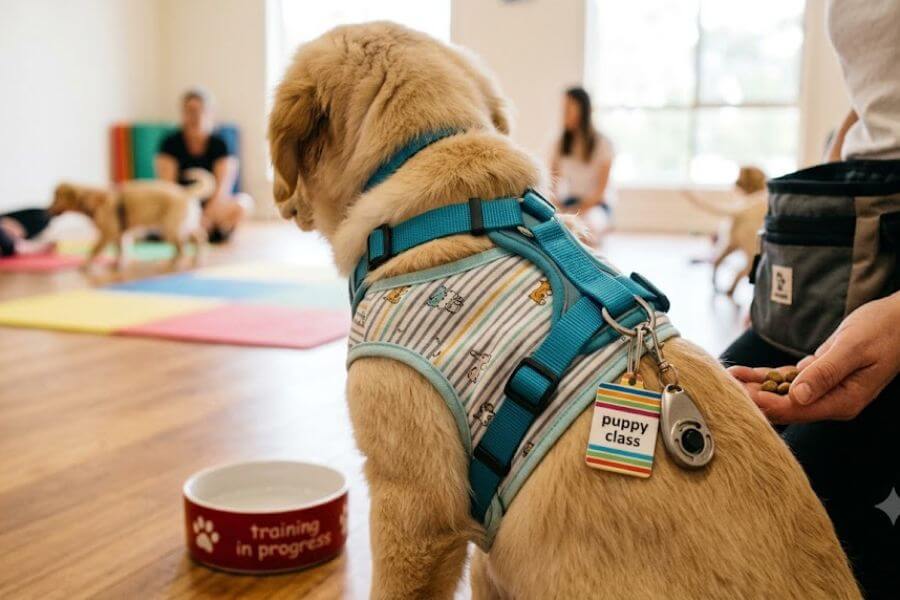
Many trainers highly recommend a back-clip harness for young puppies. A harness wraps around your dog’s chest and shoulders rather than putting pressure on their throat. Young dogs have very fragile windpipes, and if they suddenly lung forward to greet a classmate, a collar can make them cough or gasp. A harness spreads the pull across their whole body, keeping them safe from harm. Look for a harness that has adjustable straps because your pup is growing bigger by the minute. It should have quick-snap buckles so you do not have to struggle to get it on and off your wiggly pet.
Leashes for Learning
The type of leash you bring to puppy kindergarten can make or break your training success. You need a standard six-foot leash made from strong nylon or comfortable leather. A six-foot length is the perfect size because it gives your puppy enough room to take a few steps and explore, but keeps them close enough so you can guide them away from trouble. Avoid fancy leashes with metal chains because they can hurt your hands, and avoid thick ropes that are too heavy for a tiny pup to carry around.
You must leave your retractable leash at home when you go to class. Retractable leashes, the ones that roll up into a plastic handle, are not allowed in almost all puppy training schools. These leashes make it very hard to control your dog in a crowded room. If your pup runs toward another dog, the thin cord can wrap around human legs or little puppy paws, causing painful cuts or burns. Plus, retractable leashes teach your puppy that pulling hard makes the leash get longer, which is the exact opposite of what you want them to learn. Stick to a solid, fixed-length leash that keeps your puppy safely by your side.
Identification Tags
Even though you will be inside a secure building, your puppy must always wear an identification tag on their collar or harness. This tag should be made of durable metal or plastic and stamped with your most important details. It needs to show your puppy’s name, your phone number, and the town where you live.
Classrooms can be chaotic, and there is always a tiny chance that a leash slips out of your hand or a gate opens unexpectedly. Having a clear, easy-to-read tag gives you peace of mind. Make sure the tag is attached with a strong metal ring so it does not fall off during a wild puppy play session. You can also look into silent tags that slide flat against the collar strap if you find that jingling metal tags distract your pup while they are trying to focus on lessons.
The Ultimate Gear Checklist Treats and Food
Training a puppy requires a lot of positive motivation. Young dogs do not work for free, and they certainly do not understand English yet. They learn by connecting an action with a wonderful reward. If they sit down and a delicious treat instantly appears in their mouth, they think to themselves that sitting is the greatest idea ever. To keep your puppy focused in a room full of exciting smells and barking friends, you need to bring the ultimate snack jackpot.
Training Treats
The treats you use at home for basic tricks might not work well in a busy classroom. At home, your puppy might happily sit for a piece of dry kibble. But in puppy kindergarten, there are a million distractions competing for your dog’s attention. You need what trainers call high-value treats. These are treats that are extremely smelly, soft, and completely irresistible to your dog. Think of things like small bits of hot dogs, tiny cubes of cheese, freeze-dried liver, or soft chicken bites.
Size is incredibly important when it comes to training treats. You will be giving your puppy dozens of rewards during a single class session. If the treats are too big, your puppy will spend too much time chewing them, or worse, they will get full after ten minutes and stop paying attention to you. Each treat should be no bigger than the size of a tiny pea. Soft treats are best because your pup can gulp them down instantly and get right back to learning. If you use hard, crunchy biscuits, your puppy will drop crumbs all over the floor and spend their time searching the ground instead of looking at you.
| Treat Type | Textures | Value Level | Best Used For |
| Regular Kibble | Hard, dry | Low | Quiet practice at home |
| Crunchy Biscuits | Hard, crumbly | Medium | Basic tricks with no distractions |
| Freeze-Dried Meat | Light, chewy | High | Learning new commands in class |
| Cheese or Hot Dogs | Soft, smelly | Ultra-High | Difficult tasks and heavy distractions |
Treat Pouches
Holding a handful of greasy hot dog bits in your bare hands or stuffing them into your jeans pocket is a recipe for a messy disaster. You need a dedicated treat pouch that clips onto your belt or straps around your waist. A good treat pouch stays wide open so you can plunge your hand inside and grab a reward in less than a second. In dog training, timing is everything. If your puppy does something great and you spend ten seconds fumbling with a zipper, your pup will forget what they did right by the time they get the food.
Look for a pouch with a magnetic closure or a drawstring that you can quickly close when class is over. It should have a washable lining because soft treats leave behind oils and crumbs that need to be wiped out regularly. Many great treat pouches also feature extra zippered pockets where you can store your car keys, your phone, and extra poop bags, keeping your hands completely free to hold the leash and guide your puppy.
Portable Water Bowls
Learning is hard work, and all that treat chewing will make your young pup very thirsty. While most training centers have water available, it is always safest to bring your own portable water bowl and a bottle of fresh water from home. Sharing a communal water bowl with ten other puppies can spread germs and illnesses, which you want to avoid at all costs.
A collapsible silicone bowl is perfect for this. It folds completely flat so you can slide it into your bag, and then pops open into a sturdy dish when your puppy needs a drink. Give your dog small sips of water during natural breaks in the class. Do not let them gulp down an entire bowl at once, as a stomach full of water and treats can make them feel sick when they start running around and playing again.
Health and Veterinary Requirements
Before your puppy can take one single step inside a training classroom, the instructors need to know that your dog is healthy and safe to be around other animals. Puppies have developing immune systems, meaning they can catch bugs and illnesses very easily. Responsible training schools have very strict rules about health paperwork to protect every single puppy in the room. Gathering these documents ahead of time prevents any sad surprises on the first night of school.
Vaccination Records
Your veterinarian will become your best friend during your puppy’s first year of life. To enter puppy kindergarten, you must bring official proof that your dog is up to date on their initial rounds of shots. Most schools require at least the first two series of the distemper, hepatitis, parainfluenza, and parvovirus combination shot, often called the DHPP vaccine. Parvovirus is a highly dangerous disease that can live on surfaces for a long time, so schools must check that all puppies have some level of defense against it.
Depending on your puppy’s age and where you live, the school might also require the rabies vaccine and the bordetella vaccine, which protects against kennel cough. Call your veterinarian a week before class starts and ask them for a printed copy of your puppy’s vaccination history. Check that the printout clearly shows the dates the shots were given and when the next boosters are due. Keep this paper in a safe folder so you can hand it right to the trainer when you arrive.
Parasite Prevention
No one wants to hang out with a puppy that is carrying uninvited creepy crawlies. Your pup needs to be free of external parasites like fleas and ticks, as well as internal parasites like worms. Fleas can quickly jump from one puppy to another in a classroom setting, causing a massive itchy problem for everyone involved.
Talk to your vet about starting a monthly flea, tick, and heartworm prevention plan. Many training schools will ask you to sign a form stating that your puppy is currently on these medications. Additionally, you may need to show proof of a clear fecal test from the vet, which ensures your puppy does not have any hidden tummy worms that could spread to other dogs through accidental messes on the floor.
Vet Clearance Forms
Sometimes, a training school will provide a specific health form that your veterinarian needs to sign. This form states that the doctor has examined your puppy recently and believes they are physically fit enough to participate in a play and training group.
If your puppy has experienced a recent bout of puppy sniffles, a soft tummy, or any skin rashes, they must stay home until your vet gives them a clean bill of health. Training centers are very careful about this, so if your pup is acting tired or showing signs of being under the weather on class day, it is always best to call the school and skip that lesson. Your puppy will not learn well if they are feeling sick anyway.
Socialization and Behavioral Prep
Puppy kindergarten is not just about teaching your dog how to listen to commands like sit and stay. A huge part of the experience is socialization, which means helping your puppy feel calm, confident, and happy around new people, strange objects, and other dogs. Doing a little bit of homework before your very first class makes the transition into the classroom setting much smoother for your furry friend.
Handling and Grooming Prep
During class, the trainer or other owners might need to touch your puppy, look at their paws, or check their teeth. Veterinarians and groomers will also need to do this throughout your dog’s life. If your puppy screams or snaps every time someone touches their feet, class will be a stressful experience. You can prepare them at home by practicing gentle handling games.
When your puppy is calm and relaxed on the couch, gently touch their front paws, lift up their ears to peek inside, and softly slide your finger along their gums. Every time you touch a sensitive spot, immediately give them a delicious treat. This teaches your puppy that human hands touching their body always leads to wonderful things. Practice holding their collar gently too, as trainers often use the collar to guide puppies during specific exercises.
Step 1: Softly touch your puppy’s paw or ear for one second. Step 2: Instantly say “Good!” in a happy voice. Step 3: Hand them a tiny, delicious treat. Step 4: Repeat a few times until they wag their tail when you touch them.
Meeting New Sounds and Sights
A training room can be a noisy place. There will be clickers clicking, bags crinkling, toys squeaking, and other puppies whining or barking. If your puppy has only ever experienced a completely quiet home, these sounds can feel quite scary. You can build up their bravery by introducing them to unique sights and sounds in a comfortable environment.
Play videos of dogs barking or sounds of city traffic at a very low volume while you feed your puppy their dinner. Slowly turn the volume up over a few days as long as your puppy remains happy and focused on their food. Let them see unusual items around the house, like an open umbrella sitting on the living room floor, a vacuum cleaner that is turned off, or a trash bag being crinkled. Let them explore these items at their own pace, rewarding them with treats whenever they take a brave step forward to sniff something new.
Crate Training Comfort
Many puppy classes utilize dog crates or small puppy pens during times when the human students are listening to a lecture or when the dogs need a short break from playing. If your puppy has never spent time in a crate before, being shut behind bars in a strange room can cause them to panic and bark loudly, making it hard for anyone to hear the instructor.
Spend some time getting your puppy used to a crate at home before your first class. Throw yummy treats inside and let them walk in and out on their own. Feed them their meals inside the crate with the door wide open. Slowly practice closing the door for just a few seconds while they chew on a special toy. The goal is to make the crate feel like a safe, cozy bedroom where they can relax when the world gets a little too overwhelming.
What to Expect on Your First Day
The first night of puppy kindergarten is filled with high emotions for both the humans and the dogs. You might feel a little nervous about how your puppy will act, and your puppy will likely be vibrating with pure curiosity. Knowing what to expect when you arrive helps you keep your cool and set up your dog for a successful session.
Arriving Early
Plan to arrive at the training facility at least fifteen minutes before your class is scheduled to begin. This extra time allows you to find a good parking spot, gather up your heavy supply bag, and give your puppy a chance to use the outdoor bathroom area. A puppy with an empty bladder is much more capable of paying attention during class than one who is holding it in.
When you walk into the building, keep your puppy close to your side on a short leash. Do not let them rush up to greet the other puppies in the lobby right away. The other dogs might be feeling scared or stressed, and a hyperactive puppy bouncing into their face could cause a negative reaction. Find a quiet corner to sit down, pull out your high-value treats, and reward your puppy every time they look up at you instead of staring at the other dogs.
Managing Your Own Energy
Dogs are incredible mind readers when it comes to human emotions. If you are feeling stressed, anxious, or worried that your puppy is going to be the worst behaved student in the class, your puppy will pick up on that nervous energy. They will think that because you are scared, there must be something truly dangerous in the room, which makes them act nervous or hyperactive.
Take a deep breath and remember that everyone in that room is in the exact same boat. Every single person there has a young puppy that chews on things, pee on floors, and forgets their manners. Instructors do not expect your dog to be perfect; if your dog already knew everything, you would not need to pay for the class. Keep your voice light, happy, and encouraging. If your puppy makes a mistake or has an accident on the floor, do not get upset. Simply wipe it up with the cleaning supplies provided by the facility and keep moving forward with a positive attitude.
Frequently Asked Questions
At what age should my dog start attending puppy kindergarten?
Most young dogs can start puppy kindergarten between eight and sixteen weeks of age. This specific window of time is a critical stage for socialization. During this phase, your puppy’s brain is like a sponge, absorbing experiences and deciding what things are safe or scary. Waiting until your dog is older means missing out on this natural learning window, which can make it harder for them to adapt to new situations later in life.
Can my puppy go to class before they have all their adult shots?
Yes, as long as they have received their first round of shots and you are attending a clean, indoor facility that requires health checks for all students. The American Veterinary Society of Animal Behavior states that the benefits of early socialization far outweigh the small risk of illness, provided the environment is controlled. Keeping a puppy completely isolated until all their booster shots are done at four months old can lead to long-term behavioral issues like fear and aggression.
What should I do if my puppy has a potty accident during class?
Do not worry at all because potty accidents are an expected part of puppy kindergarten. Training centers are fully prepared for this and always keep plenty of paper towels and special enzyme cleaning sprays right in the room. If your puppy starts to pee or poop, do not yell or punish them. Simply alert the instructor, grab the cleaning supplies, and clean the spot thoroughly to remove any scent so no other puppies use that same spot later.
Can multiple family members attend the training sessions?
Most training centers highly encourage family members to attend the classes together. It is incredibly important that everyone living in your home uses the exact same commands, hand signals, and reward methods. If you use the word “sit” but your child uses the word “sit down,” your puppy will get confused. Just check with your specific facility beforehand to see if they have a limit on the number of human guests allowed per dog due to room size constraints.
What if my puppy is too shy or barks the entire time?
Trainers see shy or loud puppies in every single class session. If your puppy is terrified, the instructor will likely place a small barrier or screen around your seating area so your pup can feel safe while watching the world from a distance. If your puppy barks out of excitement or fear, the trainer will teach you how to redirect their attention using your high-value treats. Kindergarten is exactly where these types of behavioral bumps get smoothed out.
Should I feed my puppy dinner before we come to class?
It is best to skip your puppy’s regular dinner or give them a very small fraction of it before heading to class. If your puppy arrives with a completely full belly, they will not care about the delicious training treats you brought along. A slightly hungry puppy is much more motivated to work for food rewards. You can always feed them the remainder of their normal kibble when you get back home after class as a nice bedtime snack.