Quick Summary Table
| Rank | Command | Core Purpose | Best Age to Start |
| 1 | Look at Me | Focus and Attention | 8 weeks |
| 2 | Sit | Basic Control and Calmness | 8 weeks |
| 3 | Come | Safety and Recall | 8 weeks |
| 4 | Leave It | Safety from Dangerous Objects | 8-9 weeks |
| 5 | Drop It | Releasing Objects Safely | 8-9 weeks |
| 6 | Down | High Control and Relaxation | 9-10 weeks |
| 7 | Stay | Impulse Control and Patience | 9-10 weeks |
| 8 | Loose Leash Walking | Safe Walking and Control | 10+ weeks |
How We Ranked These
To find the absolute best commands for a young Cane Corso, we looked at how these dogs grow, think, and act. A Cane Corso is a large guardian dog. Because they grow so fast and get so strong, their early education must focus on safety, control, and a strong bond with you. We used three key factors to pick and rank these specific skills:
- Safety Value: Commands that keep your dog out of immediate danger or stop them from eating bad things.
- Impulse Control: Skills that teach a large, energetic dog how to calm down and wait for your permission.
- Foundation Building: Simple actions that make future training and public outings much smoother.
1. Look at Me
The very first thing you need to teach your Cane Corso puppy is to pay attention to you. This command is often called the focus command. A Cane Corso is naturally very watchful. They like to look at everything around them to see if it is safe. If your puppy is looking at a bird, another dog, or a moving car, they cannot listen to you. Teaching them to look at your face on command changes their focus back to you.
To train this, sit on the floor with your puppy. Hold a small, tasty treat in your hand. Bring the treat up close to your nose. Your puppy will naturally follow the treat with their eyes and look at your face. The exact moment they make eye contact with you, say a word like yes and give them the food.
After a few times, you can add the spoken words look at me. Say the words first, wait for eye contact, and then reward them. This skill is vital because it stops bad behavior before it even starts. If your puppy looks at you, they cannot chew the shoes or bark at the mail carrier.
2. Sit
Sitting is the building block for almost every other skill your dog will learn. It is the international sign for good manners in the dog world. For a giant breed like the Cane Corso, sitting is a wonderful tool to prevent jumping. A tiny fifteen-pound puppy jumping up on you might seem cute, but a one-hundred-pound adult dog doing the same thing can knock a person down.
You can teach this easily using a method called luring. Hold a piece of food right in front of your puppy’s nose. Slowly move your hand back over their head toward their tail. To keep their eyes on the food, your puppy will naturally lower their rear end to the floor. As soon as their bottom touches the ground, say your reward word and give them the treat.
Once they do this smoothly, add the word sit right before you move your hand. Never push your puppy’s rear end down with your hand, as this can hurt their growing bones or make them fight against the pressure. Practice this before every meal, before you open the door to go outside, and before you pet them. This teaches your puppy that they must sit politely to get the good things in life.
3. Come
The recall command, or teaching your dog to come when called, is a true lifesaver. There will be times when your Cane Corso gets out of the house or slips out of their collar. If they know this command completely, you can bring them back to safety before they run into a busy street or approach an unfriendly animal.
Start training this inside your house where there are no distractions. Stand just a few feet away from your puppy. Call their name in a happy, excited voice and say Come. You can clap your hands or open your arms wide to look inviting. When your puppy runs to you, praise them heavily and give them a very high-value treat, like a small piece of cooked chicken.
Never use this command to call your puppy to you for something bad, like a bath they dislike or a scolding. If you do that, they will learn that coming to you means the fun stops, and they will stop listening. You want your Cane Corso to think that running to you is the best thing in the whole world.
4. Leave It
Cane Corso puppies are like little vacuum cleaners. They want to put everything in their mouths, including rocks, sticks, old garbage, and toxic plants. The leave it command tells your puppy that they must ignore an object completely and look away from it.
To start, place a low-value treat inside your closed fist and hold it out to your puppy. They will sniff, lick, and paw at your hand to get it. Ignore this behavior completely. The moment your puppy stops trying and pulls their nose away, say your success word and give them a much better treat from your other hand.
They will quickly learn that giving up the item they want leads to something even better from you. Once they understand this, you can put food on the floor, cover it with your foot, and say Leave it. Gradually work up to walking past objects outside. This command builds immense self-control, which is a key trait for a stable adult Cane Corso.
5. Drop It
While leave it stops your dog from picking something up, drop it tells them to release an object that is already inside their mouth. This is critical for a Cane Corso because they have very strong jaws. You do not want to get into a physical tug-of-war match to take a dangerous item away from an adult guard dog.
The best way to teach this is through a trade. When your puppy is chewing on one of their toys, hold a piece of high-value food right in front of their nose. To eat the food, they must open their mouth and drop the toy. As the toy falls, say Drop it, give them the food, and then immediately give them the toy back.
Giving the toy back is a secret trick. It teaches your puppy that giving things to you does not mean they lose their toys forever. It builds deep trust. If they ever pick up something truly dangerous, like a sharp piece of plastic, they will happily drop it because they know you always treat them fairly.
6. Down
The down command means your puppy puts their belly and chest completely on the floor. For a large, protective breed, this is a position of total relaxation and submission. It is a much stronger control command than a simple sit. It is very hard for a dog to lung, jump, or run away when they are flat on the floor.
To teach this, start with your puppy in a sitting position. Hold a piece of food in front of their nose and move your hand straight down to the floor between their front paws. Once your hand touches the ground, slowly pull it outward along the floor away from your puppy. Your puppy should follow the food with their nose and slide their body down into a lying position.
The moment their chest is flat on the floor, praise them and give them the treat. If they stand up instead of sliding down, you might be moving your hand too fast or too far away. Go slow. This command is perfect for teaching your Cane Corso how to settle down under the table while you eat dinner or when guests visit your home.
7. Stay
Once your puppy knows how to sit and lie down, you must teach them to hold that position until you give them permission to move. This is the stay command. It prevents your puppy from rushing out of the front door when you open it, and it keeps them safe while you load groceries into your car.
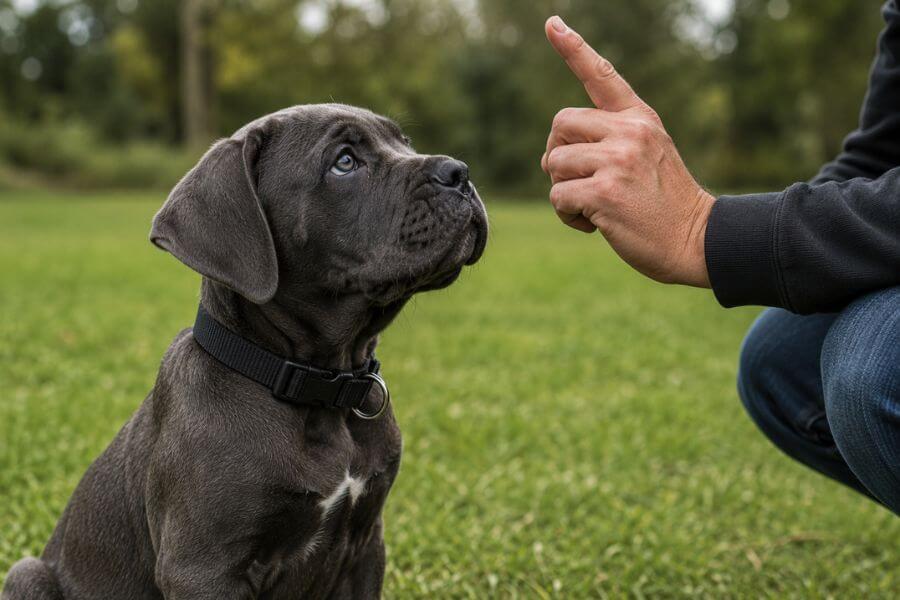
Start by asking your puppy to sit. Hold your hand out with your palm facing their face like a stop sign and say stay. Take just one small step backward. Wait two seconds, then step back to your puppy, say a release word like free or okay, and give them a treat.
In the beginning, you must reward them while they are still sitting, not after they get up. Slowly increase the number of steps you take and the time they must wait. If your puppy breaks the stay, do not get angry. It just means you moved too far or waited too long. Step closer and try again for a shorter time.
8. Loose Leash Walking
Walking gracefully on a leash is an absolute necessity for this breed. An adult Cane Corso can easily weigh more than a grown human. If you do not teach them how to walk nicely when they are a small puppy, they will pull you down the street like a sled when they grow up.
Attach a standard flat collar and a light leash to your puppy inside the house. Put some treats in your pocket and start walking around your living room. Every time your puppy walks next to your leg with the leash hanging down in a loose U-shape, give them a treat.
If your puppy pulls forward and the leash goes tight, stop moving instantly. Become a heavy statue. Do not pull back on the leash; just stand completely still. Your puppy will wonder why the movement stopped and will turn around to look at you. The moment they step back toward you and the leash goes slack, start walking again. This teaches them that pulling makes the walk stop, while a loose leash keeps the fun moving.
Frequently Asked Questions
What should I do if my Cane Corso puppy gets frustrated during these short training sessions?
If your puppy starts biting at your hands, barking at you, or looking away completely, it means the session has gone on too long or the task is too hard. Cane Corso puppies have very short attention spans. Keep your training times between three and five minutes long, a few times a day. If they get frustrated, ask them to do a super simple skill they already know, like a look at me or a sit. Reward them for that easy success, and then end the session on a happy note.
Can I use a prong collar or a choke chain to teach my puppy these basic commands?
No, you should not use these harsh tools on a young puppy. Heavy correction collars can cause physical damage to your puppy’s delicate neck and throat. More importantly, they can make your puppy fearful or aggressive. A Cane Corso is a sensitive breed that wants to work with you. Using food, praise, and positive rewards creates a dog that loves to listen. Save the advanced tools for much later in life, and only use them if you are working directly with a professional trainer.
Why does my Cane Corso puppy listen perfectly inside the kitchen but ignore me when we go to the backyard?
Dogs do not generalize well. This means a sit inside the quiet kitchen feels like a completely different skill to your puppy than a sit outside where there are grass smells, blowing leaves, and singing birds. When you change locations, you must act like your puppy is learning the command for the very first time. Use higher-value treats, make your voice more exciting, and expect shorter hold times until your puppy builds up their focus in the new outdoor area.
Is it okay to use my puppy’s regular kibble for these important training sessions?
Yes, using their regular dry food is a wonderful idea, especially for daily skills like sit and look at me. You can measure out their breakfast or dinner and use the entire bowl of food for training rewards throughout the day. However, for highly important or difficult safety commands like come and leave it, you should upgrade to special high-value treats. Small bites of cheese, hot dog pieces, or freeze-dried meat work best because they hold your puppy’s focus through heavy distractions.
How many days does it usually take for a puppy to fully master the come command?
Real mastery of the recall command takes many months of steady practice. Your puppy might learn the basic concept in just a few days inside a quiet room, but that does not mean they will master it when a squirrel runs past. True mastery means your dog returns to you every single time, no matter what else is happening around them. Keep practicing this skill daily in different places, always use amazing rewards, and never stop praising them for returning to your side.