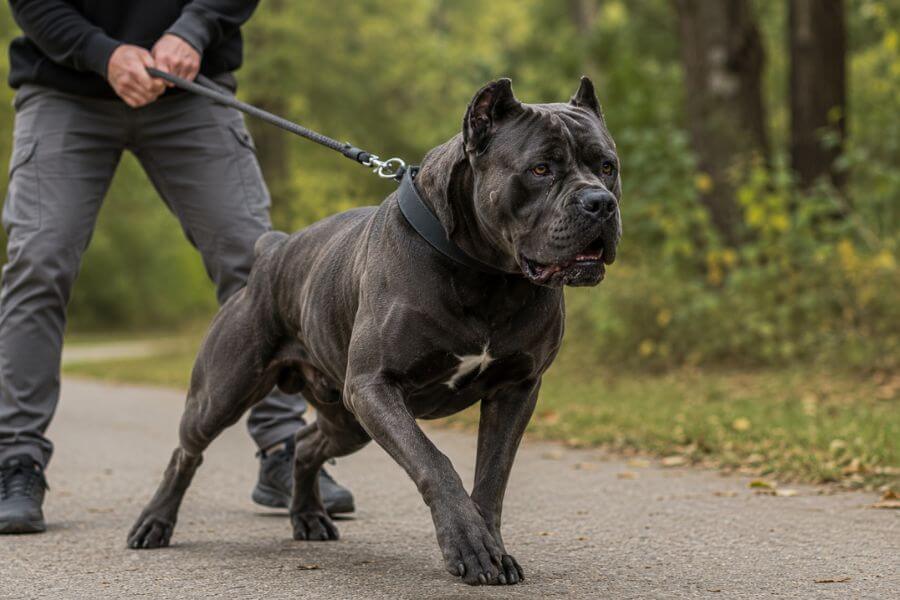
Quick Summary Table
| Method | Best For | Time to See Results | Tools Needed |
| The Red Light, Green Light Method | Teaching self-control | 1 to 2 weeks | Standard collar and leash |
| The Direction Change Trick | Regaining your dog’s attention | 3 to 5 days | Standard flat collar |
| Front-Clip Harness Training | Physical leverage and control | Instant management | Front-clip harness |
| The Reward Zone Marker | Rewarding the correct position | 1 week | High-value treats |
| The Head Halter Introduction | Strong pullers and large handlers | 2 to 4 days | Properly fitted head halter |
| High-Value Reward Scaling | Beating outside distractions | 1 to 3 days | Premium real-meat treats |
How We Ranked These
We chose these specific methods based on how well they work for a massive, powerful breed like the Cane Corso. When you handle a dog that can easily weigh over 100 pounds, standard advice for small dogs will not cut it. We looked at several key factors to find the absolute best options for you:
- Safety and Control: The method must protect your shoulders and back while keeping your dog safe from neck injuries.
- Speed of Results: We picked techniques that show clear changes in your dog’s behavior within just a few days of practice.
- Ease of Use: You do not need professional dog trainer skills to make these methods work at home today.
- Positive Reinforcement: Every method relies on clear communication and rewards rather than force or pain.
- Breed-Specific Needs: These steps address the high prey-drive and natural protective instincts of the Cane Corso.
1. The Red Light, Green Light Method
This method is the most important foundation for stopping your Cane Corso from pulling. The main idea is very simple. Forward movement is the biggest reward your dog can get on a walk. When they pull, they want to get to a smell, a tree, or another area quickly. If you let them pull you forward, they learn that pulling works.
To start this training, put your Cane Corso on a standard flat collar and a strong six-foot leash. Walk forward normally. The very second the leash goes tight and you feel tension, you must stop walking immediately. Act like a stone statue. Do not plant your feet and pull back on the leash. Just hold your ground and do not move forward even one inch.
Your big dog will likely keep pulling for a few seconds because they expect you to follow them. Stand completely still and wait. Eventually, your Cane Corso will realize that they are not moving forward anymore. They will look back at you or step back to see why you stopped. The exact moment they step back and the leash goes loose, praise them happily. Then, immediately start walking forward again.
This creates a clear rule in your dog’s mind. A tight leash means everything stops. A loose leash means the walk continues. You must be completely consistent with this rule. If you let your dog pull you to a tree just one time because you are in a hurry, you will ruin days of training. Every single time the leash is tight, you must stop. In the beginning, you might only travel ten feet in ten minutes. That is completely normal. Stay patient and stick to the plan.
2. The Direction Change Trick
If your Cane Corso is extremely focused on something ahead of them, stopping in place might not work right away. They might just stand there staring at a squirrel or another dog with a tight leash for minutes. When this happens, you need to use the direction change trick to break their focus and get their mind back on you.
Start walking down your sidewalk. When your dog starts to rush ahead and is about to reach the end of the leash, do not wait for them to pull you. Turn around on your heels and walk in the exact opposite direction. You do not need to jerk the leash hard. Just turn and walk away with a confident, steady pace.
As you turn, your dog will suddenly find themselves behind you. They will have to run a few steps to catch up to your new direction. As they catch up and walk next to your leg, give them a tasty treat and praise them. After a few steps, you can turn back around and walk in the original direction again.
This technique teaches your Cane Corso that they must watch your body movements constantly. If they do not pay attention to you, they will suddenly get left behind or have to change paths. It turns the walk into a game where you are the leader. It also keeps your dog from locking their eyes onto a distraction ahead because the picture in front of them keeps changing.
3. Front-Clip Harness Training
Training takes time, but sometimes you just need to walk your dog to the bathroom without getting your arm pulled out of its socket. For immediate help, you should change the equipment you use. A standard collar or a back-clip harness actually encourages a heavy dog to pull because of something called the opposition reflex. When your dog feels pressure on their chest or neck, their natural instinct is to lean into that pressure and push harder.
A front-clip harness changes the mechanics of the walk. On this type of harness, the metal ring for the leash is located right on the center of the dog’s chest. When your Cane Corso tries to lunge or pull forward, the leash pulls from the front. This physical setup automatically turns their body sideways toward you whenever they try to run ahead.
They physically cannot use their full body weight and back legs to pull you forward anymore because their momentum gets redirected in a circle. When you use this harness, make sure it fits snugly around their shoulders and chest. It should not be loose enough to rub against their skin or trip them up.
Remember that a tool is not a permanent fix for behavior. The front-clip harness gives you the physical leverage to stay safe while you practice the other training steps in this article. Combine the use of this harness with treats and praise whenever the leash is loose so your dog learns how to behave without relying entirely on the gear.
4. The Reward Zone Marker
Many owners spend all their time telling their dog what not to do. They yell when the dog pulls or turn around when the dog runs ahead. However, they completely forget to reward the dog when the dog is actually walking nicely next to them. To fix this, you need to create a reward zone.
The reward zone is the specific space right next to your left or right leg. Choose one side and stay with it for all your training. When your Cane Corso is walking calmly in this zone, their head should be level with your hip, and the leash should hang down in a relaxed shape like the letter U.
To teach this, hold a handful of small, soft treats in the hand closest to your dog. Walk forward a few steps. If your dog stays in that reward zone next to your thigh, say a reward word like yes in a happy voice. Instantly feed them a treat right down at your hip level. Do not reach out ahead of you to feed them, or they will start walking ahead to meet your hand.
Feed a treat every two steps in the beginning. As your dog gets better at staying by your side, space the rewards out. Give a treat every five steps, then every ten steps, and eventually only once every block. Your Cane Corso will quickly learn that standing right next to your leg is the most profitable spot on the entire planet.
5. The Head Halter Introduction
If you are a smaller person handling a massive Cane Corso, a harness might still feel like a lot of work. In this situation, a head halter is an excellent tool. A head halter looks a bit like a horse halter. It features a soft strap that goes around your dog’s nose and another strap that fastens securely behind their ears. The leash connects to a ring under their chin.
The logic behind a head halter is simple: control of the head. Wherever a dog’s head goes, their massive body must follow. If your Cane Corso tries to pull forward with a head halter, their nose is gently guided down and back toward you. This robs them of their immense physical power instantly.
You must introduce this tool slowly with lots of treats before you ever try to walk with it. Most dogs do not like the feeling of something on their nose at first. Place a treat through the nose loop and let your dog put their nose through the loop voluntarily to eat the snack. Repeat this for a few days until they are happy to see the halter.
When you start walking with a head halter, keep your arm relaxed. You do not need to pull or tug. Let the tool do the work. The moment your dog walks nicely without tension, give them praise. This tool gives incredible peace of mind to owners who worry about being pulled over by their strong dogs.
6. High-Value Reward Scaling
Sometimes your Cane Corso walks perfectly inside your living room or backyard, but the second you step out onto the sidewalk, they ignore you completely and start pulling. This happens because the outside world has high-value distractions like birds, cars, and strange smells. If you are using boring, dry dog biscuits for training, your dog will decide that the environment is much more interesting than your food.
To beat these distractions, you must scale up the value of your rewards. This means you only use your absolute best treats during outdoor leash walks. Leave the dry kibble at home. Instead, cut up small pieces of cooked chicken breast, hot dogs, freeze-dried liver, or low-sodium cheese.
The treats should be very soft and small, about the size of a pea. This allows your dog to swallow them instantly without stopping to chew on the sidewalk. When your dog sees a distraction like another person approaching, bring out a piece of this high-value food and hold it near your leg to guide them past the distraction cleanly.
By using premium food, you change your dog’s emotional state. They stop looking at the environment as a place to run wild and start looking at you as the source of amazing rewards. Your Cane Corso will start focusing heavily on your pockets, which naturally keeps the leash loose and relaxed throughout the journey.
Frequently Asked Questions
Why does my Cane Corso pull even harder when I try to pull back on the leash?
Your Cane Corso pulls back harder because of a natural physical response called the opposition reflex. When a dog feels a sudden pull or pressure on their collar, their muscles automatically tighten up and push directly against that force to maintain balance. When you pull back on the leash, you are actually triggering this reflex, which causes your dog to lean forward and pull with even more power. This is why staying completely still or changing your walking direction works much better than trying to win a physical tug-of-war with a massive breed.
Can I use a very long retractable leash to give my dog more freedom so they stop pulling?
You should never use a retractable leash with a large and powerful breed like the Cane Corso. These leashes maintain constant tension on the collar or harness, which actually teaches your dog that pulling against pressure is a normal part of walking. Additionally, thin cords can easily snap under the weight of a giant dog, or they can cause severe friction burns to your hands and legs. A standard, heavy-duty nylon or leather leash that is four to six feet long is the safest choice for proper control and clear communication.
My puppy is only four months old but already pulling. Should I start this training now?
Yes, you must start this training immediately while your puppy is still small enough for you to manage easily. A four-month-old puppy might only weigh forty pounds, making them easy to guide, but that same puppy will quickly grow to over one hundred pounds in just a few short months. Teaching them the correct habits right now will save you from dangerous situations later. Keep your puppy training sessions very short, about five to ten minutes at a time, and use plenty of praise and soft treats to keep it fun.
How long will it take for my adult Cane Corso to stop pulling completely on walks?
The timeline depends on your consistency, but most owners see a noticeable improvement within one to two weeks of daily practice. If you enforce the rules strictly and never allow a single step of forward movement on a tight leash, your dog will adapt very quickly. However, if you let your dog pull when you are tired or in a rush, the process will take several months. Consistent daily practice for fifteen minutes is much more effective than a long one-hour walk with mixed rules.
Should I stop walking my dog for exercise while we are still learning how to walk properly?
You should not stop exercising your dog, but you should separate exercise time from training time. If your Cane Corso has too much pent-up physical energy, they will find it nearly impossible to concentrate on loose-leash training. Before you start a training walk, play a vigorous game of fetch in your enclosed backyard or engage in a fun game of tug to burn off that initial burst of energy. This tires out their muscles and calms their mind, making them much more receptive to learning your sidewalk rules.