Bringing home a Golden Retriever puppy is one of the most exciting things you will ever do. Those big brown eyes, fluffy ears, and wagging tails can melt any heart. But along with all that cuteness comes a lot of responsibility. One of the very first things you should focus on is crate training.
Some people feel unsure about using a crate because they worry it feels like a jail. But dogs actually love having a safe space that belongs just to them. Think of a crate as your puppy’s personal bedroom. It helps them feel safe, makes potty training much easier, and keeps them out of trouble when you cannot watch them. This complete guide will show you exactly how to crate training your Golden Retriever puppy step by step using lots of love and patience.
Why Crate Training Matters for Golden Retrievers
Golden Retrievers are energetic, smart, and very curious dogs. They love to explore everything with their mouths. If you leave a puppy alone for even five minutes, they might chew on a shoe, a chair leg, or an electrical cord. A crate keeps your puppy safe from these dangers when you are busy cooking dinner, taking a shower, or sleeping at night.
Using a crate also speeds up house training. Dogs naturally want to keep their sleeping area clean. Since your puppy does not want to go to the bathroom where they sleep, they will learn to hold it until you let them outside.
Finally, a crate creates a wonderful routine. Golden Retriever puppies need a lot of sleep to grow into healthy adult dogs. A quiet crate gives them a cozy place to take naps without any distractions.
Picking the Right Crate Size
Choosing the right crate size is very important for a Golden Retriever. These puppies grow incredibly fast. A tiny eight-week-old puppy will quickly become a large seventy-pound dog. You do not want to buy a new crate every single month, but you also cannot put a small puppy in a giant crate. If the crate is too big, your puppy might sleep on one side and use the other side as a bathroom.
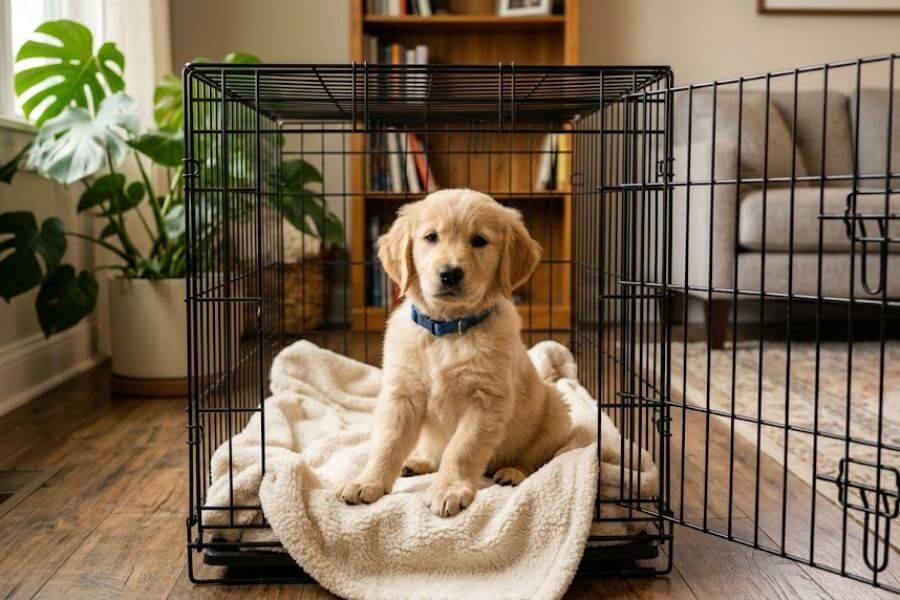
The perfect solution is a life-stages wire crate that comes with a divider panel. A divider panel is a movable wall that lets you change the size of the inside of the crate as your puppy grows.
To set the divider correctly, make sure your puppy has just enough room to stand up, turn around in a full circle, and lie down comfortably. If they can do those three things, the space is perfect. As your puppy gets bigger, you simply move the divider back to give them more room.
Setting Up a Cozy Crate
You want your Golden Retriever to view their crate as a happy place. The location of the crate matters a lot because Golden Retrievers are social pack animals. They love being near their human family. Place the crate in a busy area of your home, like the living room or your bedroom. Do not put it in a dark basement or a lonely garage.
Inside the crate, place a soft, washable blanket or a durable dog bed. Be careful with fluffy beds at first, because some puppies like to chew them up and swallow the stuffing.
You can also throw in one or two safe chew toys. Hard rubber toys filled with a little bit of dog-safe peanut butter are amazing options. This gives your puppy something fun to do while they hang out inside.
Step One: Introducing the Crate
Never force your puppy into the crate and slam the door shut. That will scare them, and they will learn to hate the crate. Instead, you need to introduce it slowly.
Start by opening the crate door and securing it so it cannot swing shut by accident. Toss a few high-value treats near the entrance. High-value treats are special snacks like small pieces of chicken or cheese that your puppy does not get every day. Let your puppy walk over and eat the treats.
Once they are comfortable eating near the door, toss a few treats just inside the crate. Let your puppy step inside to get them and walk right back out. Praise them with a happy voice whenever they go inside. Do this a few times until your puppy happily runs into the crate looking for treats.
Step Two: Feeding Meals in the Crate
A great way to build a strong bond between your puppy and their crate is by feeding them their breakfast and dinner inside it. Food makes puppies very happy, so eating in the crate builds great memories.
Place your puppy’s food bowl all the way at the back of the crate. Let them walk inside to start eating. While they are happily munching on their food, gently close the crate door. Do not lock it yet.
As soon as they finish the last bite of food, open the door and let them out. After a few days of doing this, you can lock the door while they eat. Leave the door locked for one minute after they finish eating, then let them out. Slowly increase the time to five minutes, then ten minutes.
Step Three: Increasing Crate Time During the Day
Now that your puppy loves going into the crate for meals and treats, you can start crating them during regular daytime hours. Call your puppy over to the crate and give them a command word like bed or kennel. Toss a treat inside, and when they step in, close the door and lock it.
Sit quietly next to the crate for a few minutes. Then, walk out of the room for a short moment and come right back. This teaches your puppy that even when you leave, you will always return.
Slowly increase the amount of time you spend out of the room. Start with two minutes, then five, then fifteen. If your puppy stays quiet, always give them lots of praise when you let them out.
Remember the golden rule of puppy crate training. Never let your puppy out of the crate while they are whining, barking, or crying. If you open the door while they are making noise, you teach them that crying gets them what they want. Wait for at least five seconds of absolute silence before you unlock the door.
Step Four: Crate Training Overnight
Sleeping in the crate at night can be tough for a new puppy because they are used to snuggling with their mothers and littermates. To make the first few nights easier, place the puppy crate right next to your bed. This allows your puppy to smell you and hear you breathing. If they get a little nervous, you can even put your hand against the wire door to comfort them.
Make sure your puppy goes outside for a final potty break right before bedtime. Put them in the crate with a safe toy and turn off the lights.
Young puppies have very small bladders and cannot hold their pee through the entire night. You will likely need to wake up once or twice during the night to take them out. When you do night-time potty breaks, keep things very boring. Do not play, do not speak in an excited voice, and do not turn on bright lights. Carry them straight outside, let them do their business, give a quiet praise, and put them straight back into the crate.
Handling Whining and Crying
It is completely normal for a Golden Retriever puppy to whine a little bit when they are learning to stay in their crate. It takes time for them to learn independence. Your job is to figure out why they are crying.
If your puppy has been in the crate for a couple of hours, they probably need to go to the bathroom. Take them outside immediately on a leash.
If you know they just went to the bathroom, they are likely just whining for attention. In this case, you must ignore them. Do not look at them, do not talk to them, and do not let them out. Even saying stop it counts as attention to a puppy. As soon as they realize that crying does not work, they will calm down and go to sleep.
Frequently Asked Questions
How long can a Golden Retriever puppy stay in a crate?
The total number of hours a puppy can safely stay in a crate depends on their age. A good rule of thumb is to take your puppy’s age in months and turn that into hours. For example, a two-month-old puppy can stay in the crate for about two hours. A three-month-old puppy can handle three hours. Adult dogs should never be left in a crate for longer than eight hours during the day.
Can I put water in the puppy crate?
It is usually best to avoid putting a large bowl of water inside the crate for a young puppy. Puppies love to play in water bowls and will likely spill it everywhere, making their bedding wet and cold. Drinking too much water right before crate time will also cause bladder accidents. Instead, make sure your puppy gets plenty of water throughout the day when they are outside of the crate.
What should I do if my puppy has an accident in the crate?
If your puppy pees or poops in the crate, do not yell at them or punish them. Puppies do not understand punishment and it will only make them afraid of you. Simply take your puppy outside right away. Clean the crate completely using an enzymatic cleaner. This special type of cleaner removes the scent completely so your puppy does not smell it and think that the crate is a proper bathroom spot.
Should I cover the Golden Retriever puppy crate with a blanket?
Many Golden Retriever puppies love having their crate covered because it turns the wire box into a dark, cozy cave. It also blocks out visual distractions, which helps energetic puppies calm down much faster. If you decide to cover the crate, make sure to use a breathable sheet or a special crate cover. Always leave one side uncovered so plenty of fresh air can flow inside.