Living in a high-rise apartment with a tiny, furry bundle of joy is an amazing experience. Yorkshire Terriers, or Yorkies as most people lovingly call them, are bursting with personality, charm, and affection. They are the perfect size for cozy spaces, and their beautiful coats make them look like living stuffed animals. However, bringing a new Yorkie puppy into an apartment building comes with a unique set of challenges. The biggest hurdle you will face is teaching your miniature companion where to go to the bathroom when you do not have a private, fenced-backyard just a few steps away.
Potty training a Yorkie in a multi-story building requires patience, consistency, and a solid plan. Because these dogs are so small, their bladders are equally tiny, meaning they need to eliminate much more frequently than larger breeds. Walking down a long hallway, waiting for a slow elevator, and crossing a busy lobby can feel like an endless journey when your puppy needs to go right now. This guide will walk you through every single detail of the process, helping you turn your apartment into a harmonious, accident-free home for you and your four-legged best friend.
Understanding Your Yorkie and the Apartment Challenge
Before you even bring your puppy home, it is vital to understand how their minds and bodies work. Yorkies are members of the toy group, which means they were bred down to be small companions. Historically, they were also used to hunt rats and mice in textile mills, which gave them a brave, independent, and sometimes stubborn streak. This bold attitude is wonderful for companionship, but it can make house-training a bit of a puzzle.
Your puppy does not inherently know that your beautiful living-room rug is different from the grass outside. To a tiny puppy, a soft carpet feels a lot like a patch of moss or thick turf. Additionally, because they are so close to the floor, it can be difficult for human eyes to notice the subtle signs that a Yorkie needs to go before it is too late.
The physical limitations of a Yorkie puppy are the first thing you must consider. A two-month-old puppy can only hold their bladder for about two hours at most. When you factor in the layout of an apartment complex, the distance to the designated outdoor spot increases the difficulty level. If you live on the tenth floor, a two-minute elevator ride plus the walk through the lobby represents a significant portion of your puppy’s total holding capacity. Recognizing these factors allows you to develop empathy for your pup, which will keep you calm during the inevitable mistakes.
Choosing Your Bathroom Strategy: Indoor vs Outdoor
One of the first major decisions you need to make is whether you want your Yorkie to go to the bathroom exclusively outside, or if you want to set up a dedicated indoor potty station. Both methods have distinct advantages and drawbacks, especially when you live in a high-density building.
The Outdoor-Only Approach
Training your Yorkie to only go outside is the traditional path. The main benefit is that your apartment remains completely free of pet waste, and your dog builds a strong habit of waiting for their outdoor walks. This method also encourages great socialization, as your pup gets used to the sights, sounds, and smells of the neighborhood every time they step outside.
The downside is the pure logistics. If it is two o’clock in the morning, raining heavily, or freezing cold, you still have to get fully dressed, grab your keys, leash your dog, and ride the elevator down to the street level. For a tiny Yorkie, extreme weather can also be terrifying, making them reluctant to do their business when they are shivering outside.
The Indoor Potty Station Approach
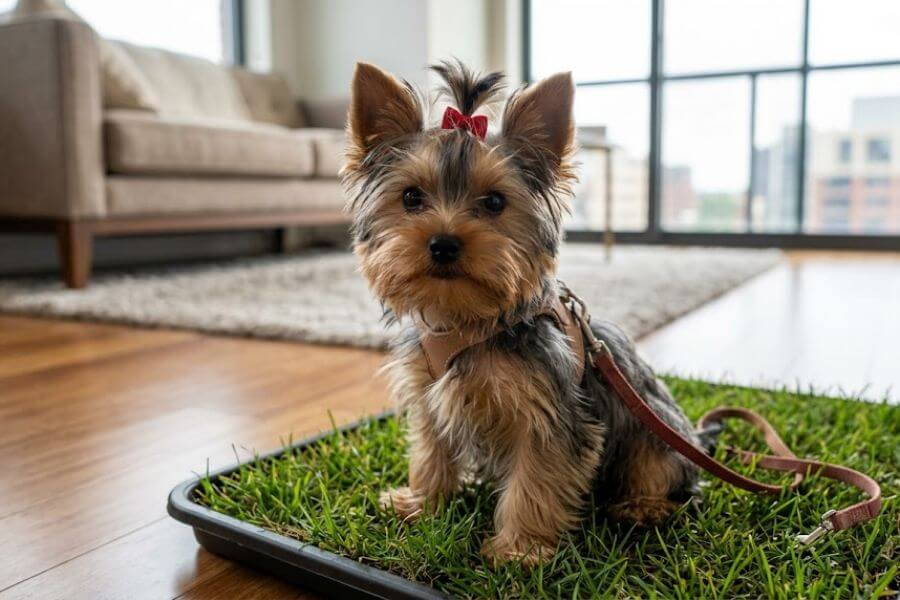
Many apartment dwellers choose to create a designated potty spot inside the home. This can be a specific corner of the bathroom, a laundry room, or a sheltered balcony. You can use disposable paper training pads, reusable cloth pads, or modern indoor dog-boxes that contain real or synthetic grass.
This strategy offers incredible convenience. You do not have to worry about late-night elevator trips, bad weather, or building security. It is also excellent for young puppies who have not yet received all their vaccinations, as it keeps them safe from diseases that linger in public grass areas where other dogs walk.
The challenge with indoor training is that it can sometimes confuse the puppy. If they are allowed to go on a pad inside, they might think any flat, soft object on the floor is fair game, such as a bathmat, a fallen towel, or a blanket. It also means you must be meticulous about cleaning the indoor area to prevent odors from taking over your living space.
The Hybrid Method
Some owners successfully teach their Yorkies to use both options. They use indoor pads during the night or during severe storms, and they take the dog outside during the daytime. While this offers the ultimate flexibility, it takes longer for a young puppy to grasp. If you choose this route, start with one clear method first, and introduce the second option only after your dog is completely reliable with the first one.
Essential Supplies for Apartment Training
Success in house-breaking depends heavily on having the correct tools ready from day one. Gathering these items ahead of time will prevent frantic rushes to the store when an accident occurs.
A Properly Sized Crate
A dog-crate is one of the most effective tools for house-training. Dogs are naturally clean animals that prefer not to soil the place where they sleep and rest. A crate capitalizes on this instinct. For a Yorkie, the crate must be quite small. If it is too large, your puppy will sleep in one corner and use the opposite corner as a bathroom. It should only be spacious enough for them to stand up, turn around in a full circle, and lie down comfortably. Many crates come with movable divider panels, allowing you to increase the space as your puppy grows.
High-Quality Training Pads or Grass Boxes
If you decide on an indoor or hybrid strategy, invest in sturdy supplies. Look for training pads that feature a built-in attractant scent, which helps guide the puppy’s nose to the right spot. For an eco-friendly option, look into subscription services that deliver fresh patches of real sod in plastic trays. The natural scent of real grass triggers a puppy’s instinct to eliminate much faster than plastic or paper surfaces.
An Enzymatic Cleaner
This is a non-negotiable item for every pet owner. Regular household cleaners might make your apartment smell fresh to you, but they often leave behind microscopic scent markers that only a dog can detect. If a Yorkie smells even a faint hint of their previous urine on a rug, they will return to that exact spot to go again. Enzymatic cleaners use specialized proteins to break down the waste molecules completely, erasing the scent blueprint entirely.
Treats That Pack a Punch
To motivate a Yorkie, you need rewards that they find absolutely irresistible. Ordinary dry kibble usually will not cut it for high-stakes training. Look for soft, freeze-dried liver treats, tiny pieces of cooked chicken breast, or small bits of cheese. Keep these treats exclusively for successful potty trips so that they maintain their high value in your puppy’s mind.
A Lightweight Leash and Harness
Even if you are just walking down the hallway to an indoor pad or heading down to the street, a harness is vital for a Yorkie. Their windpipes are incredibly fragile, and a standard neck-collar can cause severe injury if they pull or plunge forward unexpectedly. A step-in harness distributes pressure evenly across their chest, keeping them safe and secure.
Setting Up Your Apartment Space
When you bring a new puppy home, giving them immediate run of the entire apartment is a recipe for disaster. To a tiny pup, a multi-room apartment feels like a vast kingdom, and they will easily find hidden corners to relieve themselves out of your sight.
The Confinement Zone
Create a limited living space for your puppy during the initial weeks. A great setup is a metal play-pen placed on a non-porous floor, such as tile or linoleum. Inside this play-pen, place their crate with the door open, their water bowl, a few safe chew-toys, and their indoor potty pad at the furthest point from their sleeping area.
This controlled environment keeps your puppy safe from household hazards and dramatically limits their opportunities to make mistakes. If you are sitting on the couch watching television, keep the puppy in the play-pen or right next to you on a leash. By keeping their world small, you make it easy for them to choose the right spot.
Transitioning to Larger Spaces
As your Yorkie goes days, then weeks, without a single accident inside their confinement zone, you can gradually grant them access to more areas of the apartment. Open up one room at a time. If you let them into the bedroom and they have an accident, it means you moved too quickly. Promptly scale back their freedom and return to the previous step for another week.
Crafting a Perfect Daily Schedule
Consistency is the absolute secret weapon of potty training. Puppies thrive on predictable routines. When their meals, walks, and nap-times happen at the exact same hours every single day, their digestive systems become remarkably predictable too.
The Puppy Time-Clock
A young Yorkie needs a bathroom break during the following key moments:
- Immediately when they wake up in the morning or after a nap.
- Fifteen to twenty minutes after eating a meal or drinking a large amount of water.
- Right after an energetic play-session.
- Right before they go to sleep for the night.
A Sample Daily Routine
To give you an idea of how to structure your days, here is a balanced schedule designed for a typical apartment-dwelling puppy:
- 6:00 AM: Wake up. Immediately pick up the puppy from their crate and carry them to the designated potty spot (indoor pad or outside grass). Do not let their feet touch the ground until you arrive, as the movement can trigger their bladder too soon.
- 6:15 AM: Return to the apartment for breakfast and fresh water. Leave the food bowl down for twenty minutes maximum, then pick it up. This ensures they eat on time rather than grazing all day.
- 6:35 AM: Take the puppy back to the potty spot. Their morning meal will stimulate their bowels quickly.
- 7:00 AM: Supervised playtime in their pen or interactive bonding with you.
- 8:00 AM: Nap-time inside the crate or play-pen while you get ready for work or school.
- 10:00 AM: Mid-morning bathroom break.
- 12:00 PM: Lunchtime meal, followed quickly by another trip to the potty station.
- 2:00 PM: Mid-afternoon bathroom break and a short indoor training session to work their mind.
- 5:00 PM: Dinnertime meal, followed by a dedicated outdoor walk or a long visit to their indoor pad.
- 7:00 PM: Evening playtime and relaxation on the couch, keeping a watchful eye for any sniffing or circling behaviors.
- 9:00 PM: Final water offering for the night, then lift the bowl away to prevent midnight accidents.
- 10:00 PM: Final potty trip of the evening, then directly into the crate for bedtime.
Step-by-Step Training Guide For Outdoor Adopters
If you have chosen to train your Yorkie to use the outdoor grass exclusively, you need a precise plan to handle the journey from your apartment door to the sidewalk.
Step One: The Lift and Carry
When it is time for a potty break, open the crate or pen and immediately lift your Yorkie into your arms. Do not let them walk through your living-room or down the apartment hallway. Walking stimulates their internal organs, and a young pup will often urinate right in front of your neighbor’s door before you reach the elevator. Carrying them ensures they hold it until you reach the proper destination.
Step Two: Navigating Public Spaces
As you ride the elevator and walk through the lobby, stay calm. If your puppy starts whining or squirming, speak to them in a soothing, quiet voice. Keep your high-value treats hidden in your pocket so the puppy knows that something amazing is waiting for them at the end of the trip.
Step Three: The Action Cue
Once your feet hit the actual grass outside, set your Yorkie down on their harness and long leash. Give them a specific verbal cue in a pleasant tone. Phrases like “go potty,” “do your business,” or “hurry up” work beautifully. Pick one phrase and stick to it completely. Stand in one general area and avoid walking around like it is an exercise walk. You want your puppy to understand that this specific trip is purely for business, not for exploring the entire block.
Step Four: The Celebration
The very instant your Yorkie finishes urinating or defecating, throw an absolute party. Within three seconds of them finishing, hand them a tiny piece of premium treat and praise them with an enthusiastic, happy voice. You can clap your hands softly and tell them what a spectacular dog they are. The timing here is incredibly critical. If you wait until you get back upstairs to give them the treat, they will think they are being rewarded for riding the elevator, not for going potty on the grass.
Step-by-Step Training Guide For Indoor Adopters
If the indoor pad or balcony grass box is your chosen path, the steps are slightly different but require the exact same level of focus.
Step One: Guiding to the Zone
When your schedule indicates it is time to go, gently guide your Yorkie to their indoor potty station. If they are very young, carry them over to avoid any pre-emptive leaks on the kitchen floor.
Step Two: Creating Boundaries
Keep the potty pad or grass tray in a fixed location. Moving it around the apartment will throw your puppy into total confusion. If you use paper pads, consider placing them inside a plastic pad-holder frame. This prevents the puppy from shredding the paper with their teeth or sliding the pad across the floor during use.
Step Three: Cue and Wait
Place your puppy onto the pad and repeat your chosen cue phrase. Give them about five minutes to sniff around and find their focus. If they step off the pad, gently pick them up and place them right back onto the center of it. Remain quiet and still so you do not distract them with play.
Step Four: Reward and Refresh
As soon as they complete their business on the pad, deliver their delicious treat and shower them with warm praise. Afterward, change the pad or clean the area promptly. Yorkies are pristine creatures; if a pad is heavily soiled, they will refuse to step on it a second time and will search for a clean spot on your carpet instead.
Recognizing the Subtle Signs
One of the most common complaints from Yorkie owners is that their dog gives absolutely no warning before making a mistake. However, dogs almost always communicate their intentions; we just have to learn how to read their language. Because Yorkies are so tiny, their physical signs are minute.
The Sniff and Circle
Watch for sudden changes in your puppy’s movement. If they are happily playing with a toy and suddenly drop it to sniff the floor intently, this is a major warning sign. Dogs look for a safe, scented spot to go, and intense floor-sniffing is their way of scanning the area. They will often walk in a tight, frantic circle right before crouching down.
The Sudden Disappearance
If your apartment goes completely quiet, or if your puppy wanders out of the room where you are sitting, stand up immediately and check on them. Puppies often seek out quiet, secluded spots behind a sofa, under a dining table, or in a dark hallway to relieve themselves because they want privacy.
General Restlessness
An unexpected burst of whining, pacing back and forth along the edge of their play-pen, or looking directly at you with wide, intense eyes can indicate that their bladder is completely full. When in doubt, always treat restlessness as an immediate request for a bathroom break.
Handling Accidents the Right Way
Accidents are a completely normal part of the learning process. No puppy has ever been trained without making a few mistakes along the way. How you react to these moments will dictate how fast your Yorkie learns.
If You Catch Them in the Act
If you turn around and see your Yorkie actively urinating on your floor, do not scream, yell, or stomp your feet. Scaring your puppy will only teach them that going to the bathroom in your presence is dangerous. This will cause them to hide their waste in secret places in the future.
Instead, make a gentle, sudden sound like a soft clap or a calm “Oops!” to interrupt them. This will usually cause them to pause their bladder mid-stream. Immediately pick them up and carry them directly to their proper potty spot. If they finish the rest of their business there, give them a treat and praise them.
If You Find It After the Fact
If you walk into the kitchen and discover a puddle that happened ten minutes ago, simply accept it and move on. Do not rub your puppy’s nose in it, do not drag them over to it, and do not scold them. A puppy’s memory operates in the immediate present. They will have absolutely no idea why you are angry, and they will simply think you are unpredictable and scary.
The Deep-Clean Protocol
Keep your puppy completely out of the area while you clean up the mess. Blot up as much liquid as possible using paper towels. Then, saturate the entire area with your enzymatic cleaner. Let the cleaner sit for the full recommended time on the bottle so it can completely eat away the organic materials. Dry the spot thoroughly before allowing your Yorkie back into that room.
Overcoming Common Training Obstacles
Even with the best schedule and tools, you might hit a few speed-bumps during your apartment training journey. Knowing how to handle these hurdles will keep you moving forward.
Submissive or Excitement Urination
Does your Yorkie leak a few drops of urine the exact moment you walk through the apartment door after a long day? This is known as excitement or submissive urination, and it is very common in tiny toy breeds. It is an involuntary physical response, meaning your puppy cannot control it.
To solve this, make your homecomings completely low-key. When you open your apartment door, ignore your puppy for the first few minutes. Do not make eye-contact, do not bend down to pet them, and do not speak to them in a high, squeaky voice. Walk inside, take off your coat, let the puppy’s excitement levels cool down completely, and then calmly take them straight to their potty station. Once they have emptied their bladder, you can give them all the cuddles you want.
Regression Factors
Sometimes, a Yorkie who has been doing beautifully for weeks will suddenly start having multiple accidents a day. This is called training regression. It can happen due to minor changes in their life, such as a shift in your work hours, a loud construction noise outside your apartment building, or even a dental teething phase that causes them mild stress.
If regression happens, do not despair. Simply take one full step backward in your training plan. Treat them like a brand-new puppy again: shrink their living space, increase the frequency of your bathroom trips, and reinforce your rewards. Their good habits will return quickly with a little extra support.
Weather Sensitivity
Yorkies originate from Yorkshire, England, but they absolutely despise getting wet and cold. Because they lack a traditional insulating undercoat, their single layer of fine hair offers little protection against chilly elements. If it is pouring rain outside, your puppy might refuse to step onto the wet sidewalk, choosing instead to freeze in place or pull back toward the warm lobby.
To combat this, equip your Yorkie with a functional, water-resistant dog-jacket or a tiny umbrella designed for pets. If the outdoor conditions are truly dangerous or miserable, this is where having an alternative indoor pad setup can be a lifesaver for both you and your little companion.
Frequently Asked Questions
How long does it typically take to completely potty train a Yorkie puppy in an apartment?
Potty training duration varies quite a bit depending on individual consistency, but most Yorkie puppies take anywhere from four to eight months to become completely trustworthy in an apartment setting. Because of their tiny biological makeup, full physical bladder control is rarely achieved before they reach six months of age. If you remain dedicated to a strict daily routine and prevent opportunities for unmonitored mistakes, you will notice significant improvements within the first month.
Can I leave my Yorkie home alone all day with a potty pad while I am at work?
Leaving a young puppy completely alone for a full eight-to-ten-hour workday is highly discouraged, as it can harm their emotional well-being and stall their training progress. If you must be away for long periods, it is best to hire a professional pet-sitter or ask a trusted neighbor to drop by every three to four hours to check on your pup, refresh their water, and guide them to their indoor pad. If that is not possible, ensure your puppy is housed in a spacious play-pen with a clear separation between their bed and their potty pad, though expect the overall training process to take longer.
My Yorkie keeps pooping right next to the training pad instead of on top of it. What should I do?
This common issue usually stems from a simple spatial misunderstanding or a cleanliness preference. First, ensure you are using a large enough pad; sometimes a Yorkie will place their front paws on the pad, assuming their whole body is on it, while their backend hangs over the edge. Second, make sure the pad is perfectly clean, as many Yorkies will refuse to step on a pad that has even a single wet spot from an earlier trip. You can also try using a plastic pad-holder with a raised border to help your puppy physically feel when they have stepped inside the proper boundary.
Is it true that female Yorkies are easier to house-break than male Yorkies?
There is no scientific proof that one gender is inherently easier to train than the other; success depends entirely on individual personality and owner consistency. However, unneutered male Yorkies do possess a stronger biological drive to mark their territory with small amounts of urine as they reach adolescence. Having your male Yorkie neutered at the appropriate age recommended by your veterinarian will significantly reduce this marking behavior, making your apartment training efforts much smoother.
Why does my Yorkie try to eat their own poop, and how can I stop this behavior?
This habit is known scientifically as coprophagia, and while it seems highly unpleasant to humans, it is a relatively common behavior in young puppies. It can happen due to natural curiosity, boredom, an instinct to keep their nesting area clean, or a lack of specific nutrients in their diet. The most effective way to eliminate this habit is to clean up every stool immediately after they finish, leaving zero opportunity for them to investigate it. You can also talk to your veterinarian about safe, over-the-counter food additives that make the stool taste unappealing to the puppy.
Should I use belly-bands for my male Yorkie while house-training in an apartment?
Belly-bands are fabric wraps that fit around a male dog’s midsection to catch urine, and they can be a helpful management tool to protect your apartment furniture during transitional periods or hotel stays. However, they should never be used as a shortcut or a replacement for actual training. If your puppy wears a belly-band constantly, they will never learn to control their bladder muscles or understand the concept of waiting for a proper potty spot. Use them occasionally for accident prevention during high-stress moments, but rely on your core schedule for daily success.
My apartment complex does not have a grassy area nearby. Can my Yorkie use concrete or gravel?
Yes, dogs can easily learn to eliminate on any surface as long as you introduce it consistently with positive reinforcement. If concrete or gravel are your only local options, always take your puppy to the exact same patch of ground every single day so their own scent markers begin to identify it as a designated bathroom. Be extra mindful during hot summer months, as pavement can absorb intense heat and burn your Yorkie’s sensitive paw-pads; always check the temperature with your hand first.
Can I use a regular household cleaner to wipe up my puppy’s accidents?
You should avoid regular multi-surface cleaners because they are insufficient for pet accidents. While standard soaps might mask the smell to human noses, they typically leave behind the strong chemical scent of ammonia, which is a major component of real urine. When a dog smells ammonia on a floor, their brain interprets it as a signpost saying this is an acceptable place to go again. Always use a dedicated, high-quality enzymatic pet cleaner to dissolve the waste molecules at a microscopic level.