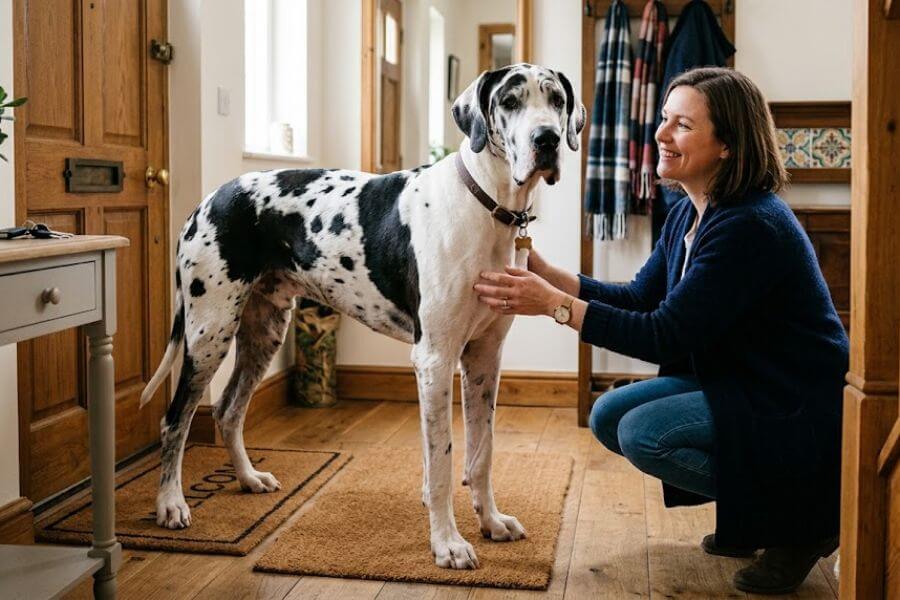
You know that feeling when the doorbell rings and you hold your breath for a second? You look over at your Great Dane, who is wagging his tail with enough force to clear a coffee table, and you just know what is coming next. He hears a friend arrive, his excitement levels spike to the moon, and before you can even reach for his collar, he is launching his massive frame toward the front door like a furry cannonball. When he reaches your guest, he does not just say hello. He puts his front paws on their shoulders, stands up to his full, towering height, and tries to lick their face.
Living with a Great Dane is like sharing your home with a lovable, oversized piece of furniture that happens to have a heartbeat. They are famously known as gentle giants, and most of the time, they are the best companions you could ask for. But when those one hundred and fifty pounds of muscle and enthusiasm decide to greet a visitor by jumping, it is no longer just a cute display of affection. It becomes a safety issue, a stress-inducing event for your guests, and a situation that needs to be addressed with patience and consistency.
You might feel a little embarrassed when it happens. You might feel like you have failed in your training efforts. Let me tell you right now that this is a very common challenge. Because Great Danes are so tall, they reach human eye level effortlessly. When they jump, they are not necessarily trying to be aggressive; they are simply trying to get closer to the thing they love most: people. They are social creatures who crave interaction, and they have learned that jumping gets them exactly what they want, which is attention.
To change this behavior, we have to flip the script. We need to teach your dog that keeping all four paws on the floor is the golden ticket to getting the attention he craves. This process does not happen overnight. It takes a shift in how you and your visitors interact with him. By the end of this guide, you will have a clear, step-by-step roadmap to transforming your excitable giant into the well-mannered host you know he can be.
Understanding the Why Behind the Jump
Before we dive into the training techniques, it helps to put yourself in your dog’s giant paws for a moment. Why does he jump in the first place? It is not because he is trying to be naughty or dominant. It is almost always rooted in pure, unadulterated excitement. To a dog, a new person entering the house is like a lottery win. The sensory input is overwhelming. There are new smells, new sounds, and the promise of a potential new friend who might give him ear scratches or treats.
When your Great Dane jumps, he is practicing a self-rewarding behavior. Think about what usually happens when he jumps on a guest. The guest might yell, push him down, or laugh and talk to him. To a dog, all of that is interaction. Even if the guest is saying no or trying to push him away, they are touching him and looking at him. In the world of dog psychology, any interaction is better than no interaction. He interprets the chaos as a game.
Also, consider his physical stature. Because he is so tall, he can naturally reach a person’s face without needing to jump very high. When he is a puppy, jumping might seem cute or harmless, so we might inadvertently encourage it by reaching down to pet him while he is jumping. As he grows into a massive adult, that early habit becomes deeply ingrained. He learned that jumping is the fastest way to get face-to-face with the people he loves.
Your goal is to change the math of the situation. You need to make jumping result in the complete opposite of what he wants. Instead of getting attention, jumping should make the attention disappear entirely. This requires a complete change in how your household handles arrivals. It is about removing the reward for the behavior you do not want and providing a much better reward for the behavior you do want.
The Foundation of Training Success
Before you start working on guest greetings, you need to ensure you have a solid foundation of basic training in place. If your dog does not listen to you in a quiet room, he is certainly not going to listen to you in the middle of a doorway with a guest standing there. The most important skill you can teach your Great Dane is the sit command. It sounds simple, but sitting is the opposite of jumping. A dog cannot jump if his bottom is on the floor.
Start by practicing the sit command in low-distraction environments. Use high-value treats that he really loves. When you say sit and he complies, reward him immediately. You want him to view the act of sitting as an automatic response to a request. Practice this every single day. Make it a game. Gradually increase the difficulty by practicing in different rooms of your house, or even out in the yard where there are more smells and distractions.
Another crucial component is the concept of a calm state of mind. If your dog is a frantic mess before you even open the door, he is already in a state of high arousal where he is not thinking clearly. Practice teaching him to settle on a mat or his bed. Give him a long-lasting chew toy or a puzzle toy to keep him occupied. If you can get him to spend time in a calm, settled state, it will be much easier to keep him that way when the doorbell rings.
Consistency is your best friend during this journey. Every single person in your home needs to be on the same page. If you are teaching him not to jump, but someone else is letting him jump because they think it is cute, the training will not work. You have to be a team. Make sure everyone understands that from now on, the rule is four-on-the-floor. No exceptions, no excuses, and no leniency, even when he looks at you with those soulful, pleading eyes.
Preparing Your Home for Success
Managing the environment is half the battle when you are training a dog. If you know your Great Dane struggles at the front door, do not wait for a guest to arrive to start figuring out what to do. Set yourself up for success by creating a management plan. This prevents the behavior from happening in the first place, which is the most effective way to extinguish a bad habit.
Consider using a baby gate or an exercise pen to create a physical boundary between your dog and the front door. When you hear the doorbell, your dog stays safely behind the gate. He can see the visitor, he can sniff the air, and he can be part of the excitement, but he literally cannot jump on them because he is physically separated. This removes the opportunity for him to practice the unwanted behavior.
If you do not have a gate, use a leash. Even if you are just in your own house, put a leash on your Great Dane before you open the door to a guest. This gives you a physical handle on the situation. If he starts to get too excited or tries to jump, you can calmly use the leash to guide him away and redirect him. The leash acts as a safety tether that keeps him from reaching the guest in the first place.
You should also talk to your friends and family members beforehand. Explain to them that you are working on your dog’s manners and ask them for their help. Tell them that when they walk in the door, they should completely ignore the dog. No talking to him, no looking at him, and no touching him until he is calm and sitting. It might feel rude to your guests, but it is a necessary part of the process. Most people are happy to help once they understand that it is for the dog’s benefit.
The Art of the Ignore
This is perhaps the hardest part for most dog owners. The ignore method is incredibly powerful, but it requires nerves of steel. When your dog jumps on someone, your natural instinct is to push him off, say no, or scold him. Remember what we talked about earlier: to a dog, that is still attention. You are still looking at him, touching him, and talking to him. You are just being a grumpy partner in his game.
To stop the behavior, you must become invisible to him the moment his paws leave the floor. If he jumps on you, turn your back immediately. Cross your arms over your chest and look at the ceiling. Do not say a word. Do not shove him away with your hands. Just make yourself as uninteresting as a stone wall. If he follows you, turn your back again. Wait for those four paws to hit the floor.
As soon as he settles down and all four paws are touching the floor, give him quiet, calm praise and maybe a treat. Do not make a huge deal out of it. If you get all excited and happy, he might get excited and jump again. Keep your voice low and gentle. The message you want him to receive is: jumping makes people turn into statues, but standing calmly makes people give me love and treats.
This takes time. In the beginning, he will probably keep jumping because he is confused. He will try harder to get a reaction out of you. This is called an extinction burst. He is essentially saying, wait, this used to work, why is it not working anymore? He will test the boundary. You must stay consistent. If you give in even once during this period, you have just taught him that he needs to jump harder or longer to get what he wants. Stay the course, keep your back turned, and be patient.
Redirecting the Energy
While you are teaching your dog what not to do, you also need to teach him what he should do instead. It is not enough to just tell him to stop; you have to give him an alternative job. A great option is to teach him to go to a specific spot, like a mat or a rug, when the doorbell rings. This is often called place training.
Start by practicing this without any guests present. Use a treat to lure him to his mat. When he steps onto it, say your cue word, like mat or place. Give him a treat. Keep him there for a few seconds, then release him with a word like free or okay. Gradually build up the duration he stays on the mat. You want this to become his default behavior whenever he hears the doorbell.
Once he is solid on this skill, try it with a distraction. Have someone ring the doorbell, and immediately guide him to his mat. Reward him heavily for staying there. If he tries to jump up and run to the door, calmly reset him and take him back to the mat. The goal is to make the mat the most rewarding place in the house. If he stays on his mat, he gets treats, he gets calm attention, and he feels like a good boy.
Another way to redirect his energy is by giving him a toy to carry. Some dogs are just so excited that they have to put their mouth on something. If you give him a toy as soon as your guest arrives, he has something to focus on other than jumping. He will be busy carrying his prize, which naturally keeps his paws on the floor. It is hard to jump and greet a guest while you are busy showing them your favorite stuffed squirrel.
Troubleshooting Common Setbacks
Training is rarely a straight line. There will be days when your Great Dane is an angel, and days when he seems to forget everything you have ever taught him. This is perfectly normal. Do not get discouraged if you have a bad day. It does not mean your dog is broken or that you are a bad owner. It just means you need to tighten up your management and go back to basics.
One common setback is when guests do not follow the rules. It happens all the time. A well-meaning friend comes over, sees the big, beautiful dog, and immediately starts petting him or talking in a high-pitched voice while he is jumping. You have to be willing to advocate for your dog. Kindly but firmly explain, I am really sorry, but could you please ignore him until he sits? We are working on his manners and I need your help to make sure he stays calm.
Another issue is when your dog jumps on people outside of your home. The same principles apply, but it is much harder to manage the environment on a walk. If you are approaching someone and your dog starts to get wiggly and excited, create space. Ask the person to wait a moment while you get your dog into a sit. If you cannot get him to sit or settle, it is okay to simply keep moving. Do not force an interaction that you know will lead to jumping.
If you find that your dog is just too excited to learn in the moment, you might need to lower the criteria. Maybe instead of expecting him to sit, just aim for him to be near you without throwing his body weight around. Build up his self-control slowly. Think of it like a muscle; the more he practices calm, controlled greetings, the stronger that self-control will become over time.
Maintaining Progress Over Time
Once you start to see success, it is tempting to think the job is done. But maintenance is the secret to long-term success. Even after your Great Dane has mastered the art of polite greetings, you need to continue practicing. Do not just stop the training once he gets it right a few times. Keep reinforcing the behavior with treats and positive feedback.
Make your training sessions fun. Take him out to new places where he might encounter strangers and practice his polite greetings in different settings. The more he practices in a variety of environments, the more reliable his behavior will become. He will learn that the rules apply everywhere, not just at your front door.
Also, continue to keep the excitement levels in your home manageable. If your house is always chaotic and loud, it is hard for a dog to remain calm. Try to keep the environment relatively quiet when people are coming over. A calm atmosphere makes it much easier for your dog to keep his composure. Remember, your dog feeds off your energy. If you are anxious or rushing around when the doorbell rings, he will be too. If you are calm, slow, and deliberate, he is much more likely to match that energy.
Take pride in the progress you make, no matter how small it seems. A Great Dane is a large, powerful animal, and the fact that you are taking the time to train him to be a polite member of your household says a lot about your commitment to him. You are helping him become a better companion, and that bond you share will only grow stronger as you work through these challenges together.
Frequently Asked Questions
Why does my Great Dane jump even when he is tired?
Sometimes, jumping is not just about having too much energy. It can also be a sign of over-stimulation or stress. When a dog is tired, their threshold for excitement can actually drop. They might lose their self-control more easily because their brain is exhausted. If your dog jumps when he is tired, it might be that he is struggling to process the environment, and he is falling back on his most ingrained habits. In these moments, it is best to remove him from the situation entirely so he can rest. Put him in a quiet space with a comfortable bed where he can decompress away from the noise and activity.
Should I ever use a muzzle to stop jumping?
Using a muzzle is not a way to stop jumping, and it should never be used as a punishment. A muzzle is a tool for safety, typically used for dogs that have a history of biting or in situations where a dog might be a risk to others. If your Great Dane is jumping, a muzzle will not change his desire to greet people; it will just change the outcome of that greeting. If you are worried about him scratching someone with his nails or accidentally nipping during a moment of high excitement, you should focus on physical barriers like gates or leashes. These tools prevent the physical contact entirely and keep both your dog and your guest safe while you work on the root cause of the behavior.
How long does it typically take to stop this behavior?
There is no specific timeline, as every dog is different. It depends on how long the behavior has been happening, how much he is rewarded for it, and how consistent you are with the training. For some dogs, you might see improvements in just a few weeks of diligent training. For others, it might take several months to completely solidify the habit of keeping four paws on the floor. The key is to look for incremental progress rather than expecting an overnight fix. If he is jumping less frequently or if he is easier to get off of you than he was a month ago, you are winning. Celebrate those small victories and keep working.
What should I do if my Great Dane knocks someone over?
Safety is the absolute priority. If you have a dog that is large enough to knock people over, you must treat every visitor interaction with the utmost seriousness. If you cannot guarantee that your dog will not jump, then he should not have free access to the front door when guests arrive. You must use a baby gate, a crate, or a leash every single time someone comes over. It is not fair to your guests to put them in a position where they might be injured, and it is not fair to your dog to put him in a situation where he is likely to fail. Once you have complete physical control of the situation, you can work on the training in a safe, controlled manner until he is ready for more freedom.