You love your Rottweiler. That is why you are reading this right now. You love the big, goofy head, the loyalty that feels like a warm blanket, and the quiet moments when your massive dog just wants to rest a chin on your knee. But lately, a shadow has fallen over that bond. Maybe it started with a low growl when you walked past the food bowl. Maybe it was a sudden lunging flare-up on a neighborhood walk that left your arms aching and your heart racing.
When a Rottweiler shows signs of aggression, the world changes. Walks become a stressful game of scanning the horizon for other dogs or people. Friends stop coming over because they are worried about the large dog in the other room. You start to feel isolated, trapped, and deeply worried about the future. It is a lonely place to be, but you need to know something right now: you are not alone, and your dog is not a villain.
Rottweilers are working dogs. They were bred to drive cattle and guard property. They have deep instincts to protect, to think independently, and to use their strength when they feel it is necessary. When that power matches with fear, frustration, or confusion, it can look terrifying.
This guide is written for you. It is a deep, honest look at how to navigate this difficult road. We will talk about what causes this behavior, how to keep everyone safe right now, the steps to rebuild your dog’s trust, and exactly how to know when it is time to bring in a professional behaviorist. You can get through this, but it requires patience, understanding, and a clear plan.
Why Is Your Rottweiler Acting Out?
To change how your dog acts, you have to understand why your dog is acting that way in the first place. Dogs do not wake up one day and decide to be mean. Aggression is always a message. It is a coping mechanism for an emotional state that your dog cannot handle. When a big dog uses their teeth or their voice to scare things away, they are usually trying to solve a problem.
Fear and Self-Defense
This is the most common reason for aggression in any dog breed, including Rottweilers. A fearful dog believes that the world is out to get them. They might be afraid of strangers, loud noises, sudden movements, or other animals. Because they are big and powerful, a Rottweiler’s version of fear is rarely to hide under the bed. Instead, their instinct tells them that the best defense is a good offense. They growl, bark, and lunge to make the scary thing go away before it can hurt them. If the person or dog backs off, your Rottweiler learns that aggression works.
Resource Guarding
Rottweilers love their things. This can include food, toys, bones, their favorite sleeping spot on the couch, or even their human family members. Resource guarding happens when a dog values an item so much that they feel they must protect it from being stolen. If you walk toward your dog while they have a high-value bone and they stiffen up or bare their teeth, they are saying, “This is mine, and I do not trust you to leave it alone.” This behavior is rooted in a deep survival instinct, but it can become very dangerous in a household setting.
Territorial Protection
Your home is your castle, and to a Rottweiler, it is their kingdom. This breed has a natural drive to guard their space. Territorial aggression happens when your dog views visitors, delivery workers, or even people walking past the window as intruders. They feel it is their job to keep these outsiders away. While a little bit of alerting is normal for a guard dog, explosive barking, snapping at the door, or trying to attack guests is a sign that the protective instinct has spun out of control.
Frustration and Barrier Aggression
Have you ever seen a dog bark frantically at a fence or pull wildly on a leash when they see another dog? This is often barrier frustration. The dog might actually want to go say hello, or they might be slightly nervous, but the physical barrier of the fence or the leash stops them from moving freely. When a dog cannot get to the thing they are focused on, their energy builds up until it boils over into anger. Over time, this frustration turns into a habit of acting aggressive whenever they feel restrained.
Pain and Medical Conditions
Before you look at training, you must consider your dog’s health. Dogs are masters at hiding physical pain. A Rottweiler might have hip dysplasia, an ear infection, a sore tooth, or a thyroid issue that makes them feel terrible. When a dog is in pain, their tolerance for stress drops to zero. If you touch them in a sore spot, or if a child runs past them too quickly, they might snap simply because they hurt and want to be left alone.
Setting Up Your Safety Plan
When you are dealing with a powerful breed like a Rottweiler, safety cannot be something you think about later. It must be your top priority starting today. Training takes time, and while you are working on the long-term fixes, you must make sure that no one gets hurt. A safety plan protects your family, the public, and your dog.
The Power of Management
Management means changing your dog’s environment so they do not have the chance to practice the bad behavior. Every time your dog lunges at a neighbor or growls at a guest, that behavior becomes stronger in their brain. By managing the situation, you stop the cycle.
- Use crates and gates: If your dog guards food or does not like visitors, put them in a secure crate or behind a sturdy baby gate in a quiet room before food is served or guests arrive.
- Block window views: If your dog barks at people walking past your house, use frosted window film or close the blinds so they cannot see the street.
- Change your walk schedule: Walk your dog during quiet times of the day, like early in the morning or late at night, when you are less likely to run into triggers.
Muzzle Training Is a Superpower
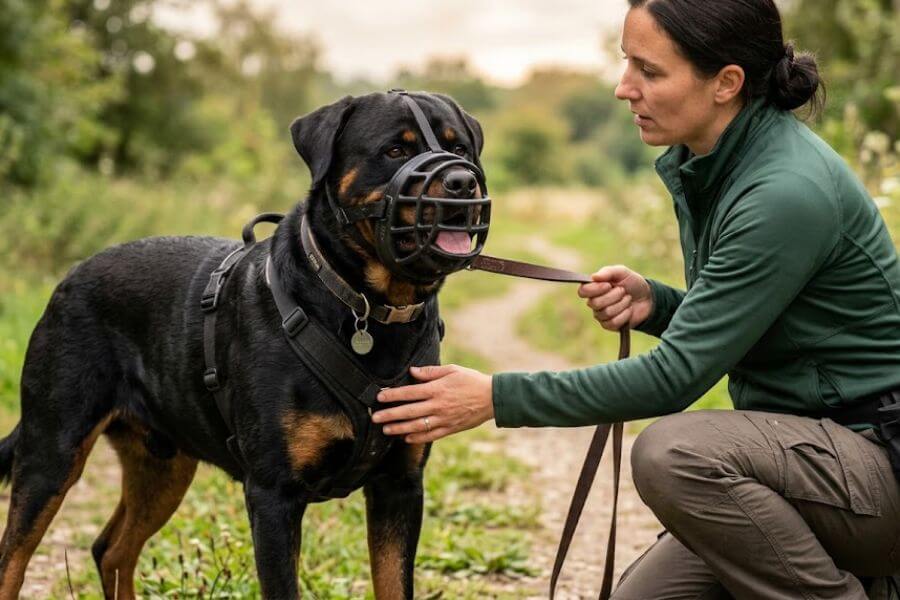
Many people feel sad when they see a dog wearing a muzzle. They think it looks cruel or makes the dog look like a monster. You need to flip that mindset completely. A muzzle is a tool of love and responsibility. It is a safety net that guarantees no teeth can make contact with skin.
When you muzzle train your dog properly using positive associations, the dog treats the muzzle just like a collar or a harness. They are happy to wear it because it means they are going for a walk or getting tasty treats.
- Choose a basket muzzle: Use a sturdy basket muzzle made of wire, plastic, or hard rubber. This allows your dog to pant, drink water, and take treats while wearing it. Never use a tight fabric sleeve muzzle for walks, as dogs cannot pant in them and can overheat quickly.
- Go slow with introduction: Do not just strap the muzzle onto your dog’s face. Hold the muzzle open, place a piece of chicken or peanut butter inside it, and let your dog voluntarily put their nose into it to get the treat. Do this for days until your dog gets excited when they see the muzzle come out.
- Build up time: Slowly increase the seconds your dog keeps their nose in the basket before giving the treat. Eventually, clip the straps for a brief moment, feed treats continuously, and take it off. Build up to long walks over several weeks.
Secure Walking Gear
Never rely on a simple collar and a flimsy leash for an aggressive Rottweiler. A strong dog can easily snap a plastic clip or pull out of a loose collar.
- Use a back-up system: Use a well-fitted, heavy-duty harness alongside a regular flat collar. You can use a double-ended leash that connects to both the harness and the collar at the same time. If one piece of gear breaks, you still have total control.
- Avoid retractable leashes: These long cord leashes are incredibly dangerous for large dogs. They can snap, they do not give you good control, and they can cause severe rope burns to your hands or legs if the dog bolts. Use a solid, six-foot nylon or leather leash instead.
The Golden Rules of Reactive Dog Training
When you begin the journey of reshaping your Rottweiler’s behavior, you need to follow a specific set of rules. Training an aggressive dog is different from teaching a puppy how to sit or roll over. You are working with deep emotions, and a wrong move can set you back weeks or even lead to an injury.
Never Use Force, Fear, or Pain
It can be tempting to yell, hit, jerk the leash, or use electronic shock collars when your dog is growling or lunging. It seems like you need to show them who is boss. This is the biggest mistake you can make.
Aggression is almost always driven by negative feelings like fear or stress. If your dog is afraid of a stranger, and you shock them or choke them every time a stranger appears, what does your dog learn? They learn that strangers cause intense physical pain. Your dog will not stop being angry; they will simply become more terrified and more dangerous. Punishing a warning sign like a growl is like taking the battery out of a smoke detector. The fire is still there, but now you have no warning before the dog bites.
Reward the Good Things
Positive reinforcement is the path forward. You want to teach your dog that good things happen when they choose to stay calm. Find out what your dog loves most in the world. It might be pieces of roast beef, cheese, hot dogs, or a special squeaky toy that they only get during training sessions. Use these high-value rewards to pay your dog for making good choices, like looking at another dog without barking, or stepping away from the front door when the bell rings.
Consistency Is Your Best Friend
Dogs crave predictability. If you let your Rottweiler guard the couch on Monday but yell at them for doing it on Tuesday, they will become confused and anxious. Everyone in your household must follow the exact same rules, use the exact same words, and respond to your dog’s actions in the exact same way. Clear boundaries make a dog feel safe.
Foundation Training: Building Focus and Trust
Before you can fix big problems out on the street, you need to build a strong foundation of communication inside your own home, where it is quiet and calm. If your dog will not listen to you in your living room, they certainly will not listen to you when they are staring down a delivery truck.
The Focus Game
You need your dog to look at you on command, no matter what is happening around them. This is called eye contact training, and it is a lifesaver when you need to divert your dog’s attention away from a trigger.
- Sit on the floor with your dog and a handful of treats.
- Say your dog’s name or a cue word like “Look” or “Focus.”
- The moment your dog looks up and makes eye contact with you, say “Yes!” in a happy voice and immediately give them a treat.
- Repeat this dozens of times a day. Eventually, your dog will snap their eyes to your face the second they hear their cue word, expecting something wonderful.
The Hand Touch
Teaching your dog to touch their nose to the palm of your hand is a fantastic way to move them around without having to grab their collar, which can spark an aggressive reaction.
- Hold your bare hand out a few inches from your dog’s nose, palm facing them.
- Curiosity will usually cause your dog to lean forward and sniff your hand.
- The exact millisecond their nose touches your skin, say “Yes!” and reward them with a treat from your other hand.
- Move your hand to different positions, higher, lower, or a step away, and repeat. This turns into a fun game that distracts your dog and gets them moving where you want them to go willingly.
The Place Command
Having a specific spot, like a durable raised dog bed or a specific mat, where your dog knows they must go and stay is essential for managing aggression around guests or doors.
- Lead your dog to the mat with a treat.
- When all four paws are on the mat, say “Place” and give them the treat.
- Teach them to lie down on the mat and feed them treats every few seconds to show them that staying there is a great job.
- Slowly add distance. Step back one foot, then step back to the mat and reward them if they stayed put. Build this up until you can stand across the room while your dog relaxes on their place mat.
Rewiring the Brain: Desensitization and Counter-Conditioning
This is the core work of changing aggressive behavior. It sounds scientific, but the concepts are straightforward once you see them in action. You are going to change how your dog feels about their triggers so that their automated response shifts from anger to joy.
Understanding the Threshold
Imagine your dog has a stress line inside their mind. When they are far away from a trigger, they are below the threshold. They are calm, they can take treats, and they can listen to your commands.
The moment the trigger gets too close, your dog crosses over the threshold. They flip into survival mode. They bark, lung, snarl, and their brain shuts down. They cannot hear you, and they will not care about your treats.
The number one rule of this training is: always keep your dog below their threshold. You cannot train a dog whose brain is flooded with adrenaline and cortisol, the stress chemicals.
Desensitization: Distance Is Your Shield
Desensitization means exposing your dog to the thing they hate or fear at a level so low that it does not scare them. Usually, this means using a lot of physical distance.
- If your dog hates other dogs, find a big park.
- Stand one hundred yards away from the walking path.
- At this distance, your Rottweiler can see the other dogs, but they are far enough away that they feel safe. They might watch the dogs, but they are not growling or pulling. This is your starting line.
Counter-Conditioning: Changing the Meaning
Counter-conditioning means pairing the sight of the trigger with something absolutely spectacular. You are changing the emotional association from “Oh no, a stranger, I must fight!” to “Wow, a stranger, that means I get steak!”
- Stand far away from the trigger, well below your dog’s threshold.
- The moment a stranger or another dog appears in the distance, look at your dog. As soon as your dog notices the trigger, start feeding them high-value treats rapidly, piece after piece.
- The moment the stranger walks out of sight, stop feeding the treats completely.
- You want your dog to realize that the scary thing is actually a magical light switch that turns on a waterfall of delicious food. When the scary thing leaves, the party ends.
Over days, weeks, and months, you will notice something incredible happen. Your dog will see a stranger and, instead of stiffening up, they will look directly at your face with a wagging tail, asking for their treat. This means you have successfully changed their emotional state. Once that happens, you can slowly move a few feet closer to the path and repeat the process at the new distance.
Step-by-Step Training for Specific Problems
Every type of aggression requires a slightly tailored approach. Let us look at how to tackle some of the most common issues Rottweiler owners face at home and on the road.
Handling Resource Guarding
If your dog guards items, you must never try to rip the object out of their mouth or yell at them. That teaches them that they were right to worry because you are indeed an item thief. Instead, you must teach them that when you approach, good things happen, and they will always get a fair deal.
- The Approach Game: When your dog is eating kibble from their bowl, walk toward them but stop five feet away, well outside the zone where they get stiff. Toss a piece of high-value chicken right into or next to their bowl, then immediately turn around and walk away. Do this every day. Soon, your dog will see you approaching the bowl and think, “Excellent, the food fairy is here to add better things to my dinner!”
- The Trade Up: If your dog has a toy and you need to take it, never just grab it. Hold a piece of smelly meat right in front of their nose. To eat the meat, they must drop the toy. The moment they drop it, say “Thank you,” give them the meat, pick up the toy, examine it, and then give the toy back to them along with another treat. This shows them that trading with you is an amazing deal where they often get to keep both things.
Tackling Leash Aggression
Walking an aggressive Rottweiler can feel like a nightmare. Here is how to regain control of your neighborhood strolls.
- Be a proactive scout: When walking, keep your eyes scanning far ahead. Do not look at your phone. If you see a dog coming around the corner, do not wait for your Rottweiler to explode. Turn around immediately or step off the path into a driveway.
- The “Let’s Go” Cue: Teach a quick turn command at home. Say “Let’s go,” turn around quickly in a circle, and jog a few steps in the opposite direction, rewarding your dog when they follow you. Practice this until it is a fast, fun muscle memory. When you see a trigger on a walk, use your “Let’s go” cue to head the other way before your dog even has a chance to cross their threshold.
- Create safety bubbles: If you cannot turn around, step behind a parked car, a large bush, or a trash can. Breaking the line of sight can help your dog calm down and keep their stress levels under control.
Managing Territorial Door Barking
If your dog goes wild when people ring the bell or knock, you need to use your foundation skills to change the routine.
- Enlist a friend or family member to help you by standing outside your door.
- Have them tap gently on the door, not loud enough to cause a full explosion, but enough for your dog to notice.
- The moment your dog hears the tap, say your “Place” command and point to their mat.
- When your dog goes to the mat, go over and feed them high-value treats continuously.
- Practice this until the sound of a knock becomes a visual cue that tells your dog to automatically run to their mat to wait for treats, rather than running to the door to fight.
Common Mistakes That Will Hurt Your Progress
Training a reactive dog is hard work, and it is easy to slip into bad habits without realizing it. Watch out for these common traps that can slow down your progress or make your dog’s behavior worse.
Moving Too Fast
This is the number one mistake people make. You have a few good days of training at a distance of fifty feet, so you assume your dog is cured and you try to walk them right up to another dog the next day. This results in a massive explosion, and your dog’s brain resets back to square one. Behavior modification is a slow journey. It takes months, not days. Be patient and stay at a safe distance for much longer than you think you need to.
Tightening the Leash
When you see a trigger, your natural human reaction is to panic, wrap the leash tightly around your hand, and pull your dog close to your body. Your dog feels that sudden tension instantly. To a dog, a tight leash is a physical signal that says, “Be alert! Something dangerous is happening right now!” You are essentially telling your dog that they are right to be afraid or angry. Try your best to keep your hands relaxed and the leash loose, even as you guide your dog away from the situation.
Using the Wrong Rewards
A piece of dry dog kibble or a standard biscuit might work when your dog is sitting in the kitchen, but it will not cut it when they are staring down a scary stranger. You cannot bring a knife to a gunfight. You need the big guns: fresh turkey, real cheese, pieces of hot dog, freeze-dried liver, or wet food squeezed out of a reusable tube. The food must be so delicious that it can break through your dog’s intense focus on the trigger.
Ignoring Early Warning Signs
Aggression does not look like a sudden explosion out of nowhere. Dogs give many subtle hints before they bark or bite. If you ignore these early signs, you miss your chance to intervene while your dog is still below their threshold. Look closely for these warning signals:
- A sudden freezing or stiffening of the body
- A hard, unblinking stare at an object
- Mouth closing suddenly if it was open or panting
- Ears pinning back tightly against the head
- The tail held high, stiff, and vibrating rather than loose and wagging
- Licking the lips or yawning when not tired, which are signs of deep stress
If you see any of these signs, your dog is telling you that they are uncomfortable. Do not wait for them to growl or lunge. Move away immediately.
When to See a Professional Behaviorist
Let us be completely honest with each other. You love your dog, and your dedication is beautiful. But sometimes, love and internet guides are not enough. Rottweilers are massive animals that can weigh over one hundred pounds. They have immense jaw pressure and physical power. When a dog of this size is aggressive, the risk level is very high.
Knowing when to ask for expert help is not a sign of failure. It is a sign of deep responsibility, maturity, and love for your dog. It means you care enough to make sure things are done perfectly. Here are the clear signs that it is time to stop doing this on your own and bring in a professional animal behaviorist.
There Has Been a Bite That Broke Skin
This is a non-negotiable line in the sand. If your Rottweiler has bitten a human or another animal and caused an injury that required medical attention or broke the skin, you must see a professional immediately. A dog who has crossed the line from making threats to actually using their teeth to cause harm is a high-risk animal. You need an expert eye to evaluate the situation and keep everyone safe.
You Feel Constantly Afraid of Your Dog
The bond between a human and a dog must be built on trust, safety, and mutual respect. If you find yourself walking on eggshells in your own home, worried that a wrong look or a sudden movement might cause your dog to attack you, the dynamic is broken. Living in fear is terrible for your mental health, and dogs can sense human fear, which often makes them feel even more unstable and nervous. A professional can help rebuild that safety so you can breathe easily again.
Your Dog’s Aggression Is Escalating
If you have been trying your best with positive training methods for several weeks, but your dog’s behavior is getting worse instead of better, something is wrong. Perhaps their threshold distance is growing larger, or they are starting to show aggression over new things they used to be fine with. This escalation means that the underlying cause of the problem is not being addressed correctly, and you need a specialist to figure out why.
The Aggression Appears Unpredictable
Most aggressive dogs have clear patterns: they hate the mail carrier, they protect their food, or they fear large male dogs. But if your Rottweiler seems to switch from happy to explosive in the blink of an eye with zero warning, zero triggers, and zero clear patterns, this is highly dangerous. Unpredictable aggression can sometimes be linked to complex neurological issues, deep-seated trauma, or hidden medical conditions that only an expert team can diagnose.
You Are Feeling Overwhelmed and Ready to Give Up
It is okay to admit that you are exhausted. Caring for an aggressive dog can feel like a full-time job that drains your energy, your emotions, and your spirit. If you are at the end of your rope, crying over your dog’s actions, or thinking about giving up your dog, please reach out to a professional first. They can take the heavy weight off your shoulders, look at the situation with clear eyes, and give you a realistic, sustainable plan that fits your life.
Choosing the Right Professional
The dog training industry can be confusing because it is not regulated. Anyone can buy a leash, print out a business card, and call themselves a dog trainer. When you are dealing with aggression, hiring the wrong person can have disastrous results. You need to know exactly who to look for.
Understand the Titles
- Certified Applied Animal Behaviorist (CAAB): These individuals have advanced university degrees, like a master’s degree or a doctorate, in animal behavior science. They are highly trained experts who look at the biology, psychology, and environment of the animal to solve severe issues.
- Veterinary Behaviorist (DACVB): These are licensed veterinarians who have gone through years of extra training to specialize in animal behavior. Because they are doctors, they can look at how physical health affects behavior and can prescribe specialized medications if your dog’s brain needs chemical support to calm down enough to learn.
- Certified Professional Dog Trainer (CPDT-KA or CDBC): Look for trainers certified by organizations like the Certification Council for Professional Dog Trainers or the International Association of Animal Behavior Consultants. These letters mean they have passed tests, logged hundreds of hours of experience, and agreed to follow ethical standards.
Red Flags to Avoid
When interviewing a trainer or behaviorist to help you with your Rottweiler, turn around and walk away if they do any of the following:
- Guarantees a one hundred percent fix or cure in a short amount of time. Behavior is complex, and no honest expert can guarantee a quick cure.
- Tells you that you need to dominate your dog, be the alpha, or break their spirit.
- Wants to use shock collars, prong collars, or physical punishment to stop the aggression.
- Refuses to tell you about their education, certifications, or methods.
Frequently Asked Questions
Can an aggressive Rottweiler ever be completely cured?
In the world of animal behavior, experts rarely use the word “cured.” Instead, we talk about long-term management and improvement. Think of it like a human dealing with anxiety or anger issues. You can learn to manage your emotions, recognize your triggers, and make healthy choices so that you never get into a physical fight, but that inner sensitivity might always be a small part of who you are. With dedicated training, many aggressive Rottweilers can become safe, calm, and wonderful family companions who can enjoy walks and life without explosions. However, you must always remain responsible and aware of their potential triggers for the rest of their life to keep everyone safe.
How much does a professional behaviorist cost?
Hiring a highly qualified professional behaviorist is an investment in your dog’s life and your family’s safety. Because these experts have advanced degrees and specialized skills, their fees are higher than standard puppy obedience trainers. An initial consultation, which usually lasts one to two hours and includes a deep history review and a customized plan, can cost anywhere from two hundred to six hundred dollars depending on where you live. Follow-up sessions are typically less expensive. While it can feel like a lot of money upfront, a behaviorist can save you thousands of dollars in potential vet bills, legal fees, or medical bills down the road by preventing a serious incident.
Could my dog’s aggression be caused by their genetics?
Genetics play a foundational role in how any dog interacts with the world. Rottweilers were bred for centuries to be protective, strong, and alert. If your dog came from parents who were nervous, overly sharp, or aggressive themselves, your dog likely inherited a baseline personality that leans toward those traits. However, genetics are not a final life sentence. Genetics load the gun, but the environment and experiences pull the trigger. Even if your dog has a genetic lean toward being suspicious or protective, proper socialization, positive training, and good management can shape that raw material into a well-behaved, safe companion.
Will getting my Rottweiler neutered or spayed fix the aggression?
There is a common myth that fixing a dog will instantly solve all behavior problems. The truth is much more complex. Hormones like testosterone can play a role in behaviors like roaming, marking, and certain types of male-on-male dog aggression. If your young male Rottweiler is starting to show slight dominance-related friction with other intact dogs, neutering may help lower that specific energetic edge. However, if your dog’s aggression is driven by deep fear, resource guarding, or territorial protection, altering them will rarely solve the problem on its own. In fact, some studies suggest that removing sex hormones from a deeply fearful dog too early can sometimes make their anxiety and fear-based aggression worse because those hormones help provide behavioral confidence. Always discuss the timing of spaying or neutering with a vet or behaviorist who understands your dog’s specific behavioral profile.
Is it safe to keep an aggressive Rottweiler in a home with young children?
This is the hardest question any parent or dog owner has to ask, and it requires absolute honesty. Children are small, move unpredictably, make high-pitched noises, and often do not understand how to respect a dog’s boundaries. If your Rottweiler has shown direct aggression toward your children, or if they have severe resource guarding issues where they might bite a child who accidentally wanders near their toy or food bowl, the situation is incredibly dangerous. Total separation using crates and closed doors must be maintained every single second. If you cannot guarantee one hundred percent separation, or if the stress of managing that separation is breaking your family apart, you must bring in a professional behaviorist immediately to evaluate the home safety. In some severe cases, rehoming the dog to an adult-only household where they can thrive safely is the kindest and most responsible choice for everyone involved.