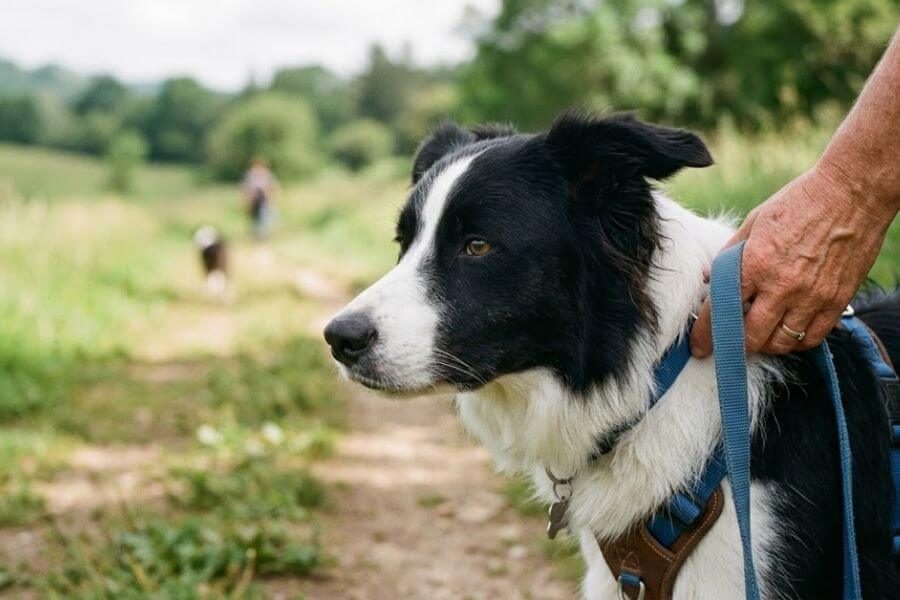
Imagine this scenario. You lace up your sneakers, grab the leash, and head out the front door with your gorgeous border collie. The sun is shining, and you are looking forward to a peaceful stroll around the neighborhood. But the moment you turn the corner, you see it. A person jogging on the opposite sidewalk, or maybe a mail truck rolling down the street.
Before you can even react, your sweet, highly intelligent dog transforms. They are suddenly lunging, barking like crazy, spinning in circles, and pulling on the leash so hard that your arm feels like it might pop out of its socket. Your heart sinks. You feel embarrassed, stressed, and completely exhausted.
If this sounds familiar, you are not alone. Living with a reactive border collie can feel incredibly isolating, but there is hope. These dogs are remarkably smart, which means they can learn to choose calm behavior just as quickly as they learned to react. It takes time, patience, and a solid plan. Let us dive deep into how you can help your dog relax and enjoy your outdoor adventures together again.
Understanding the Brilliant and Sensitive Border Collie Mind
To help your dog calm down, you first need to understand why they act this way. Border collies are not like other dogs. They were bred for centuries to work alongside farmers, herding sheep across vast, windy hills. This history shapes everything they do today, even if they have never seen a sheep in their life.
First, border collies have a massive instinctual drive to look at things, chase things, and control movement. When a bicycle zooms past, your dog does not see a fun toy; their ancient brain tells them that a rogue sheep is escaping and they must stop it.
Second, these dogs have an incredibly sensitive nervous system. They notice everything. A leaf blowing across the grass, a strange sound three blocks away, or a change in your body language will catch their eye instantly. Because they process the world at lightning speed, they can easily become overwhelmed by too many sights and sounds.
Reactiveness is almost never about your dog trying to be bad or dominant. It is a sign that your dog is feeling afraid, frustrated, or simply overstimulated. Their brain has gone into a survival mode, and barking or lunging is their way of dealing with a situation they do not know how to handle. Once you view their behavior through this lens of understanding, it becomes much easier to stay patient and helpful.
The Danger of Stress Stacking in Herding Breeds
Have you ever had a day where you spilled your morning juice, got stuck in traffic, forgot your lunch, and then finally snapped when someone asked you a simple question? That is exactly what happens to your dog, and trainers call it stress stacking.
When your dog experiences something scary or exciting, their body releases stress hormones like cortisol and adrenaline. These hormones do not just disappear the moment the scary thing goes away. They can stay in your dog’s system for days.
If you take your dog on a walk on Monday and they bark at a garbage truck, their stress levels go up. If you go out on Tuesday and they see a stray cat, their stress climbs higher. By Wednesday, their stress bucket is completely full. When they see a simple bicycle, they explode with barks because they literally cannot hold any more stress.
To fix this, you must learn to empty your dog’s stress bucket. This means giving them quiet days at home with zero walks when they have had a really bad experience. Letting them rest, play brain games in the living room, and sleep in a quiet space will reset their brain so they can learn effectively on their next outing.
Getting Your House Ready Before You Step Outside
Many people think that walk training only happens when you are out on the sidewalk. In reality, successful walks start inside your living room. If your dog is a chaotic mess inside the house, they will be an absolute tornado outside.
Start by practicing leash skills in your hallway. Put the collar or harness on your dog, attach the leash, and just walk around your kitchen. Reward your dog with a tasty treat every single time they look up at your face or walk with a loose leash. Since there are no distractions inside, your dog can actually listen to you and learn what a loose leash feels like.
You also need to evaluate your exit routine. Does your dog spin, bark, and jump when you pick up the leash? If they leave the front door with an adrenaline rush, they are already primed to react to the first thing they see.
Change your routine completely. Pick up the leash, and if your dog goes crazy, put it right back down and walk away. Sit on the couch and read a book. Wait until your dog sighs and lies down. Then, try again. Only attach the leash when your dog is completely relaxed. Next, walk to the front door. If your dog rushes ahead, step back and close the door. Repeat this until your dog can stand quietly while you open the door. It might take forty tries on the first day, but this teaches your dog that calmness is the only key that opens the door to the outside world.
Finding the Magical Zone Known as the Threshold
One of the biggest mistakes dog owners make is trying to train their dog while the dog is already screaming and lunging. At that point, your dog’s thinking brain is completely turned off. They cannot hear your voice, and they certainly do not care about a piece of cheese.
To train successfully, you must find your dog’s threshold. This is the exact distance where your dog can see the trigger, like another dog, but they are far enough away that they remain calm, quiet, and capable of eating a treat.
For some dogs, the threshold might be the length of a football field. For others, it might be twenty feet. Your job is to act like a detective and observe your dog’s subtle body language. Look for these warning signs that mean your dog is getting close to their threshold:
- Their body goes completely stiff and still.
- Their ears flip forward or pin back tightly.
- They stare intensely at the trigger without looking away.
- Their mouth closes firmly, and their tail stays high and rigid.
If you see these signs, you are on the edge of the danger zone. You need to create more distance immediately. Walk backward, turn down a different driveway, or step behind a parked car. Always train in the safe zone where your dog feels secure enough to look at you and learn.
The Power of High-Value Treats and Toy Rewards
When you are working with a reactive border collie, a piece of dry dog food will not cut it. You are asking your dog to ignore their deepest instincts, so you need to pay them with something truly incredible.
High-value rewards are treats that your dog rarely gets and absolutely loves. Think about tiny pieces of cooked chicken, cubes of cheese, freeze-dried beef liver, or plain hot dogs. The treats should be very small, about the size of a pea, so your dog can swallow them quickly and keep focusing on you.
Since border collies are herding dogs, many of them actually prefer toys over food. A special fleece tug toy or a tennis ball that only appears during walks can be a superpower. The act of biting and tugging a toy can actually release feel-good chemicals in your dog’s brain, which instantly lowers their stress and redirects their intense drive to bite and grab moving things. Find out what your specific dog loves most, and use that as your training currency.
Step-by-Step Training Method One: The Look at That Game
This game is a classic training method developed by experts, and it works wonders for smart dogs like border collies. It completely changes how your dog views their triggers. Instead of seeing another dog as an enemy to bark at, they start to see the other dog as a green light that means they are about to get a piece of delicious chicken.
Start in a safe space where you can see triggers from a long distance, like the far edge of a large park. Stand with your dog on a loose leash and wait for a distraction to appear.
The moment your dog looks at the trigger, say a specific word like “Yes!” or use a clicker. Say it in a happy, clear voice. The second you say the word, your dog should turn their head toward you, expecting a treat. Give them the treat immediately.
Repeat this process. Your dog looks at the dog, you say “Yes!”, your dog turns to you, and you feed them. What you are doing here is rewiring their brain. You are teaching them that noticing a trigger is actually a cue to turn around and check in with you. Soon, you will notice that the moment a dog appears, your border collie will look at them and then immediately look at your face with a wagging tail, waiting for their reward.
Step-by-Step Training Method Two: The Pattern Game
Border collies thrive on predictability. They love knowing exactly what is going to happen next. You can use this love for structure to keep them grounded when the environment feels overwhelming. A fantastic method is the basic 1-2-3 pattern game.
You can practice this while walking down a quiet sidewalk. As you take steps, count out loud in a calm, rhythmic voice. Say, “One,” then take a step. Say, “Two,” and take another step. Then say, “Three,” and immediately drop a treat on the ground for your dog to eat.
Keep doing this as you walk. One, step. Two, step. Three, treat. Your dog will quickly learn the rhythm. They will realize that whenever you start counting, a treat always lands on the ground on the count of three.
Once your dog understands the game, you can use it when you see a trigger in the distance. The counting acts like a comforting anchor for your dog’s mind. They focus on the familiar rhythm of your voice and the anticipation of the treat rather than panicking about the strange object down the road. It keeps their brain occupied with a simple, safe task.
How to Handle an Emergency Breakdown Calmly
No matter how careful you are, mistakes will happen. A dog will escape from a loose gate, or a person will jog around a corner out of nowhere, right into your dog’s personal space. Your border collie will explode into a barking, lunging mess.
First, do not panic. Your dog feels your energy. If you get angry, tighten your grip, and start screaming “No!”, your dog thinks, “Wow, my human is yelling too! That thing really is terrifying!”
Instead, stay completely silent. Keep your breathing slow and deep. Do not try to correct your dog or make them sit. Their brain is offline, so punishment will only make them associate the trigger with pain or fear.
Use the emergency U-turn technique. Firmly anchor your leash hand against your hip to keep your balance. Turn your entire body around and walk away from the trigger, encouraging your dog with a cheerful, inviting voice like, “Let us go this way!” If your dog is too heavy to pull away easily, walk sideways or at an angle to break their visual lock on the target. Once you have moved twenty or thirty yards away and your dog stops barking, stop, let them sniff the grass, and take a moment for both of you to catch your breath.
The Critical Role of Mental Work and Physical Outlets
A tired border collie is a happier, calmer border collie. However, physical exercise alone is not enough. If you only run your dog for miles every day, you will simply build a super-athlete with amazing stamina who is still completely stressed out. You must exercise their massive brain.
Mental stimulation tires a dog out much faster than a long run. Before you go for a walk, try giving your dog a puzzle toy, a frozen treat holder stuffed with peanut butter, or a snuffle mat filled with dry kibble. Sniffing and licking are natural behaviors that lower a dog’s heart rate and soothe their nervous system.
You can also introduce scent work games in your backyard. Hide their favorite toy under a cardboard box and tell them to “Find it!” Forcing a border collie to use their nose requires an immense amount of mental concentration. When they use their brain to solve problems, their overall anxiety decreases, making them much less reactive when they finally encounter the real world during their walks.
Managing Your Own Emotions and Leash Handling
It is time for some honest talk about human behavior. Having a reactive dog is hard, and it can make you feel incredibly anxious. You might find yourself constantly scanning the horizon, gripping the leash tightly, and dreading every single corner.
Your border collie is a master at reading your body language. When you shorten the leash and hold your breath, that tension travels straight down the cord to your dog’s neck. They interpret that tight leash as a clear warning signal that danger is near.
Practice keeping your leash loose, hanging in a relaxed curve like a smile. Keep your shoulders down and your hands relaxed. If you see a trigger, intentionally blow out a deep breath.
Remember to ignore the judgments of other people. Passers-by might give you dirty looks or offer unhelpful advice. Forget about them. Your only priority is the dog at the end of your leash. Celebrate the small victories, like the time your dog looked at a bicycle for one second without barking. Progress is not a straight line, and you are doing a wonderful job.
Frequently Asked Questions
How long does it take to train a reactive dog to be calm?
There is no magical timeline for fixing reactivity because every dog and every environment is completely different. Some dogs show major improvements within a few weeks, while others might take months or even years of consistent practice. It depends heavily on how long your dog has practiced the barking behavior, how old they are, and how consistently you can manage their environment. Remember that training is a lifelong journey of communication with your intelligent dog, so try to focus on celebrating the small moments of progress rather than focusing on a final destination.
Should I use a prong collar or a shock collar to stop the barking?
It is highly recommended to avoid using painful or scary tools like prong collars, choke chains, or electronic shock collars for reactivity. While these tools might stop the barking temporarily because the dog is afraid of getting hurt, they do not fix the underlying emotion of fear or frustration. In fact, they usually make reactivity much worse over time. If your dog gets shocked every time they see another dog, they will quickly realize that other dogs cause them pain, making them hate and fear other dogs even more. Stick to positive methods that teach your dog to feel safe and happy around their triggers.
Can a reactive border collie ever have dog friends or go to dog parks?
Yes, many reactive dogs can absolutely have close dog friends, but dog parks are usually a terrible idea for this specific breed. Dog parks are chaotic, unpredictable, and filled with overstimulated animals, which is a recipe for disaster for a sensitive herding dog. Instead of a free-for-all park, introduce your dog to a calm, friendly, neutral dog on a structured walk where both dogs are kept at a safe distance moving in the same direction. With slow, careful introductions, your border collie can build wonderful, deep bonds with specific dog buddies.
Why does my border collie only act crazy when they are on a leash?
This is a very common issue known as leash reactivity. When a dog is off-leash, they have the freedom to move away from things that make them uncomfortable. The leash takes away their ability to choose flight, so they are forced to choose fight to protect themselves. Furthermore, the restriction of a leash causes immense frustration for an energetic dog who wants to run over and investigate or herd something. The barrier of the leash creates a burst of intense emotion that explodes outward in the form of barking and lunging.
What should I do if someone else’s off-leash dog charges toward us?
This is every reactive dog owner’s absolute worst nightmare, but you can handle it if you stay focused. First, body-block the incoming dog by stepping firmly in front of your border collie. Put your hand out like a traffic cop and yell “Stop!” or “Go home!” in your loudest, deepest, most commanding voice. You can also carry an open umbrella to pop open as a sudden visual shield, or toss a handful of high-value treats directly into the face of the approaching dog to distract them while you quickly walk away in the opposite direction.
My dog will not take treats outside at all what am I doing wrong?
If your dog refuses to eat an amazing treat like fresh chicken or cheese while you are outdoors, it is a definitive biological sign that your dog is over threshold and too stressed to function. When a dog’s brain perceives danger, their digestive system shuts down completely to conserve energy for running or fighting. You are not doing anything wrong, you are simply too close to the trigger or the environment is too intense. Move back inside your house, practice in your quiet backyard, or stand much further away from the sidewalk until your dog’s nervous system settles down enough to accept food again.