Imagine this scenario. The sun is shining, the air is crisp, and you are enjoying a peaceful walk with your furry best friend. Your dog is sniffing a patch of grass, their tail swaying gently. Then, you see it. A block away, another person is walking their dog.
Suddenly, your peaceful walk turns into a stressful tug-of-war. Your dog freezes. Their ears shoot forward. Before you can even react, your dog throws themselves forward, barking furiously, growling, and lunging at the end of the leash. You feel your heart drop into your stomach. You shorten your grip on the leash, apologize profusely to the passing neighbor, and feel a wave of embarrassment wash over you. Your hands are shaking, and your dog is panting heavily.
If this sounds familiar, please take a deep breath. You are not alone, and your dog is not a bad dog. You are dealing with leash reactivity. This is one of the most common behavioral challenges that dog owners face across the world. It can feel deeply isolating and exhausting, but there is a clear, kind path forward. This comprehensive guide will walk you through everything you need to know to transform those stressful walks into calm, connected adventures.
Understanding the Root Cause of the Behavior
To fix a problem, we must first understand why it is happening. When your dog lunges and barks at another dog, it looks like pure aggression. It is easy to think that your dog wants to attack the other animal. However, behavior experts know that reactivity is rarely born out of a desire to fight. Instead, it is usually driven by big, overwhelming emotions.
The Power of Fear and Anxiety
The vast majority of reactive dogs are acting out of fear or deep discomfort. Imagine you are terrified of spiders, and suddenly a giant tarantula appears right in front of your face. You cannot run away because you are trapped. You would likely scream, swat at it, and try to scare it off.
This is exactly what is happening inside your dog’s mind. When they are on a leash, they know they cannot run away. The leash traps them. If they see another dog and feel unsafe, they use the only tool they have left. They make themselves look as big, loud, and scary as possible to force the other dog to go away. In their mind, the strategy works. The other dog walks past, so your dog thinks, “Wow, my barking and lunging scared that monster away. I will definitely do that again next time.”
Frustrated Greeters
On the flip side, some dogs lunge because they love other dogs way too much. These are what trainers call frustrated greeters. When these dogs are off the leash, they play beautifully. But when they are on a leash, they feel trapped by the barrier. They want to run over and say hello, but the tight leash stops them. This restriction creates a massive buildup of frustration. Eventually, that happy excitement boils over into frantic barking and lunging. To a stranger, a frustrated greeter looks identical to a fearful dog, even though their internal motivation is completely different.
The Role of Breed and Genetics
It is also vital to recognize that genetics play a massive role in how dogs perceive the world. Some breeds were created to guard, herd, or protect. These dogs naturally notice changes in their environment much faster than a laid-back companion breed. A herding dog might see a moving dog down the street and feel an intense, hard-wired urge to control that movement. A guarding breed might feel it is their duty to keep strange dogs away from you. Acknowledging your dog’s genetic background helps you replace your frustration with deep empathy.
Decoding Your Dog’s Body Language
Dogs speak to us constantly, but they do not use words. They use their eyes, ears, tails, and posture. Long before your dog lunges or barks, they are sending out subtle warning signs that they are uncomfortable. Learning to read these quiet signals is your ultimate superpower in training.
The Subtle Signs of Early Stress
Many owners only notice the reactivity when the barking starts, but your dog was likely stressed a minute before that. Look for these subtle, early signs of tension:
- The Freeze: Your dog suddenly stops walking and becomes stiff like a statue.
- The Stare: Their eyes lock onto the other dog with an intense, unblinking focus.
- Lip Licking: They flick their tongue out to lick their nose, even though they have not been eating or drinking.
- Yawning: A slow, exaggerated yawn when they are not actually tired.
- The Low Tail: Their tail drops below its normal carrying position, or it wags very stiffly and quickly at the tip.
The Escalation Zone
If you miss the early signs, your dog will move into the next phase of stress. This is where you will see their body shift dramatically. Their hackles, which is the hair along their spine, might stand up on end. This is a involuntary physical reaction, much like human goosebumps, caused by a rush of adrenaline. They might lean their weight forward onto their front paws, ready to spring. Their breathing will become fast and shallow. Once your dog reaches this point, they are right on the edge of a full outburst.
Understanding the Threshold
In reactive dog training, the word threshold is incredibly important. Think of the threshold as an invisible line. When your dog is below threshold, they are calm, relaxed, and capable of thinking and learning. They can look at another dog far away and still look back at you to take a treat.
When your dog crosses above threshold, their thinking brain completely shuts down. The emotional, survival-driven part of their brain takes over entirely. Once your dog is above threshold, they cannot hear your commands, they will not eat treats, and they cannot learn. Your only goal when your dog is above threshold is to gently remove them from the situation as fast as possible.
Essential Management Strategies for Daily Success
Training takes time, often months of consistent effort. While you are working on changing your dog’s underlying emotions, you need to use daily management to keep everyone safe and prevent the behavior from getting worse. Management means changing the environment so your dog does not have the chance to practice lunging.
Choosing the Right Walking Gear
The equipment you use can make a massive difference in your safety and your dog’s comfort. You should always avoid gear that causes pain or discomfort, such as pinch collars, choke chains, or electronic shock collars. These tools might stop the barking temporarily through fear, but they actually increase your dog’s anxiety. Your dog will start to connect the painful pinch or shock with the sight of the other dog, making them even more reactive in the long run.
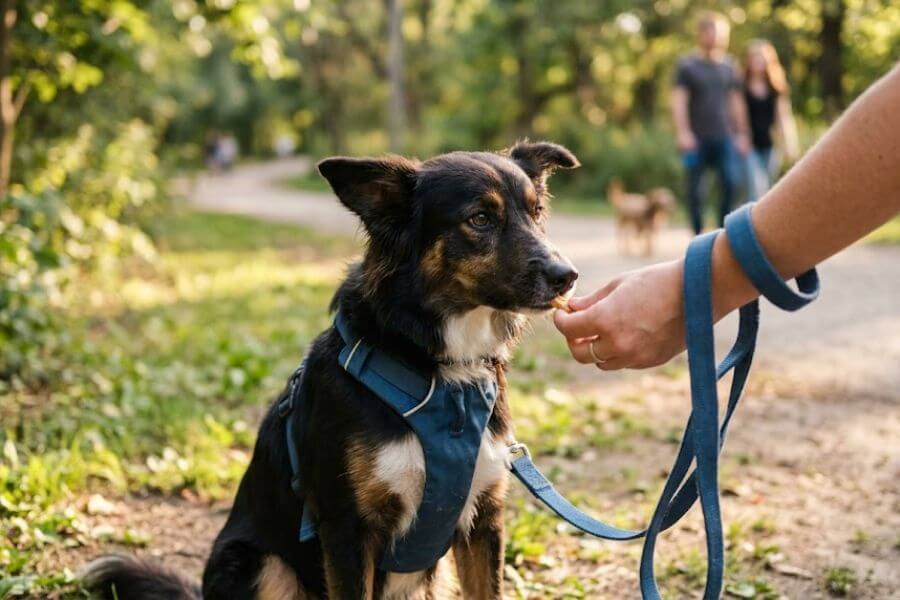
Instead, invest in a high-quality, front-clip harness. A front-clip harness gives you excellent steering control. When your dog tries to pull forward, the front attachment gently steers their body back toward you. Combine this with a sturdy, fixed-length leash that is four to six feet long. Avoid retractable leashes entirely, as they give you very little control and can easily break or tangle in an emergency.
Becoming a Master of Distance
Distance is your best friend when living with a reactive dog. If your dog reacts to another dog at twenty feet, you need to walk thirty or forty feet away. You must become highly aware of your surroundings during walks. Scan the environment constantly. Look ahead around corners, check behind you, and watch the driveways. If you see another dog approaching, do not try to squeeze past them on a narrow sidewalk. cross the street, duck behind a parked car, or step up onto a driveway to create a wide safety buffer.
Changing Your Walk Schedule
If your neighborhood is bustling with dogs at five o’clock in the evening, change your routine. Try walking very early in the morning before most people wake up, or later at night when the streets are empty. You can also explore quiet industrial parks on the weekends, large empty school parking lots after hours, or open fields where you have a clear line of sight in every direction. Giving your dog a break from constant stress will lower their baseline anxiety and make them much more receptive to training.
The Core Principles of Counter-Conditioning
Now that you have your management tools in place, it is time to start the actual training. The gold standard method for changing leash reactivity is called counter-conditioning and desensitization. This is a scientific process that changes your dog’s emotional response to their triggers.
What is Counter-Conditioning?
Right now, your dog sees another dog and thinks, “Oh no, danger is coming.” Our goal is to flip that mindset completely. We want your dog to see another dog and think, “Wow, awesome things are about to happen.”
To do this, we pair the sight of the trigger with something your dog absolutely loves. This is usually high-value food. Standard kibble or dry biscuits will not work for this training. You need something spectacular that your dog rarely gets to enjoy. Think small pieces of roasted chicken, hot dogs, cheese, or freeze-dried beef liver. The treats must be cut into tiny, pea-sized bites so your dog can eat them quickly without getting full or choking.
The Law of Precise Timing
For counter-conditioning to work, the order of events must be perfect. The trigger must always appear before the food begins. If you stick a piece of chicken in your dog’s face before they even see the other dog, you are just distracting them. Worse, your dog might start to realize that getting chicken means a scary dog is about to pop out, which can actually make them dislike the chicken.
The correct sequence is:
- Your dog sees the other dog at a safe distance.
- You immediately praise them or click a training clicker.
- You feed them a continuous stream of high-value treats while the other dog passes.
- The other dog leaves the area.
- The treats stop completely.
Through repetition, your dog learns a powerful lesson. The presence of another dog makes delicious chicken appear. The departure of the other dog makes the chicken disappear. Suddenly, the strange dog becomes the predictor of good things.
Step-by-Step Training Guide
Let us break down the actual training process into clear, manageable steps. Remember to go slowly. Your dog sets the pace. Never rush from one step to the next until your dog is completely relaxed.
Step One: Finding the Sweet Spot
Before you start training around real dogs, you need to determine your dog’s baseline distance. Go to a large park where you can see dogs from very far away. Find the distance where your dog can notice another dog but remains totally calm. They might watch the dog, but their body is loose, their mouth is open, and they can easily look away when you say their name. This is your starting point. For some dogs, this might be the length of a football field. For others, it might be fifty feet. Whatever it is, accept it without judgment.
Step Two: The Look at That Game
Invented by renowned dog trainer Leslie McDevitt, the Look at That game is a fantastic tool for reactive dogs. It teaches your dog that looking at a trigger is actually a cue to turn around and get a treat from you.
While standing at your safe baseline distance, wait for your dog to look at the other dog. The very second they glance at the other dog, click your clicker or use a verbal marker word like “yes!” Your dog will naturally turn their head back to you to receive their treat. Feed them the treat. Repeat this over and over.
Eventually, you will notice a magical shift. Your dog will look at the other dog, and instead of freezing or stiffening, they will immediately whip their head back to look at you, expecting a treat. They are now actively choosing to engage with you rather than fixating on the trigger.
Step Three: Gradually Closing the Gap
Once your dog is a master at the Look at That game at your starting distance, you can begin to decrease the space between you and the other dogs. Move forward by just a few steps. Practice the game at this new distance until your dog is completely relaxed. If your dog becomes tense, stiffens, or barks, you have moved too close, too fast. Do not punish them. Simply take several steps back to where they were successful and build their confidence again. Training is not a straight line; it is normal to take two steps forward and one step back.
Step Four: Real-World Generalization
Dogs are situational learners. Just because your dog is perfect at the park does not mean they will automatically understand how to behave on your neighborhood sidewalk. You need to practice these games in various environments. Try training on different streets, near pet stores, or outside a busy park. Keep the distance wide whenever you enter a new location, as the novelty of the environment will temporarily reduce your dog’s ability to focus.
Advanced Skills for Sticky Situations
No matter how careful you are, mistakes will happen. A dog will run out of a garage, or a neighbor will turn a corner unexpectedly. For these high-stress moments, you need a toolkit of emergency escape maneuvers.
The U-Turn Protocol
The emergency U-turn is a vital skill that you should practice at home until it is fluid and automatic. You want to be able to turn your dog around instantly without jerking their neck.
To teach this, walk forward with your dog on a loose leash. Suddenly, make a cheerful kissing sound, say “let us go!”, and turn around in a smooth circle, walking back the way you came. As your dog follows your movement, praise them enthusiastically and feed them several treats as you walk. Practice this randomly on every single walk when no other dogs are around. When a real emergency happens, you can execute this smooth turn, and your dog will happily spin around with you because they think it is just a fun game.
The Magnet Treat Technique
If you find yourself trapped on a narrow path and cannot turn around, use the magnet treat technique. Take a large handful of small, highly aromatic treats and press them directly against your dog’s nose. Keep your hand firmly planted against their muzzle like a magnet, letting them nibble and lick the treats continuously out of your fingers as you walk quickly past the danger. This acts as a physical and mental shield, keeping your dog’s eyes locked onto your hand and away from the passing dog.
Common Training Mistakes to Avoid
Even the most dedicated dog owners can accidentally fall into habits that slow down their training progress. Being aware of these common traps will help you stay on the fastest path to success.
Tightening the Leash Prematurely
When you see another dog, your natural human instinct is to pull the leash tight and hold your breath. Dogs are incredibly sensitive to our physical tension. When you shorten the leash and freeze up, you send a clear message down the line to your dog: “I am scared, something bad is about to happen.” Your dog feels that tension and immediately matches it. Try your best to keep your shoulders relaxed, breathe deeply, and keep the leash loose, letting the distance do the work of keeping you safe.
Labeling Your Dog as Lazy or Stubborn
When a dog refuses to listen during a stressful event, owners often say, “He is just being stubborn, he knows his commands.” In reality, a dog that is over threshold is physically unable to listen. Their brain is flooded with stress hormones like cortisol and adrenaline. They are in a state of panic, not defiance. Treat your dog with the same patience you would show a human child who is having a severe panic attack.
Relying on Distraction Rather Than Education
Using a treat to pull your dog’s eyes away before they see a trigger is a useful emergency tool, but it does not teach them anything long-term. True counter-conditioning requires the dog to safely look at the trigger, process its presence, and realize that nothing bad happened. Let your dog look, then reward the calm observation.
The Human Side of the Leash: Managing Your Own Stress
Training a reactive dog is just as much about training the human as it is about training the canine. It takes a heavy emotional toll on owners. Many people experience profound anxiety before every walk, feeling a sense of dread whenever they open the front door.
Overcoming the Judgment of Strangers
One of the hardest parts of having a reactive dog is the fear of being judged by neighbors or passersby. People who have never owned a reactive dog might give you disapproving looks or offer unhelpful, unsolicited advice. It is essential to remember that their opinions do not matter. They do not know your dog’s history, and they do not understand the hard work you are putting in. Focus entirely on your dog. You are your dog’s protector and advocate.
The Cortisol Trigger Stack
Just like humans, dogs experience a buildup of stress over time, known as trigger stacking. If your dog has a scary encounter with a dog on Monday, their stress hormone levels can stay elevated for days. If they see another dog on Tuesday, they will react much faster and louder because their system never fully recovered from Monday. If your dog has a massive outburst, give them a training break for forty-eight hours. Stick to indoor brain games, backyard play, or quiet mental enrichment activities like sniffing out treats hidden in a rolled-up towel. Let their body reset before you face the world again.
Frequently Asked Questions
Will my dog ever be able to play with other dogs like a normal dog?
This is a poignant question that many owners ask. The answer depends heavily on your dog’s individual personality and the root cause of their reactivity. If your dog is a frustrated greeter who loves dogs but hates the leash, they can absolutely enjoy wonderful play dates in off-leash settings once you master leash control.
However, if your dog’s reactivity is rooted in deep fear or a lack of socialization during puppyhood, they may never want to be social butterflies, and that is completely fine. Success does not mean your dog must love every dog they see. Success means your dog can walk calmly past another dog without feeling terrified or explosive. Your dog can live a deeply fulfilled, joyful life with a small circle of human friends, without ever needing to interact with strange dogs.
How long does it take to fix leash reactivity completely?
There is no universal timeline for behavior modification. For some dogs, you will see significant improvements within a few weeks of consistent training. For others, especially dogs that have practiced the lunging behavior for years, it can take many months or even years of steady work.
Reactivity is an emotional response, and changing deep-seated emotions takes time. Think of it as a journey rather than a destination. Celebrate the small victories, like the first time your dog looks at a dog across the street and chooses to look back at you instead of barking. Consistent, daily practice will yield lasting results.
Should I use a muzzle on our walks for safety?
Muzzle training is a wonderful, responsible choice for any dog owner, and it should carry absolutely zero shame. A basket muzzle allows your dog to pant, drink water, and take treats easily while ensuring that everyone stays perfectly safe.
Using a muzzle often has an unexpected benefit: it makes the human owner feel much more relaxed. When you know there is no physical risk of a bite, your baseline anxiety drops significantly. Your dog feels your newfound calm, which helps them stay more relaxed too. Ensure you introduce the muzzle slowly at home using plenty of peanut butter or cream cheese so your dog views it as a comfortable, happy piece of clothing.
What should I do if an off-leash dog charges toward us?
This is the ultimate nightmare scenario for the owner of a reactive dog, and it happens far too often. If you see an off-leash dog heading your way, the first step is to advocate loudly for your dog. Shout to the owner in a firm, booming voice, “Please catch your dog! My dog needs space!”
If the owner is not around or cannot catch their dog, you can carry an automatic umbrella on your walks. Popping open a large umbrella in front of the charging dog creates an instant physical and visual barrier that will usually cause the incoming dog to stop in their tracks. You can also throw a large handful of high-value treats directly at the charging dog’s face. Often, the strange dog will stop to sniff and eat the food on the ground, buying you precious time to turn around and walk away safely.
Can I still give my dog exercise if we cannot go on long walks?
Absolutely. Walks are actually not the most efficient way to tire out a dog. Mental stimulation burns significantly more energy than physical running. If you need to skip walks due to high stress or bad weather, you can provide incredible exercise right inside your living room.
Use puzzle toys, teach them new trick sequences, or play hide-and-seek with their favorite toys. You can also use a flirt pole, which is essentially a giant cat wand for dogs. A short fifteen-minute session with a flirt pole or a puzzle toy will leave your dog happily exhausted without ever exposing them to the triggers that cause them distress.
Why does my dog only lunge when they are with me but not with the dog walker?
This is a very common puzzle that leaves many owners feeling confused or hurt. There are two main reasons for this. First, dogs are incredibly perceptive of our emotions. If you are anxious because your dog has lunged in the past, your dog picks up on your specific stress and goes on high alert to protect you. The dog walker enters the walk with a clean slate, total confidence, and no emotional history, which helps the dog stay calmer.
Second, it can sometimes be a sign of a phenomenon called coping. A dog might be so overwhelmed with a stranger that they shut down entirely and hide their fear, appearing well-behaved when they are actually terrified. Rest assured, your dog is not acting out to spite you; they simply feel safe enough to express their true emotions when they are by your side.