Welcome to the ultimate weekend challenge for you and your brilliant curly-coated best friend! Poodles are famous for their stunning looks, but anyone who lives with one knows their real superpower is their mind. These pups are lightning-fast learners, bursting with energy, and always looking for a job to do. If you leave a poodle bored, they might decide to reinvent your living room rug or organize your shoes in a way you did not ask for.
Teaching your dog new skills is the absolute best way to channel that big brain into something positive. It builds an unbreakable bond between the two of you, gives your dog a fantastic mental workout, and honestly, it is just incredibly fun.
You do not need a professional training ring or fancy equipment to turn your poodle into a superstar. With a handful of tasty treats, a positive attitude, and a few free blocks of time this weekend, you can teach your dog some jaw-dropping moves. Grab your treat bag, clear a little space on the living room floor, and let us dive into the best weekend project ever.
Why Poodles Love a Good Challenge
Before we start moving and grooving, it helps to understand exactly what makes your poodle tick. Poodles were originally bred as water retrievers hundreds of years ago. This means they are hard-wired to work closely with humans, follow complex directions, and solve puzzles. They are widely ranked as the second-most intelligent dog breed on the entire planet.
The Mental Workout Connection
When you teach your poodle a new skill, you are doing much more than just showing off for friends. Mental exercise actually tires a dog out faster than a long run around the block. Thinking hard, listening closely, and trying to figure out what you want requires an immense amount of brainpower. A fifteen-minute training session can leave your poodle happily snoozing on their bed for hours afterward. It is a fantastic tool for rainy days or when you have too much homework to go for an extra-long walk.
Building Your Communication Code
Every single time you practice a skill with your dog, you are building a private language. Your poodle learns to watch your hand gestures, listen to the exact pitch of your voice, and read your body posture. You learn to read your dog’s signals too, like the slight tilt of their head when they are trying to understand, or the happy bounce they do when they finally get it right. This weekend project is going to make you an incredible team.
Keeping It Super Positive
The secret to success with any poodle is joy. Poodles are sensitive souls who want to make you happy. If you get frustrated, they will pick up on it instantly and shut down. Keep your voice light, enthusiastic, and cheerful. Think of yourself as a coach cheering on your favorite athlete. If a step is too tricky, just take a step back and celebrate the small wins.
Getting Your Training Toolkit Ready
You do not need to buy expensive gadgets to have an amazing training weekend. Most of what you need is already sitting right in your kitchen or your toy box. Having everything ready before you start ensures that your training sessions flow smoothly without any awkward breaks.
Choosing the Ultimate Rewards
The right treat is the ultimate motivator. For standard obedience, regular kibble might work, but for cool weekend moves, you want the good stuff. Think about high-value rewards that your dog rarely gets to experience.
- Tiny cubes of mild cheddar cheese
- Leftover plain unseasoned chicken breast chopped into pea-sized bits
- Freeze-dried beef liver or salmon bites
- Soft, smelly dog treats from the pet store that you can break into miniature pieces
The golden rule here is to keep the pieces incredibly small. You want a treat that your poodle can swallow in one quick gulp without stopping to chew for a minute. If the treats are too big, your dog will get full too fast, and your training session will come to an early end.
Setting Up the Perfect Stage
Dogs get distracted easily, especially when they are learning something brand-new. For the first few sessions, pick a quiet room in your house where you can close the door.
- Turn off the television and put away loud toys.
- Make sure other family members or pets are in a different room so they do not interrupt the focus.
- Choose a room with a non-slip floor, like a carpet or a large area rug, so your poodle feels secure on their paws when they spin or jump.
The Secret Weapon of Training: The Marker Word
To teach these moves smoothly, you need a way to tell your dog exactly when they did the right thing. Imagine your dog does a cool move, but by the time you reach into your pocket and hand them a treat, they have already sat down or walked away. Your dog will think they are getting rewarded for sitting or walking! A marker word solves this problem perfectly.
Picking Your Perfect Word
A marker word is a short, sharp, distinct word that acts like a camera snapshot. It tells your dog, “That exact motion you just did is perfect, and a treat is coming right now!” Most trainers use one of these simple words.
- “Yes!”
- “Good!”
- “Click!”
Pick one word and stick to it all weekend. Consistency is the main ingredient here.
Loading the Marker Word
Before you start teaching tricks, you have to teach your poodle what the marker word actually means. This is a fun and simple process called loading the marker.
- Sit on the floor with your dog and a bowl of treats.
- Say your marker word in a clear, happy voice, like “Yes!”
- Immediately give your poodle a tiny treat.
- Wait three seconds, say “Yes!” again, and give another treat.
- Repeat this ten to fifteen times.
Very quickly, your poodle’s brilliant brain will connect the dots. They will realize that hearing that word means a reward is absolutely guaranteed. Once their eyes light up when they hear the word, you are ready to start training.
Trick One: The Elegant Spin
Let us start our weekend with a flashy move that looks beautiful and helps stretch out your poodle’s back and core muscles. The spin is a trick where your dog turns in a complete, tight circle on all four paws. Once they master it, you can even teach them to spin clockwise on one cue and counter-clockwise on another!
Step One: The Nose Magnet
Hold a piece of high-value treat right between your thumb and forefinger. Put your hand directly in front of your poodle’s nose, just an inch away. Do not let them eat it just yet. Let them sniff it so their nose sticks to your hand like a magnet.
Step Two: Drawing the Circle
Slowly guide your hand in a wide circle starting from your dog’s nose, moving past their shoulder, around toward their tail, and back to the front. Your poodle should follow your hand with their nose, which forces their body to bend into a circle.
Step Three: Mark and Reward
The very second your poodle completes the full circle and returns to the starting position, say your marker word loudly and clearly. Open your fingers and let them eat the treat.
Step Four: Refining the Motion
Practice this smooth looping motion five or six times. If your dog stops halfway through or gets confused, make your hand circle a bit wider and move a little slower. You want them to find success every single time.
Step Five: Adding the Vocal Cue
Right now, your hand is doing all the talking. Once your poodle is happily looping around following your hand, it is time to attach a name to the action. Just as you begin to move your hand, say the word “Spin!” in a bright voice.
Step Six: Fading the Hand Lure
You do not want to have to bend over and lead your dog with a treat forever. To fade the treat out of your hand, try making the exact same circling motion with an empty hand, but keep your fingers shaped like you are holding a treat. When they finish the spin, mark it, and pull a treat out of your pocket with your opposite hand instead. Over time, you can make your hand movement smaller and smaller until you are just pointing your finger in a little circle from a standing position.
Trick Two: The Classic High Five
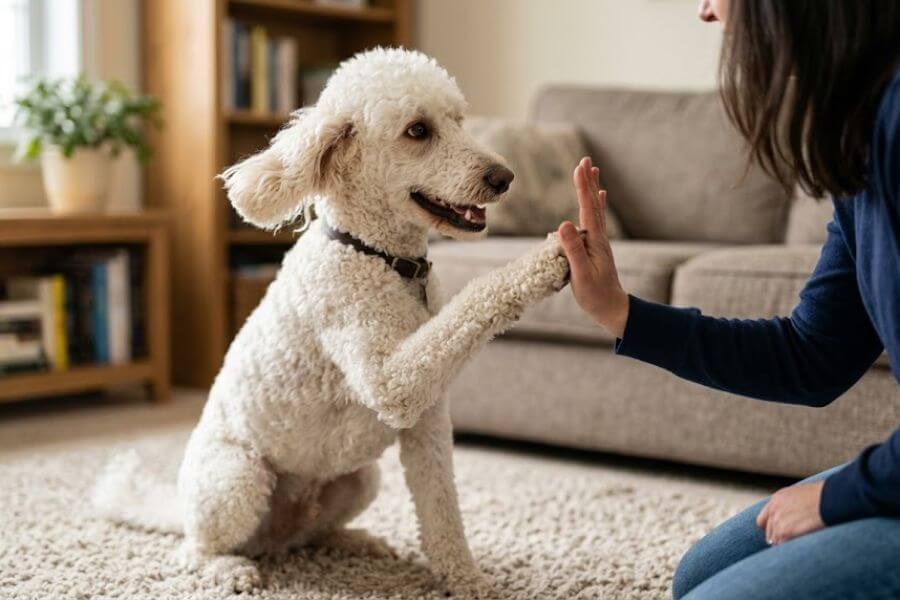
Nothing says “we are best friends” quite like a crisp, enthusiastic high five. This trick is a wonderful crowd-pleaser and is naturally suited for poodles because they love using their paws to interact with the world around them.
Step One: The Secret Palm
Sit flat on the floor directly facing your poodle. Take a smelly treat and close your fist tightly around it. Hold your closed fist out toward your dog, right about at their chest level, and just wait quietly.
Step Two: Waiting for the Paw
Your poodle will try a few things to get the treat. They might sniff your hand, lick your knuckles, or nudge you with their nose. Ignore all of these actions. Stay completely still and keep your mouth shut. Eventually, your poodle will get a bit impatient and try to scrape your hand open with their paw.
Step Three: Catching the Moment
The millisecond their paw touches your closed fist, shout your marker word and open your hand to let them have the prize. Praise them wildly!
Step Four: Shifting to an Open Palm
Repeat the closed fist exercise a few times until your dog instantly slaps your hand with their paw the moment you present it. Now, change your hand shape. Present your hand flat open, with your palm facing the dog, holding the treat hidden behind your thumb.
Step Five: Naming the High Five
As your poodle raises their paw to hit your open palm, say your chosen phrase clearly, such as “High five!” or “Give me five!” Mark the exact contact point, then hand over the snack.
Step Six: Perfecting the Height
Gradually raise your hand a few inches over several repetitions so your poodle has to reach upward to meet your palm. Make sure you do not raise it so high that they have to jump up on two legs completely, as we want them to stay comfortably seated for this specific move.
Trick Three: Weaving Through Your Legs
This is a spectacular trick that looks like a complex agility routine, but it is actually a wonderful game of follow-the-leader. Your poodle will zig-zag through your legs as you take slow, dramatic steps forward. It looks incredibly professional and is perfect for showing off in the backyard.
Step One: The Long Stride
Stand up straight with your feet pressed together. Take one giant, exaggerated step forward with your right leg, creating a large, open triangular window between your thighs.
Step Two: Leading Through the Window
Hold a treat in your right hand. Reach your right hand through the open space from behind your leg, bringing it toward the front where your poodle can see it. Guide your poodle’s nose with the treat so they walk completely through the space between your legs from the back to the front.
Step Three: The First Mark
As soon as their tail clears your legs and they are fully on the other side, mark the moment and give them the treat.
Step Four: Resetting the Trap
Now, take a giant step forward with your left leg. Take a new treat in your left hand, reach through the space from behind, and lure your poodle through this new window from the opposite side. Mark and reward as they finish the step.
Step Five: Stitching It Together
Now comes the magic part. Instead of rewarding after one single pass, try luring them through your right leg, then immediately take a step forward with your left leg and lure them through that side before you use your marker word. You are now linking two steps together for one single treat.
Step Six: Standing Tall
Slowly start to stand up straighter as you guide them. You can use the word “Weave!” as they pass through each opening. Eventually, your poodle will see you take a long step forward and will automatically dive through the open space without needing a treat in your hand to pull them through.
Trick Four: The Polite Bow
When an actor finishes a wonderful play, they take a deep bow to the audience. Your poodle can do the exact same thing! In the dog world, this is often called a play bow, where the front elbows rest flat on the floor while the hips stay high up in the air. It is an adorable posture that stretches their shoulders and looks incredibly polite.
Step One: Starting from a Stand
Have your poodle stand up squarely on all four paws. If they keep trying to sit down, place your spare hand gently under their tummy to remind them to keep their hind legs standing tall.
Step Two: The Downward Slide
Hold a treat at the tip of your dog’s nose. Slowly and smoothly move your hand straight down toward the floor, moving slightly back toward your dog’s chest, right between their front paws. Think of drawing an imaginary line from their nose down to their toes.
Step Three: Keeping the Hips High
As your poodle follows your hand down, their front elbows will drop toward the floor. Watch their back legs carefully! If you notice their hips starting to drop into a full sit or a down position, gently block them or lift your hand up slightly to reset. You want the front half down and the back half up.
Step Four: The Instant Mark
The moment your poodle’s front elbows touch the carpet while their rear end is still pointing straight up in the air, hit your marker word. Give them the treat immediately before they have a chance to change their position.
Step Five: Building Endurance
At first, your dog will only hold the bow for a split second. To help them hold it longer, feed them multiple tiny treats one after the other while they stay in the bowing position. Say “Yes, yes, yes,” giving a tiny treat each time they hold the posture. This teaches them that staying down is what keeps the treat train moving.
Step Six: Naming the Bow
Add your verbal cue, like “Bow!” or “Take a bow!” right as you begin your downward hand motion. With enough practice, you can just lean your upper body forward slightly and say the word, and your poodle will drop into a beautiful, theatrical bow.
Trick Five: The Peek-a-Boo
This is one of the most heartwarming tricks you can possibly teach. In this move, your poodle runs up from behind you and pokes their head right through your knees, looking up at you from between your legs. It is a fantastic trick for photos and makes everyone smile instantly.
Step One: Straddling the Space
Stand with your legs wide apart, enough room for your poodle to fit comfortably beneath you. Have a friend hold your dog behind you, or throw a treat a few feet away so your dog runs out to get it and turns around to face your back.
Step Two: The Under-Leg View
Reach both of your hands backward between your own legs. Hold a highly fragrant treat in your fingers so your dog can see it from across the room. Call your poodle’s name in an excited voice.
Step Three: Navigating the Tunnel
Your poodle will run up behind you and see your hands under your legs. Guide them forward until their chest and head are sitting comfortably right between your knees. Their body will be tucked behind you, and their sweet face will be popping out the front.
Step Four: Marking the Window
The second their face pops through and they look up at you, mark the moment with your word and hand over the reward.
Step Five: The Direct Entrance
Now, practice having your dog start from the front. Teach them to loop around your side to get behind you first, then pop through your legs. You can guide them in a small circle with your hand to show them the path.
Step Six: Attaching the Cue
Once they understand the destination, name it “Peek-a-boo!” or “Center!” Practice standing completely still without reaching your hands back, using just your voice. It is an amazing feeling to say the phrase and have your fluffy friend instantly park themselves right between your feet.
Trick Six: Crawling Across the Room
The army crawl is an impressive trick that showcases your poodle’s physical control and flexibility. In this move, your dog keeps their belly flat against the carpet and shimmies forward using their paws.
Step One: The Deep Base
Start with your poodle in a calm, flat down position. They should be relaxed with their belly touching the floor.
Step Two: The Low Drag
Hold a treat right at your dog’s nose level, but keep your hand pressed flat against the floor. Slowly pull your hand forward along the carpet, moving it just a few inches away from their face.
Step Three: Managing the Pop-Up
Your poodle will want to stand up to walk forward. If they pop their knees up, immediately hide the treat in your hand and reset them into a down position. You want to reward the sliding motion, not the standing motion.
Step Four: Rewarding the Inchworm
If your poodle pulls themselves forward even an inch or two while keeping their belly down, mark it instantly and reward them. It takes a lot of core strength for a dog to crawl, so celebrate even the tiniest forward slide at the beginning.
Step Five: Increasing the Distance
Slowly increase the distance your hand moves. Go from two inches to four inches, then to a whole foot. Keep your hand completely flat against the floor the entire time so your dog is not tempted to reach upward.
Step Six: Adding the Command
Name the trick by saying “Crawl!” as they shimmy across the rug. This trick takes a bit of time to master because it requires physical effort, so keep the sessions short and sweet.
Trick Seven: Cleaning Up the Toys
Are you tired of tripping over your poodle’s stuffed animals and chew toys every evening? This trick is the ultimate win-win scenario. You get to teach your poodle a highly complex sequence that ends with them actually cleaning up their own mess and putting their toys back into a storage basket!
Step One: The Solid Fetch
To build this trick, your poodle needs to know how to pick up an object and bring it to you. Grab one of their favorite soft toys, toss it a few feet away, and say “Fetch!” When they pick it up and head back toward you, mark them and swap the toy for a treat.
Step Two: Introducing the Target Bucket
Place a wide, low-sided plastic bin or a wicker basket right on the floor between you and your dog. Hold your hand directly over the center of the basket.
Step Three: The Drop Zone
Have your poodle fetch the toy. As they bring it back to your hand, guide your hand so it is positioned right inside the bucket opening. Ask your dog to “Drop it.” When they let go of the toy, it will fall directly into the basket. Mark the drop instantly and give them an amazing treat from your pocket.
Step Four: Fading Your Hand Support
Repeat this process, but gradually move your hand away from the basket. Now, your poodle has to bring the toy back and drop it over the open bin on their own, without your hand guiding them over the target. If they miss and the toy lands on the floor, pick it up, put it back in their mouth, and try again.
Step Five: Naming the Cleaning Routine
As the toy drops cleanly into the basket, say the phrase “Clean up!” or “Put it away!”
Step Six: The Multi-Toy Challenge
Once your poodle understands that the goal is to get the toy into the box, scatter three or four toys across the room. Point to a toy, say “Clean up,” and watch your clever dog go grab it, march over to the basket, and drop it inside. Repeat for the next toy until the floor is totally spotless. You will absolutely love showing off this practical trick to your family.
Trick Eight: The Shy Dog Paw Cross
This is a quiet, incredibly sweet trick where your poodle hides their face behind one of their paws, looking like they are feeling a little bit shy or playing a game of hide-and-seek. It is highly photogenic and very satisfying to teach.
Step One: Creating a Gentle Sensation
To get your dog to lift their paw over their nose naturally, we need to create a tiny, harmless tickling sensation on their muzzle. You can use a small piece of gentle painter’s tape or a tiny sticky note. Cut a tiny square, about the size of a postage stamp.
Step Two: Placing the Target
Gently press the little piece of tape right on the side of your poodle’s nose, just above their lip line. Do not press hard; it should just sit lightly on their curls.
Step Three: The Natural Swipe
Your poodle will naturally wonder what is on their face and will raise their paw to wipe the sticky note away. The exact moment their paw lifts up and covers their nose or face to swipe at the tape, shout your marker word and hand over a jackpot of treats.
Step Four: Removing the Tape
Take the tape off after two or three tries. Now, touch that exact spot on their nose with your finger as a physical cue. When they raise their paw to swipe at your touch, mark it and reward it.
Step Five: Attaching the Vocal Cue
Say the word “Shy!” or “Are you shy?” right before they lift their paw.
Step Six: Pure Visual Cue
With consistency, your dog will stop needing the physical touch on their nose. You can simply point your finger at your own face and say “Shy,” and your poodle will beautifully lift their paw to cover their muzzle, looking absolutely adorable.
Troubleshooting Common Weekend Training Hurdles
Even the most brilliant poodles hit roadblocks from time to time. Training is not a straight line; it is a series of small hops forward and occasional steps backward. If you run into a problem this weekend, do not panic! Here is how to handle the most common training bumps in the road.
My Dog Keeps Sitting Down
If you are trying to teach a standing trick like the bow or the spin, and your poodle keeps dropping their bottom onto the carpet, it usually means your hand is moving too low or too fast. When a dog sees a treat drop below their eye level quickly, their natural instinct is to sit down to get closer to it. Try keeping your hand exactly level with their nose, or use your spare hand under their belly to provide a gentle physical reminder to stay standing.
My Dog Is Biting at My Hand
If your poodle is nipping at your fingers, jumping up on you, or barking excitedly, they are likely experiencing frustration or over-arousal. The treats might be a little bit too exciting, or you might be moving through the steps too quickly for them to understand.
- Take a deep breath and ignore the wild behavior.
- Switch to a lower-value treat, like regular kibble or a less crunchy biscuit.
- Break the trick down into even smaller steps so they do not feel confused.
My Dog Loses Interest and Walks Away
If your poodle sniffs your hand, sighs, and walks over to lie down on the couch, your training session has gone on just a bit too long. Poodles have fantastic brains, but young dogs especially have short attention spans.
- Keep your training sessions under five minutes long.
- End the game while your dog is still begging for more.
- Make sure you are using high-quality rewards that are worth working for.
Making the Tricks Stick for Good
Once the weekend comes to an end, you want to make sure your poodle remembers everything you built together. Professional trainers have a few smart strategies to ensure these fun behaviors become a permanent part of your dog’s routine.
The Power of Random Practice
You do not need to set aside an hour of formal training every day to keep these skills sharp. Instead, scatter your practice throughout your normal day.
- Ask for a “High five” before you put their dinner bowl down on the kitchen floor.
- Have them do a “Spin” right before you clip their leash on for a walk.
- Practice a quick “Bow” when you wake up in the morning.
Integrating these quick prompts into real life keeps your dog’s mind sharp and teaches them that listening to you is important all day long, not just when the treat bag is out.
Shifting Away from Food Rewards
Once your poodle knows a trick perfectly, you do not want to carry a pocket full of cheese cubes for the rest of your life. Start turning the treats into a lottery system. Sometimes they get a piece of chicken, sometimes they get a scratch behind the ears, and sometimes they get a hearty “Good job!”
Dogs love the suspense of a lottery. If they never know exactly when the jackpot treat is coming, they will perform the trick even faster and with more enthusiasm every single time.
Introducing New Environments
A trick learned in your quiet living room can completely vanish when you step outside into the big world. To help your poodle generalize their skills, start practicing in different locations once they have mastered the indoor steps. Try doing a spin in your grassy backyard. Practice a high five on the sidewalk during a calm walk. Show off a peek-a-boo at a quiet park. Each new location builds their confidence and teaches them to focus on you no matter what distractions are swirling around them.
Frequently Asked Questions
Is my poodle puppy too young to learn these tricks?
Your puppy can absolutely start learning these skills right now! Poodle puppies are like little sponges, ready to soak up information from the moment they come home. The key with young puppies is to keep the sessions incredibly short, about one to two minutes at a time, and protect their growing bodies. Avoid tricks that require heavy jumping or tight, fast twisting until their joints are fully grown, usually around one year of age. Stick to simple, low-impact moves like the high five, the peek-a-boo, and the polite bow. Always use plenty of encouragement and make sure the experience feels like an exciting playtime game.
What should I do if my poodle gets frustrated during a session?
If you notice your poodle shaking their head, whining, walking away, or ignoring your cues, it means they are feeling overwhelmed. This happens when the steps are moving just a bit too fast for them to process. The best thing to do is stop the current exercise immediately. Never scold or show annoyance to your dog. Instead, ask them to do a super simple skill they already know perfectly, like a basic sit. Mark that success, give them a treat, and end the training session on a happy note. Take a break for a few hours, and when you try again, break the trick down into much smaller milestones so your dog can build up their confidence step by step.
Can older poodles learn these weekend tricks too?
There is an old saying that you cannot teach an old dog new tricks, but that is completely false, especially when it comes to poodles! Senior poodles absolutely love having a job to do, and keeping their brains active is one of the best ways to keep them feeling youthful and sharp. Learning new skills can even help prevent mental decline in aging dogs. Just be mindful of your senior dog’s physical limitations. If your older poodle has stiff hips or sore joints, skip the army crawl or the tight leg weaving. Instead, focus on low-effort, high-reward mental games like the high five, target touch, or sorting out their toy box.
How many tricks should I try to teach over one single weekend?
It is best to focus on just one or two tricks over the course of a single weekend. Even though your poodle is incredibly smart, trying to learn three or four brand-new behaviors at the exact same time can confuse their memory. Pick one active trick, like the elegant spin, and perhaps one calmer trick, like the polite bow. Spend your weekend alternating between short practice sessions for these two specific goals. Once your dog can perform them smoothly on a verbal cue, you can move on to a brand-new challenge the following weekend. Quality is always much better than quantity when it comes to dog training.
What is the difference between a hand lure and a hand signal?
A hand lure is a piece of food held right in your fingers that acts like a magnet to physically guide your dog’s nose into a specific position. It is used at the very beginning of the learning process to show your dog what movement you are looking for. A hand signal is a clear gesture you make with an empty hand from a distance, which serves as a visual command for the dog to perform the move on their own. The goal is always to move away from the hand lure as quickly as possible so your dog learns to think independently and respond to your visual or verbal signals without needing a snack right in front of their face.
Why does my poodle only do the trick when I am holding a treat?
If your poodle only listens when they see a snack in your palm, you have accidentally bribed them instead of training them! This happens when the food reward stays in your hand for too long during the initial phase. To fix this common issue, you need to hide the treats completely. Keep your food rewards in a pouch behind your back, in a deep pocket, or sitting on a high shelf nearby. Use an empty hand to guide your dog through the motion, use your marker word the instant they do it correctly, and then reach away into your hidden stash to pull out the reward. This teaches your poodle that the treat comes after the good behavior, not before it.