You walk into the living room, sit down with a warm drink, and finally find a moment to relax. Then, the doorbell rings. In a split second, your peaceful home transforms into a concert of sharp, piercing yaps. Your tiny Chihuahua is on the front lines, chest puffed out, barking at the door as if a fire-breathing dragon is on the other side. When you open the door to welcome your friend, your dog goes into overdrive.
If this sounds familiar, you are definitely not alone. Chihuahuas are famous for their massive personalities packed into pint-sized bodies. They have a reputation for being fierce protectors, but when that protection turns into nonstop barking at every single stranger, it can become incredibly exhausting.
The good news is that you can absolutely teach your small furry friend to stay calm around new people. It does not require magic, and it does not require yelling. It takes patience, a good plan, and plenty of delicious treats. This detailed guide will show you exactly how to transform your vocal little protector into a calm, polite host.
Why Your Tiny Friend Barks So Much
Before you can change a behavior, you have to understand why it is happening in the first place. Your Chihuahua is not barking just to make your ears ring or to annoy your neighbors. Barking is a form of communication, and for a dog that weighs less than a gallon of milk, the world can feel like a pretty intense place.
The Fear Factor and the Big World
Imagine looking up at everything and everyone around you. To a Chihuahua, an average adult human looks like a towering giant. When a stranger approaches, your dog might feel incredibly small and trapped. Barking is their way of saying, “Hey, I see you, and you are way too big! Please do not step on me!” This is called fear-barking, and it is the most common reason small dogs make a fuss. They think that if they make enough noise, the scary giant will leave them alone.
Guarding the Castle
Chihuahuas are fiercely loyal. They love their human family members with every ounce of their being. Because they love you so much, they often feel it is their job to protect you and your home. When a stranger enters your yard or walks through your front door, your dog sees them as an intruder. The loud barking is an alarm system designed to warn you and scare away the visitor.
Accidental Rewards
Sometimes, we accidentally teach our dogs to bark. Think about what happens when your Chihuahua barks at a delivery person. The worker drops off a package and then walks away. In your dog’s mind, their barking successfully chased the stranger away! They think, “Wow, my magic noise worked again!” Every time a stranger leaves after your dog barks, the behavior gets stronger. Even if you yell at your dog to be quiet, they might think you are simply barking along with them. To a dog, any attention can feel like a reward.
Setting Up for Success Before Training Starts
You cannot expect your dog to learn in the middle of a chaotic situation. If your friend is already at the door, your Chihuahua is too excited to listen to you. You need to prepare your training environment and your mindset before you take the first real step.
High-Value Rewards are Key
To change how your dog feels about strangers, you need something more exciting than the stranger. Standard dry kibble probably will not work for this. You need high-value treats. These are small, soft, smelly treats that your dog rarely gets to enjoy. Tiny pieces of cooked chicken, small cubes of cheese, or specialized soft training treats work wonders. Because Chihuahuas are so small, make sure these treats are no bigger than a single grain of rice. You do not want your pup getting a tummy ache or gaining weight during training.
Create a Safe Zone
Your dog needs a place where they feel completely secure. This could be a cozy crate, a soft dog bed in the corner of the room, or a specific rug. This space should be their sanctuary. Fill it with their favorite toys and a comfortable blanket. During training, you will teach your dog to go to this spot when someone arrives, which gives them a safe alternative to running to the front door.
Keep Yourself Calm
Dogs are masters at reading human body language and emotions. If you get tense, nervous, or angry when the doorbell rings, your Chihuahua will pick up on that negative energy. They will think, “Oh no, my human is scared too! I definitely need to bark!” Take a deep breath, relax your shoulders, and keep your voice soft and gentle. Your calmness will help your dog feel secure.
The Step-by-Step Training Plan
Now that you are prepared, it is time to dive into the core training methods. We will use a technique called desensitization and counter-conditioning. This is just a fancy way of saying we will slowly get your dog used to strangers while teaching them that strangers bring awesome things.
Step One: Managing the Environment
While you are training, you want to prevent your dog from practicing the bad habit. If you are not actively training, block your dog’s view of the front window. You can use window film or close the blinds. If you know a visitor is coming and you do not have time to train, place your Chihuahua in a quiet back room with a fun puzzle toy filled with peanut butter. Preventing the barking loops from happening makes the actual training sessions much more effective.
Step Two: The Look at That Game
Start this step when your home is quiet. You will need a helper, like a family member or a friend your dog does not know very well. Have your helper stand far away from your dog, perhaps across the yard or at the far end of a long hallway.
Look at your dog. The moment your Chihuahua notices the helper but before they have a chance to bark, make a clicking sound with your mouth or say a specific word like “Yes!” Then, immediately give your dog a high-value treat. Repeat this several times. Your dog will start to realize: “When I look at that human, my owner gives me chicken!”
Step Three: Moving Closer Slowly
If your dog can look at the helper without barking, you can decrease the distance. Have your helper take one single step forward. If your dog stays quiet, say “Yes!” and hand over a treat. If your dog starts to bark, it means the helper is too close. Move the helper back and try again from a further distance. Never rush this process. It might take days or even weeks to move a few feet closer, and that is perfectly okay.
Step Four: Teaching the Go to Place Command
Instead of having your dog run to the door to bark, give them a specific job to do. Point to their safe zone bed and say “Go to bed.” When they walk over and step onto the bed, give them a treat and praise them enthusiastically.
Practice this multiple times a day without any strangers around. You want your dog to love their bed so much that they rush over to it the moment they hear the command. Once they understand the trick, you can start practicing it when someone knocks gently on a wall or rings the doorbell.
Common Training Mistakes to Avoid
Even the most dedicated pet owners can make mistakes that accidentally slow down progress. By knowing what to avoid, you can keep your training sessions positive and highly effective.
Never Yell at Your Dog
When your Chihuahua is barking at the top of their lungs, it is natural to want to yell “Quiet!” or “Stop it!” However, this usually backfires. Your dog does not understand your words when they are panicked. They just hear loud noises coming from you, which makes them think you are joining in on the alarm system. Yelling can also increase their fear, making them view strangers as even more of a negative threat.
Avoid Punishing Tools
Never use spray bottles, shock collars, or loud noise makers to scare your dog into silence. These tools might stop the barking for a brief second, but they do it by using fear and pain. If your dog gets sprayed with water every time a stranger appears, they will quickly connect the stranger with the unpleasant spray. This will make them hate and fear strangers even more, which actually worsens the root problem.
Do Not Push Too Fast
Training is a marathon, not a short sprint. If your dog is doing great with a helper standing ten feet away, do not immediately ask the helper to hug your dog. Pushing your dog past their comfort zone will cause them to fail. Always move at your dog’s individual pace, and be ready to take a step backward if they have a difficult day.
How to Handle Walkies and Public Spaces
Barking at strangers inside the house is one thing, but barking at random people during outdoor walks is a whole different challenge. The outdoors are full of unpredictable triggers like bicycles, skateboards, tall hats, and moving strollers.
Use a Front-Clip Harness
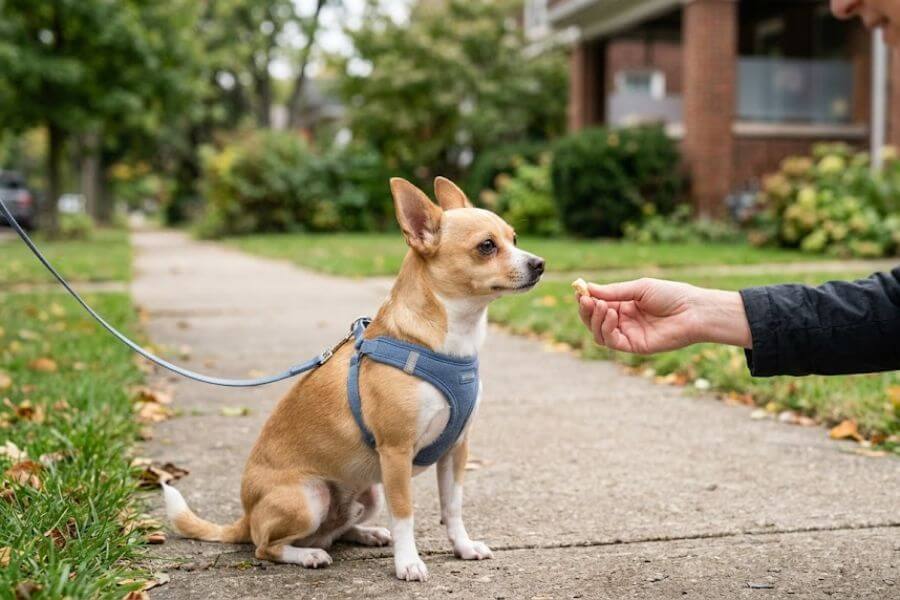
A good harness gives you excellent control over your small dog without putting dangerous pressure on their delicate neck and throat. A front-clip harness helps you gently redirect your dog’s attention back to you when they start to get too focused on a passer-by.
Create Distance on the Sidewalk
When you see a stranger walking toward you on the sidewalk, do not force your Chihuahua to walk right past them. Cross the street, step onto a driveway, or move onto the grass. By creating a wide buffer zone, you keep your dog below their threshold, which is the point where they lose control and start barking. Once you have created space, use the “Look at That” game to reward your dog for watching the person walk past calmly.
Be Your Dog’s Protector
If a stranger approaches and asks to pet your dog, it is entirely okay to say no! You are your dog’s voice. If your Chihuahua is tense, trembling, or growling, politely tell the person, “We are in training right now, so he needs some space.” Protecting your dog from forced interactions builds immense trust between you two. Your dog will realize they do not need to bark to defend themselves because you will handle the situation for them.
Long-Term Consistency and Success
To ensure your Chihuahua maintains their excellent new habits, you must stick with the program. Training is not a one-time event; it is an ongoing lifestyle shift that builds a deeper bond between you and your pet.
Daily Practice Makes Perfect
Short, frequent training sessions are infinitely better than one long session. Spend just five minutes a day practicing door manners or focus games. This keeps the training fun and fresh for your dog’s short attention span, and prevents them from getting bored or tired.
Get Everyone on the Same Page
Consistency is absolutely vital for canine learning. If you are working hard to reward quiet behavior, but your sibling or parent allows your Chihuahua to stand at the window and bark all afternoon, your dog will get incredibly confused. Sit down with everyone in your household and explain the training plan. Make sure every person uses the exact same commands, rewards, and rules.
Celebrate the Small Wins
Do not get discouraged if your dog has a setback. Progress is rarely a perfectly straight line. If your dog barks three times instead of ten times when the mail carrier arrives, celebrate that small victory! It means your hard work is starting to pay off. Keep track of these little successes to remind yourself of how far you both have traveled together.
Frequently Asked Questions
Why does my Chihuahua only bark at certain strangers?
Dogs are highly observant creatures. Your Chihuahua might be completely fine with most people but go wild when they see someone wearing a big winter coat, a shiny helmet, or dark sunglasses. They might also react to specific walking patterns or deep voices. This usually happens because the dog was not exposed to those specific visual features when they were a puppy. Treat these specific triggers just like any other stranger, and use extra distance and extra tasty treats to help your dog get used to them.
How long does it take to train a Chihuahua to stop barking?
There is no single magic number of days because every single dog is completely unique. Some Chihuahuas might show vast improvement within a few weeks, while others might need months of steady training to feel truly comfortable around new people. The timeline depends heavily on how long your dog has practiced the barking habit, how fearful they are, and how consistent you are with the daily training sessions. Patience and daily effort are your best tools.
Should I comfort my Chihuahua when they are barking out of fear?
Yes, you can absolutely comfort your scared dog. There is a common myth that comforting a fearful dog will reward the fear and make it worse. However, fear is a deep emotion, not a voluntary behavior. You cannot reward an emotion with comfort. Think about it this way: if you were terrified of spiders, and someone gave you a hug, you would not become more afraid of spiders. You would feel safer. Speaking in a soothing voice or gently holding your dog can help lower their stress levels so they can calm down faster.
Can an older Chihuahua learn to stop barking at strangers?
Absolutely! The old saying that you cannot teach an old dog new tricks is completely false. Older dogs are fully capable of learning new behaviors and changing how they feel about things. In fact, older Chihuahuas often have longer attention spans than energetic puppies, which can make training sessions go quite smoothly. You just need to be extra patient, ensure they are physically comfortable, and use their absolute favorite treats to keep them motivated.
Why does my dog bark even when the stranger is friendly and offers a treat?
When a stranger holds out a treat, it creates a major conflict inside your dog’s brain. Your Chihuahua really wants the delicious food, but they are still terrified of the large human holding it. They might stretch their body forward to grab the treat and then suddenly realize how close they are to the scary person. This causes a sudden burst of fear, which triggers defensive barking. Instead of having the stranger feed your dog directly, have the stranger toss the treats behind your dog. This allows your pup to move away from the stranger to get the reward, which takes away the pressure and builds real confidence.