Welcome to the ultimate guide on training your very own psychiatric service dog. If you are reading this, you are likely looking for a way to find comfort, safety, and independence. Navigating life with a mental health condition can feel like walking through a heavy fog. The good news is that a dedicated four-legged partner can be the lighthouse that guides you back to shore.
Having a dog that knows exactly how to help when your anxiety spikes or when a flashback hits is life-changing. Training your own service dog is a huge commitment, but it is also one of the most rewarding tasks you will ever take on. This guide will walk you through the whole process from start to finish. We will cover choosing the right dog, teaching basic manners, mastering specific tasks, and understanding the rules of public spaces. Let us dive in.
Understanding the Role of a Psychiatric Service Dog
Before you buy a leash or fill a treat pouch, it is important to know exactly what a psychiatric service dog does. These animals are much more than highly loved pets. They are specially trained working animals that perform specific jobs to help a person with a disability.
Service Dogs Versus Emotional Support Animals
It is very common for people to confuse psychiatric service dogs with emotional support animals. An emotional support animal helps its owner simply by existing. Their presence offers comfort, warmth, and companionship. This is wonderful, but it does not make them a service dog.
A psychiatric service dog must take action to mitigate a disability. This means when a specific trigger happens, the dog performs a trained behavior to make that moment easier or safer for you. Because of this intensive training, service dogs have special legal rights to enter public places like stores, restaurants, and airplanes. Emotional support animals do not have these same public access rights.
The Types of Conditions They Help With
Psychiatric service dogs support individuals facing a wide variety of mental health struggles. These include post-traumatic stress disorder, severe depression, panic disorder, agoraphobia, and obsessive-compulsive disorder.
For someone with post-traumatic stress disorder, a dog might wake them from a nightmare or check a dark room before they enter. For someone with severe panic attacks, a dog can detect the physical signs of an upcoming attack and apply deep pressure therapy to calm their nervous system. The tasks are always customized to what the handler needs most.
The Legal Rights of Owner-Trainers
In the United States, under the Americans with Disabilities Act, you have the right to train your own service dog. You do not need to pay thousands of dollars to a professional organization if you have the time and patience to do it yourself.
While your dog is in training, state laws decide whether your pup can go into public stores with you. Many states protect service dogs in training, while others only protect fully trained dogs. It is important to look up the specific rules for your local area before taking your young pup into a grocery store or a movie theater.
Selecting the Right Canine Partner
The foundation of a great service dog starts with picking the right puppy or adult dog. Not every dog has the personality or the physical health required for this demanding job. In fact, many dogs cut from professional training programs are wonderful pets but simply prefer a more relaxed lifestyle.
The Best Breeds for Psychiatric Work
While any breed can technically become a service dog, certain breeds succeed much more often than others. Trainers often refer to the top choices as the golden trio. This group includes Golden Retrievers, Labrador Retrievers, and Poodles.
These breeds are highly popular for good reason. They are eager to please, love working with humans, and possess a calm temperament. They are also large enough to perform physical tasks like deep pressure therapy but gentle enough to handle crowded public spaces without becoming defensive.
Smaller breeds, like Papillons or Cavalier King Charles Spaniels, can also make excellent psychiatric service dogs if you do not need physical tasks like balancing or heavy pressure. They are easy to travel with and can easily ride in a chest carrier to stay close to your face for anxiety detection.
Assessing Temperament and Personality
When looking at a litter of puppies or visiting a rescue shelter, you want to avoid the two extremes. Do not pick the puppy that is bursting with energy, barking at everything, and biting your shoes. At the same time, avoid the puppy that is hiding in the corner, shaking, or showing extreme fear.
You are looking for the middle-of-the-road dog. You want a pup that is curious, approaches you with a wagging tail, recovers quickly from loud noises, and does not mind being handled. A good test is to drop a set of keys on the floor near the dog. A great service candidate might startle for a second, but then they will walk over to sniff the keys to see what happened.
Health Screenings and Physical Checkups
A service dog needs to be in tip-top shape to do its job. Before committing to a dog, ensure a trusted veterinarian examines them thoroughly. For larger breeds, it is vital to get X-rays of their hips and elbows to ensure they will not develop painful joint problems later in life.
You should also check their eyesight, hearing, and heart health. Training a service dog takes one to two years of hard work. The last thing you want is to retire your dog early because of a hidden medical condition that causes them pain when they walk or stand for long periods.
Setting Up Your Training Environment
Success starts long before you give your first command. You need to prepare your home and your schedule so that both you and your dog can focus without getting frustrated.
Essential Tools and Gear
You do not need fancy gadgets to train a dog, but a few basic items will make your life much easier. First, get a high-quality clicker. This small plastic box makes a distinct sound that tells your dog the exact moment they did something right.
Next, invest in a comfortable, flat collar and a standard six-foot leash. Avoid retractable leashes, as they teach dogs to pull and offer very little control in public. You will also want a treat pouch that clips to your waist. This keeps your rewards handy so you can deliver them within one second of your dog doing a good behavior.
Creating a Distraction-Free Zone
When teaching a brand-new behavior, start in the quietest room of your house. Turn off the television, close the windows, and ask other family members to step out for a few minutes.
If there is too much going on around your dog, their brain will overload. They will struggle to figure out what you are asking them to do. Once they master a skill in your quiet living room, you can slowly move to the backyard, then to a quiet sidewalk, and eventually to a busy park.
Managing Your Own Energy and Emotions
Dogs are incredibly sensitive to human emotions. This is especially true for psychiatric service dogs, who are naturally tuned into your body language and heart rate. If you are having a high-stress day, feeling angry, or running out of patience, do not train your dog.
If you try to train while upset, your dog will associate the training sessions with negative feelings. Keep your sessions short, fun, and upbeat. Five minutes of happy, focused training is worth much more than an hour of frustrating repetition. Always end on a positive note with a big jackpot of tasty treats.
Step-by-Step Basic Obedience
Before your dog can learn to help with anxiety or panic attacks, they must become an expert in basic good manners. This foundation ensures your dog is safe around other people and fully focused on you.
Mastering the Focus Command
The focus command, often called the look or watch-me cue, is the most important tool in your kit. It tells your dog to stop looking at the world and lock eyes with you. This is how you prevent your dog from getting distracted by a dropped piece of food or a passing cat.
To teach this, hold a delicious treat between your thumb and pointer finger. Bring the treat right up to your nose. The moment your dog looks at your eyes, make your clicker sound or say a word like yes, and give them the treat. Repeat this until your dog automatically stares at your face whenever you say watch-me.
Teaching a Rock-Solid Sit and Down
Sit and down are the building blocks for more advanced positions. To teach a sit, hold a treat in front of your dog’s nose and slowly move it up and back over their head. Their nose will follow the treat up, and their bottom will naturally hit the floor. The moment it touches, reward them.
For the down command, start with your dog in a sitting position. Lower the treat straight down to the floor between their front paws, then slowly pull it forward along the ground. Your dog should slide into a lying position to follow the scent. Reward them immediately when their chest touches the floor.
Developing a Reliable Stay
A service dog must be able to stay in place, even if you walk away to pick up an item from a store shelf. Start by asking your dog to sit. Say stay, take one tiny step backward, and then immediately step back to them and give a treat.
Slowly increase the difficulty. Move from one step to three steps, then five steps. Next, practice turning your back or walking around a corner out of sight. If your dog gets up before you say they are finished, it means you moved away too fast. Go back to an easier distance and try again.
Loose-Leash Walking and the Heel Position
A service dog should never pull you down the street. They need to walk politely right by your side, a position known as heel. Your dog’s shoulder should align perfectly with your hip.
To train this, walk forward with treats held next to your hip. Every few steps that your dog walks nicely beside you without pulling, give them a treat. If the leash goes tight, stop walking immediately. Become a statue. Wait for your dog to turn around and look at you, stepping back to your side before you start moving again. This teaches them that pulling makes the fun stop, while a loose leash keeps the walk going.
Advanced Public Access Training
Public access training is what separates a regular pet from a true service dog. Your dog must behave flawlessly in places where animals are usually not allowed.
Socialization to Diverse Environments
Socialization does not mean letting your dog play with every person and animal they see. Instead, it means teaching your dog to be calm and neutral around new sights, sounds, and textures.
Take your dog to places like bus stations, construction sites, and shopping mall parking lots. Let them look at people wearing giant hats, carrying umbrellas, using wheelchairs, or riding skateboards. Feed your dog high-value treats while they watch these strange things from a safe distance. You want your pup to think new things are completely boring and always lead to delicious food.
The Art of the Under-the-Seat Down Stay
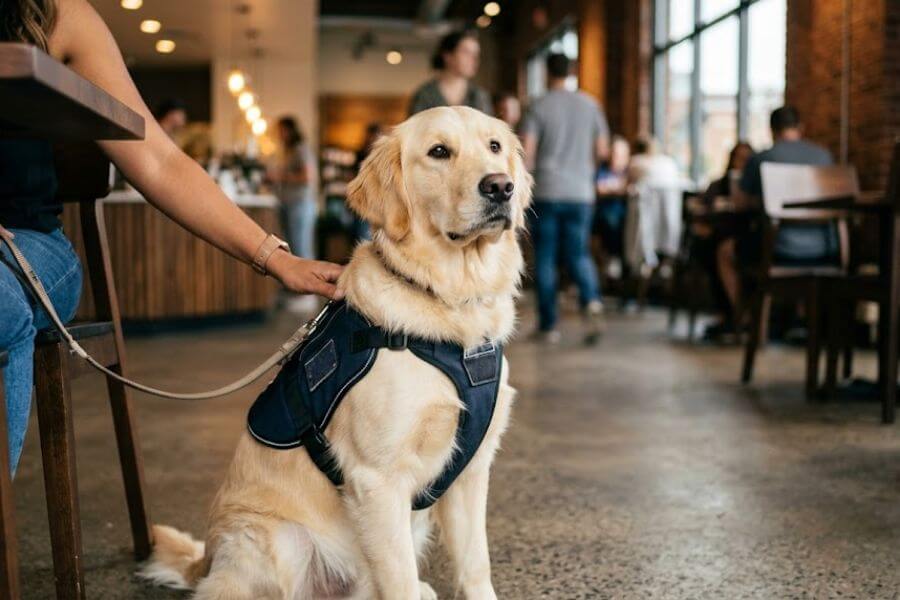
When you go out to eat or ride on a bus, your dog cannot block the aisle. They need to tuck their body away tightly so people can walk past without tripping over them.
You can practice this at home using a kitchen table or a small bench. Guide your dog under the furniture into a down position. Reward them frequently for staying tucked away in that tight space. Eventually, your dog will see a restaurant booth and automatically slide underneath it to take a peaceful nap while you eat your meal.
Ignoring Temptations and Distractions
The public world is full of interesting things for a dog. There are dropped french fries on the floor, friendly children who want to pet them, and other dogs barking from a distance. A service dog must ignore all of this.
Use the leave-it command to teach this skill. Place a low-value piece of food on the floor and cover it with your hand. When your dog stops sniffing your hand and looks away, give them a much better treat from your pouch. Slowly build up to walking past dropped food in public without your dog lowering their head to grab it.
Handling Unfriendly Interventions
Unfortunately, not everyone understands the rules of service dogs. People will try to pet your dog without asking, make weird noises to get their attention, or even bring aggressive pets near them.
Your dog needs to look to you for guidance when this happens. If someone approaches to pet your dog without permission, body-block them by stepping between your dog and the stranger. Politely but firmly say, please do not pet him, he is working. Keep your focus on your dog and reward them for remaining calm during the interaction.
Psychiatric Tasks and Mitigating Behaviors
This is the heart of psychiatric service dog training. These specific skills allow your dog to assist with your mental health condition.
Deep Pressure Therapy for Anxiety and Panic
Deep pressure therapy is like using a weighted blanket. The physical weight of the dog on your body calms your central nervous system, lowers your heart rate, and grounds you during a panic attack.
To teach this, sit on the couch or lie down on the floor. Use a treat to lure your dog’s front paws onto your lap or chest. If you have a larger dog, lure their entire body to lay across your legs or torso. Use a cue word like pressure or cover. Reward them generously for staying still and applying their warm weight to your body.
Recognizing and Interrupting Panic Attacks
Dogs have an amazing ability to notice tiny changes in our bodies before we even realize we are anxious. They can smell stress hormones like cortisol or notice physical tics like leg bouncing, hand wringing, or heavy breathing.
To train an interruption, mimic your anxious behavior on purpose. For example, sit in a chair and bounce your leg up and down rapidly. While doing this, lure your dog to push their nose against your bouncing leg or place a paw on your knee. The moment they touch you to stop the movement, stop bouncing your leg and throw a huge treat party. Your dog will quickly learn that when your body starts shaking, their job is to step in and comfort you.
Creating a Buffer Zone in Crowded Places
Many people with psychiatric conditions feel trapped or anxious when strangers get too close to them in lines or crowded stores. You can teach your dog to act as a physical shield.
To create space behind you, teach the block command. Guide your dog to stand horizontally right behind your legs, facing away from you. This creates a two-foot or three-foot buffer zone that forces people in line to stand back. To create space in front of you, teach the watch command, where the dog sits between your feet and stares forward, giving you a clear view of your surroundings.
Tactile Grounding and Reality Orientation
When a flashback or severe dissociation happens, you can lose touch with the present moment. A service dog can bring you back to reality through tactile grounding.
This involves teaching your dog to lick your hands, nudge your arms, or gently scratch at your knee on command. The physical sensation of their rough tongue or soft fur gives your brain a concrete object to focus on, helping you break out of a negative thought loop or a scary memory.
Daily Routines and Maintenance
Training a service dog is not a project that you finish and forget about. It is a lifelong lifestyle that requires consistency, care, and balance.
Structuring a Balanced Day
A service dog cannot work twenty-four hours a day, seven days a week. They are still dogs and need time to just enjoy being a dog.
Create a routine where your dog has clear working times and clear off-duty times. When their vest or special collar comes off, let them run in the yard, play fetch, chew on a bone, and act silly. This mental break prevents burnout and keeps them excited to work when the vest goes back on the next morning.
The Importance of High-Value Rewards
As your dog advances in training, you might think you can stop using treats. This is a common mistake. Imagine if your boss stopped paying you money and just gave you a high five instead. You would probably stop working hard.
Always keep a supply of high-value rewards like freeze-dried liver, small pieces of cheese, or cooked chicken. Use these rewards when your dog performs a task in an extra difficult or scary environment, like a noisy airport or a crowded festival. Keep the payment flowing so your dog stays motivated.
Grooming and Health Maintenance
A service dog represents the entire service dog community when they enter a business. They must always look clean, smell fresh, and be well-groomed.
Brush your dog regular-like to minimize shedding. Keep their nails trimmed short so they do not click loudly on store floors or scratch anyone. Keep their teeth brushed to prevent bad breath when they are working close to your face. Regular vet checkups, flea prevention, and vaccines are mandatory to keep your helper safe from illness.
Navigating Public Spaces and Legalities
Taking your service dog into the world requires confidence and a solid understanding of the rules that protect you.
The Two Legal Questions Business Owners Can Ask
Under federal law in the United States, staff at a store or restaurant are only allowed to ask you two specific questions to verify your service dog.
First, they can ask if the dog is a service animal required because of a disability. Second, they can ask what work or task the dog has been trained to perform. They cannot ask you to describe your disability, they cannot demand to see medical records, and they cannot ask the dog to demonstrate the task on the spot. You do not need any official registration papers, ID cards, or certificates.
When a Business Can Legally Ask You to Leave
While service dogs have massive public access rights, those rights are not absolute. A business owner can legally ask you to remove your dog under two conditions.
The first condition is if the dog is out of control and the handler does not take effective action to fix it. This includes continuous barking, running away from you, or lunging at customers. The second condition is if the dog is not housebroken. If your dog has an accident on a store floor, the manager has every right to ask you to take the dog outside.
Handling Inquiries with Grace and Confidence
You will eventually run into an employee or a manager who does not know the law. They might tell you that pets are not allowed, or demand to see a license that does not exist.
It helps to stay calm, polite, and professional. Carry a small card in your wallet that explains the federal service dog rules. Hand it to the manager with a smile and say, this is a trained psychiatric service dog that helps me with a medical condition, and we are protected by public access laws. Most people will apologize and let you pass once they realize you know your rights.
Troubleshooting Common Training Hurdles
Every handler encounters speed bumps during the training journey. It is completely normal for your dog to experience setbacks or difficult phases.
Overcoming Adolescent Regression
When your puppy hits seven to twelve months of age, their teenage brains kick in. They might suddenly pretend they have never heard the word sit before. They might look directly at you and choose to ignore your commands.
Do not panic, and do not get angry. This is a natural phase of development. When regression happens, take a few steps back in your training. Go back to using easier environments and higher-value treats. Be patient and consistent, and your focused working dog will return in a few months.
Managing Sudden Fear Periods
Dogs go through developmental fear periods where objects that used to be normal suddenly become terrifying. A trash can on the sidewalk or a plastic bag blowing in the wind might cause your dog to bark or back away in fear.
Never force your dog to approach something they are afraid of, as this can cause a permanent phobia. Instead, feed them treats from a safe distance where they feel secure. Let them look at the object at their own pace. As they realize nothing bad happens, their confidence will return, and you can move closer.
Recognizing Signs of Burnout and Stress
Working in public places takes a lot of mental energy from a dog. You must watch your partner closely for signs that they are feeling overwhelmed or tired.
Look for stress signals like heavy panting when it is not hot, yawning out of nowhere, licking their lips repeatedly, keeping their tail tucked tightly, or refusing to take treats. If you see these signs, it is time to wrap up your outing, head home, take off their working vest, and let your dog rest. A well-rested dog is a successful dog.
Frequently Asked Questions
Can any dog breed become a psychiatric service dog?
Yes, any dog breed can technically become a psychiatric service dog if they have the right personality, physical health, and drive to work. However, some breeds find the work much easier than others. Retriever breeds and poodles are highly popular because they naturally love working with humans and handle public stress very well. Smaller breeds can also do excellent work if you do not require heavy physical tasks like deep pressure therapy or physical stability support.
Do I need to register my service dog on a website to make it official?
No, you do not need to register your service dog on any website or database. In the United States, there is no official government registration, certification, or identification card for service dogs. The websites that sell badges, vests, and certificates online are scams and have zero legal value. Your dog is a real service dog because they are trained to perform specific tasks that help you manage your disability, not because of a piece of paper.
How long does it take to fully train a psychiatric service dog?
On average, it takes between one and two years of consistent, daily training to fully prepare a psychiatric service dog. The first year is usually spent mastering basic house manners, perfect public behavior, and advanced focus skills. The second year focuses on teaching the specific psychiatric tasks, like anxiety detection and deep pressure therapy, and practicing those skills in highly distracting public environments.
What should I do if my service dog in training barks at someone in public?
If your dog in training barks in a store, stay calm and act immediately. Step away from the crowd to a quiet corner or walk outside the building to remove the distraction. Give your dog a simple command they know well, like a sit or watch-me, to get their focus back on you. Once they are calm, reward them. Use this moment as a lesson that your dog might not be ready for that specific environment yet, and practice in quieter places before trying again.
Can a psychiatric service dog also be a family pet when they are at home?
Yes, your service dog can absolutely enjoy a normal dog life when they are off duty at home. When you take off their working vest or special collar, you can let them run, play with toys, snuggle with family members, and relax just like a regular pet. It is actually vital for their mental health to have clear boundaries between working time and free time so they do not experience stress or burnout from working too much.