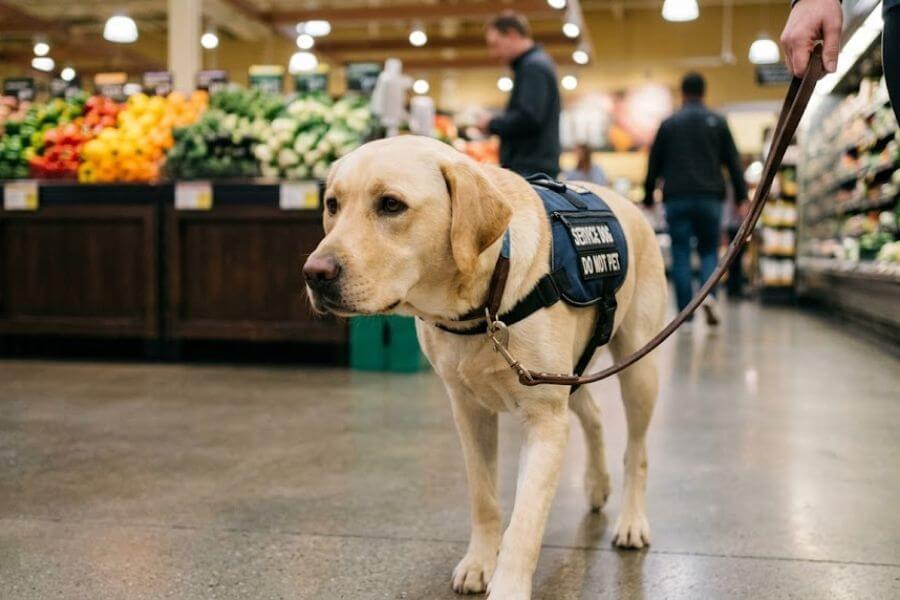
Imagine walking into a bustling grocery store. The lights are bright, shopping carts are clattering, and the smell of fresh bakery bread fills the air. For most people, it is just a regular errand. But for someone with a disability, this environment can feel overwhelming or even dangerous. Now, imagine a calm, focused dog walking perfectly by their side. This dog does not sniff the food, does not bark at strangers, and keeps its eyes locked on its owner, ready to help at a second’s notice. This is a service dog, a true real-life superhero on four legs.
If you have ever thought about training a service dog for yourself or a family member, you are embarking on an incredible journey. It is a path filled with hard work, high-fives, and amazing bonds. But it also comes with big responsibilities and rules you need to know.
This ultimate guide will walk you through everything you need to know about service dog training, the laws that protect them, and how to turn a helper pup into a fully trained partner. We will break it down step-by-step so you can understand the process completely.
What Exactly Is a Service Dog
Before diving into the training, we must understand what makes a service dog different from regular pets. It is easy to look at a well-behaved dog and think it could be a service animal, but the definition is very specific.
According to the law, a service dog is a canine that is individually trained to do work or perform tasks for a person with a disability. The most important words here are “individually trained” and “tasks.” The dog must have a specific job that directly helps its handler with a physical, sensory, psychiatric, intellectual, or mental disability.
Service dogs are not pets. They are considered essential medical equipment, much like a wheelchair, a pair of glasses, or an oxygen tank. Because they have a vital job to do, they are allowed to go places where regular pets are strictly banned, such as restaurants, hospitals, and airplanes.
Service Dogs Versus Emotional Support Animals
This is one of the most common mix-ups in the dog world, and it is crucial to get it right. An Emotional Support Animal, often called an ESA, provides comfort just by being there. Their presence helps their owner feel calm, safe, or less lonely.
While emotional support is wonderful and very real, ESAs do not count as service dogs. Why? Because they are not trained to perform specific, active tasks to mitigate a disability. Simply cuddling with you when you are sad is a natural dog behavior, not a trained task. Because of this difference, ESAs do not have the same public access rights as service dogs. They cannot go into stores or restaurants with you.
Service Dogs Versus Therapy Dogs
Therapy dogs have another job entirely. These are friendly, sweet pets that go with their owners to visit schools, hospitals, nursing homes, and disaster zones. Their goal is to bring joy and comfort to many different people, not just one specific owner.
Therapy dogs are wonderful community helpers, but they are still pets. They do not have special legal rights to enter public spaces unless they are invited for an official visit. A service dog, on the other hand, focuses entirely on helping its one specific handler and goes everywhere that handler goes.
The Different Types of Service Dogs and Their Jobs
Service dogs can be trained to help with an amazing variety of disabilities. Depending on what their handler needs, their training will look very different. Here are some of the main types of service dogs you might meet.
Guide Dogs for the Visually Impaired
These are perhaps the most famous service dogs. Guide dogs act as the eyes for handlers who are blind or have severe vision loss. They are trained to navigate sidewalks, avoid obstacles, stop at curbs, and even look out for overhead dangers like low-hanging branches.
One amazing skill guide dogs learn is called intelligent disobedience. If their handler tells them to cross a street, but the dog sees a car speeding around the corner, the dog will refuse the command to keep the handler safe.
Hearing Dogs for the Deaf
For handlers who cannot hear well, the world can be a silent and sometimes unsafe place. Hearing dogs are trained to be the ears for their owners. They listen for specific sounds like a smoke alarm, a knocking door, a ringing phone, a crying baby, or an oven timer.
When the dog hears the sound, it physically touches its handler with a paw or nose, then leads them directly to the source of the noise. If it is an emergency sound like a fire alarm, the dog will drop to the ground to signal that danger is near.
Mobility Assistance Dogs
Mobility assistance dogs help people who use wheelchairs, walkers, or have trouble with balance and strength. These strong pups can open heavy doors by pulling on ropes, turn light switches on and off with their noses, and pick up dropped items like keys or coins.
Some mobility dogs are even trained to pull wheelchairs up ramps or help their handler stand up safely after a fall. They act as the ultimate physical helpers.
Medical Alert Dogs
Our bodies go through chemical changes when we get sick or face a medical emergency, and dogs have a sense of smell that is thousands of times better than ours. Medical alert dogs use their powerful noses to sniff out these changes before humans even notice them.
For example, a Diabetic Alert Dog can smell when their owner’s blood sugar is getting dangerously high or low. They will nudge their owner to tell them to check their medicine. Other medical alert dogs can sense an oncoming seizure or a dangerous heart rate spike, giving their handler time to sit down in a safe place before they feel sick.
Psychiatric Service Dogs
Mental health conditions can be just as limiting as physical ones. Psychiatric service dogs help individuals dealing with severe anxiety, depression, post-traumatic stress disorder, or autism.
These dogs are trained to perform amazing tasks. They can use their body weight to provide deep-pressure therapy during a panic attack, which helps calm the nervous system. They can also enter a dark room ahead of their owner to turn on the lights, create a physical barrier around their owner in crowded spaces to prevent panic, or wake up their handler from terrible nightmares.
Is a Service Dog Right for You
Getting or training a service dog is a life-changing decision, but it is not the right choice for everyone. It takes an immense amount of time, energy, and resources. Before you take the plunge, you should consider a few vital factors.
Do You Have a Qualifying Disability
To legally have a service dog, you must have a physical or mental impairment that substantially limits one or more major life activities. This means things like walking, seeing, hearing, learning, or working. A doctor or mental health professional must agree that your condition meets this standard.
Can You Care for a Dog
A service dog is a worker, but it is still a living creature. It needs high-quality food, regular veterinary check-ups, daily exercise, and plenty of love and playtime when it is off duty.
If your disability makes it difficult to feed, groom, or walk a dog, you must have a reliable support system of family or friends who can help you take care of your furry companion. A dog cannot take care of you if you cannot ensure it is cared for too.
Are You Ready for Public Attention
When you walk into a store with a service dog, people will stare. Kids might point, and strangers might constantly ask to pet your dog or ask intrusive questions about your disability.
Even though the law protects your right to be there, you will occasionally face business owners who do not understand the rules and might try to stop you. You must be prepared to handle these situations calmly and advocate for yourself and your dog.
Choosing the Best Dog for the Job
Not every dog has what it takes to be a service dog. In fact, many dogs fail the training process because the job is so demanding. A service dog needs to be calm, intelligent, confident, and eager to please. They cannot be aggressive, easily frightened, or overly energetic.
Breed Choices Matter
While any breed of dog can technically be a service dog under the law, certain breeds have been bred for centuries to work closely with humans. These breeds tend to have a much higher success rate in training programs.
The Golden Retriever and Labrador Retriever are the undisputed champions of the service dog world. They are friendly, highly motivated by food and praise, large enough to do physical tasks, and very adaptable to strange environments. Standard Poodles are also excellent choices, especially for handlers with allergies, because they are incredibly smart and do not shed much fur.
Choosing the Right Puppy
If you start with a puppy, you want to look for one that is curious but not reckless. When a professional evaluates a litter of puppies for service work, they look for pups that do not panic at loud noises, are happy to be handled and held, and enjoy following human direction.
A puppy that hides in the corner or barks aggressively at a new toy is likely too fearful for public access work.
Considering an Adult Rescue Dog
Can you find a service dog candidate at a local shelter? Yes, you can, but it is much harder. Many shelter dogs have unknown histories and may carry hidden fears or behavior quirks that make public work difficult.
However, if you work with a professional trainer to test a shelter dog’s temperament, you might find a hidden gem who is eager for a second chance and loves having a job to do.
The Two Paths to Obtaining a Service Dog
Once you decide to move forward, you have two primary ways to get a service dog. You can either apply to a professional service dog organization or train the dog yourself. Both paths have pros and cons.
Applying to a Professional Organization
Professional agencies breed, raise, and train service dogs from puppyhood until they are about two years old. When the dog is fully trained, the agency matches them with a person on their waiting list.
The biggest benefit here is that you receive a dog that already knows its job perfectly. The trainers will spend a few weeks teaching you how to handle the dog, and you can step right into your new life with a fully capable partner. The downside is that these organizations often have waiting lists that last for several years, and the cost of a pre-trained dog can range from fifteen thousand to thirty thousand dollars, though some non-profit groups provide them for free to veterans or children.
Owner Training Your Service Dog
Many people choose to train their own service dogs. This option allows you to bond deeply with your dog from day one, and you can spread the cost of training out over a couple of years. It also gives you total control over the exact tasks your dog learns.
The downside is that owner training is incredibly hard work. It requires hours of daily practice, and there is always a high risk that your dog might develop a habit or fear that prevents them from graduating. If you choose this path, hiring a professional trainer to guide you is highly recommended to keep you on the right track.
Understanding the Legal Landscape
Knowing the laws surrounding service dogs is just as important as knowing how to train them. In the United States, the primary law protecting service dogs is the Americans with Disabilities Act, commonly known as the ADA. This law gives service dogs their incredible access rights.
Where Can a Service Dog Go
Under the ADA, service dogs have the right to accompany their handlers in all areas of a facility where the public is normally allowed to go. This includes:
- Restaurants and cafeterias
- Hotels and motels
- Grocery stores and shopping malls
- Public schools, colleges, and universities
- Hospitals and medical clinics
- Theaters, sports stadiums, and concert venues
- Public buses, trains, and taxis
Even if a store has a big sign on the front door that says “No Pets Allowed,” that rule does not apply to service dogs. They are guests, not pets.
The Two Questions Business Owners Can Ask
To protect your privacy, the ADA strictly limits what a business owner or employee can ask you when you walk in with your service dog. They cannot ask you about your specific medical condition, they cannot demand to see medical records, and they cannot ask the dog to demonstrate its task on the spot.
Staff members are only allowed to ask two specific questions:
- Is the dog a service animal required because of a disability?
- What work or task has the dog been trained to perform?
If you answer that the dog is for a disability and name a specific task, the business must allow you inside. You do not need to show any special identification cards or certificates.
The Truth About Registration and Certification
If you search online for service dog rules, you will find dozens of websites offering to register your dog, send you an official-looking badge, or give you a certificate for a small fee.
Here is a big, important secret: All of these websites are scams.
The United States government and the ADA do not recognize any official registry, test, or certification for service dogs. Buying a vest or an ID card from a website does not make a dog a service dog. Only proper training and a true disability make a dog a legal service animal. You do not need any paperwork to walk into a store with your trained helper.
When Can a Service Dog Be Asked to Leave
While service dogs have amazing rights, they do not have a free pass to misbehave. A business owner has every right to ask you to remove your dog from the premises if the dog meets either of these two conditions:
- The dog is out of control and the handler does not take effective action to control it.
- The dog is not housebroken.
This means if your service dog is barking repeatedly at customers, lunging at people, growling, knocking over displays, or peeing on the floor, you will be asked to leave. A service dog must always behave like an absolute professional in public.
The Foundation of Service Dog Training: Basic Manners
You cannot teach a dog to spot a medical emergency if it does not even know how to sit when asked. Every great service dog starts with an airtight foundation of basic obedience and household manners. This phase of training usually lasts through the dog’s entire first year of life.
Perfecting the Core Commands
Your dog needs to respond to core commands immediately, every single time, no matter what distractions are around. These core skills include:
- Sit and Down: The dog should move into these positions quickly and stay there until you give a release word.
- Stay: Your dog must remain exactly where you left them, whether you are standing right next to them or walking thirty feet away.
- Come: A reliable recall can save a dog’s life. When called, the dog should drop whatever it is doing and run straight to you.
- Leave It: This tells the dog to ignore something tempting, like a dropped piece of food on the floor, a dead bird on the sidewalk, or a stray toy.
Mastering Loose-Leash Walking
A service dog should never pull on its leash. Pulling can cause their handler to trip, lose balance, or experience physical pain.
Your dog should master the heel position, which means walking calmly on your left or right side with their shoulder aligned with your hip. The leash should always look like a loose, relaxed U-shape. The dog should match your pace perfectly, slowing down when you slow down and stopping smoothly the moment you stop walking.
Developing a Reliable Focus
In public, the world is full of exciting things for a dog to look at. A service dog must learn to ignore everything else and keep its attention on you.
You can train this by teaching a “Look” or “Focus” command, where the dog makes direct eye contact with you. Reward them with high-value treats whenever they look at you instead of staring at a nearby stranger or a passing bicycle.
The Second Pillar: Advanced Public Access Training
Once your dog knows its basic manners at home and in quiet parks, it is time to move on to public access training. This is where you teach your dog how to behave appropriately in indoor businesses and crowded environments.
Getting Used to Different Environments
Dogs do not automatically understand that a floor made of shiny tile is safe to walk on, or that an elevator moving up and down is not a monster. You must expose your young dog to many different environments very slowly and positively.
Take your dog to places with unique sights, sounds, and textures. Let them walk on grating, metal grates, carpets, and stairs. Let them hear shopping carts rattling, trucks backfiring, and crowds cheering. Always feed them delicious treats during these experiences so they associate new environments with wonderful things.
The Art of the Under-Table Settle
When you go out to eat at a restaurant, your dog cannot sit in a chair or block the aisle where waiters are walking. They must learn to slide under the table and curl up into a compact, quiet ball.
This skill is called a settle. A trained service dog will happily lie under a table or chair for hours at a time, staying perfectly quiet and asleep until it is time to leave. They should not beg for food, sniff the floor for dropped crumbs, or pop their head out to watch people walk by.
Ignoring Strangers and Distractions
A service dog in a public store must behave as if they are wearing an invisible shield. They should not pull toward friendly strangers to get pets, and they should never sniff merchandise on low shelves.
If another dog barks at them across a store aisle, a true service dog will look away or look directly at their handler for direction. They must remain completely neutral to the world around them.
The Third Pillar: Specialized Task Training
This is the most exciting part of the process. Task training is where your well-behaved dog transforms into a legal service animal by learning the specific actions that help minimize your disability. Task training usually begins around the age of one year, once the dog has the mental maturity to handle complex problem-solving.
How to Train a Retrieval Task
For someone in a wheelchair or with severe back pain, dropping a phone or a pair of reading glasses can be a major problem. Teaching a dog to retrieve specific items involves a few clear steps.
First, you teach the dog to put its mouth on an object using a command like “Take it.” Next, you reward them for holding the object without dropping it immediately. Once they understand holding, you place the item a few inches away and ask them to pick it up and bring it to your hand. Slowly increase the distance until they can find your phone across the room, pick it up gently by a special strap or case, and place it safely right into your palm.
How to Train deep-pressure Therapy
Deep-pressure therapy is incredibly helpful for individuals experiencing high anxiety or psychiatric distress. The physical weight of a dog pressing against the body triggers a calming response in the nervous system, lowering the heart rate and reducing stress hormones.
To train this, you use a command like “Lap” or “Pressure.” You invite the dog to place its front paws or its entire body across your lap or chest while you are sitting or lying down. The dog learns to settle its weight calmly against you, acting like a living, warm, weighted blanket until you feel better.
How to Train Medical Scent Alerts
Scent training is a fascinating process that uses positive reinforcement to turn a dog’s nose into a medical scanner. If you are training a dog to sense high or low blood sugar, you must first collect samples of your saliva or sweat when your blood sugar goes out of range. You freeze these samples in small containers.
During training sessions, you present the low or high sample to the dog. The moment the dog sniffs it, you give them an amazing reward, like a piece of fresh chicken or a favorite game of tug. The dog quickly learns that this specific biological smell means a reward is coming. Next, you teach them to perform a specific action, like pawing your knee or nudging your hand, whenever they smell that scent. Eventually, they will notice that exact same smell coming from your body in real life and alert you right away.
A Typical Service Dog Training Timeline
Training a service dog is a marathon, not a sprint. It takes an average of one to two years of consistent, daily effort to fully train a reliable partner. Here is a general breakdown of what the timeline looks like from puppyhood to graduation.
Two to Six Months Old: The Socialization Phase
During these early months, the main goal is socialization and basic household structure. The puppy learns housebreaking, crate training, and basic commands like sit, down, and focus.
You take the puppy to many safe outdoor spaces to look at the world and build up confidence. The focus is entirely on making learning fun and building a loving relationship.
Six to Twelve Months Old: Obedience and Public Access Practice
As the dog enters adolescence, their boundaries will be tested. This is the time to make obedience training rock-solid. You practice loose-leash walking around distraction-filled environments, like park boundaries or pet-friendly home improvement stores.
You teach them how to stay focused on you even when kids are running past or other animals are nearby. You also begin introducing longer settle periods.
Twelve to Twenty-Four Months Old: Task Master and Polishing
With an airtight foundation of public manners, you spend this year focused intensely on task training. Whether it is scent work, physical retrieving, or deep-pressure therapy, you practice these tasks in every environment imaginable.
You want to make sure the dog can perform their tasks just as perfectly in a loud, busy mall as they do in your quiet living room. By the end of this phase, the dog is ready to take a public access test and graduate into full service.
Common Obstacles and How to Overcome Them
The path of owner training a service dog is rarely a straight line. You will face setbacks, plateaus, and frustrating days where it feels like your dog has forgotten everything it ever learned. Knowing how to handle these challenges will keep you from giving up.
Dealing with Adolescent Regression
Just like human teenagers, dogs go through a rebellious phase when they hit adolescence, usually around seven to ten months of age. A puppy that used to listen perfectly might suddenly look at you and ignore your commands, or start chewing on things they shouldn’t.
Do not panic, and do not get angry. This is a completely normal part of a dog’s brain development. When regression happens, simply take a step back in your training. Return to easier environments and use higher-value treats until your dog’s brain settles back down and they find their focus again.
Overcoming Fear Periods
Dogs go through natural fear periods during their development, often around four months and again around one year of age. Objects that they used to ignore, like a plastic trash can on the sidewalk or a man wearing a large cowboy hat, might suddenly terrify them.
If your dog shows fear, never force them to approach the scary object. That can cause a permanent phobia. Instead, give them plenty of space, talk to them in a happy, encouraging voice, and give them treats for just looking at the object from a safe distance. Let them explore it at their own pace.
Recognizing and Preventing Burnout
Service dog training is hard mental work for a young pup. If you push them too hard for too long, they can experience burnout. Signs of burnout include a lack of enthusiasm for training, a drooping tail during work, slow responses to commands, or sudden stubbornness.
To prevent burnout, keep your training sessions short and sweet, aiming for five to ten minutes a few times a day rather than one long, grueling hour. Make sure your dog gets plenty of time to just be a regular dog. Let them run off-leash in a safe yard, play fetch, sniff the grass, and enjoy carefree playtime every single day.
Testing Your Service Dog’s Readiness
How do you know when your dog is officially ready to be called a fully trained service dog? Since there is no government test, the community relies on high-quality standard assessments to judge a dog’s readiness.
The Canine Good Citizen Test
The American Kennel Club offers a certification called the Canine Good Citizen test, or CGC. This is an excellent baseline test for any service dog candidate.
The test checks that your dog can sit calmly while a stranger approaches and speaks to you, walk through a crowd without pulling, stay calm when a loud noise occurs, and remain relaxed when you hand their leash to another person and step out of sight for a few minutes. Passing the CGC means your dog has great basic manners.
The Public Access Test
The ultimate gold standard for a service dog is the Public Access Test, often called the PAT. This test evaluates how your dog behaves inside real public spaces like grocery stores and restaurants.
During a PAT, the dog is evaluated on how smoothly they get out of a car, walk through a busy parking lot, enter a building without sniffing the doors, and ride smoothly in an elevator. The test checks that the dog stays in a perfect heel position throughout the trip, ignores food dropped right on the floor, and goes into an immediate under-table settle when you sit down at a cafe. A dog that passes a PAT with flying colors is truly ready for the service life.
Frequently Asked Questions
Can any breed of dog become a service dog?
Yes, under the law, any breed of dog can technically be a service dog. There are no breed bans or restrictions when it comes to legitimate service animals. However, you should choose a breed that matches the physical demands of the tasks you need. For example, a small Chihuahua cannot pull a wheelchair, but it can be an exceptional medical alert dog. The most important factor is the individual dog’s temperament, intelligence, and willingness to work, rather than its breed name.
Do I have to put a vest or harness on my service dog?
No, you are not legally required to put a vest, harness, tag, or special collar on your service dog. The Americans with Disabilities Act does not require service dogs to wear any identifying gear. Many handlers choose to use a vest anyway because it lets the public know the dog is working, which can help cut down on unwanted interactions and questions from strangers. But whether your dog wears a vest or a simple flat collar, its legal rights remain exactly the same.
Can a business owner make me leave if my dog barks once?
A single bark because your dog was surprised or accidentally stepped on will usually not lose you your access rights, provided you immediately correct the behavior and your dog settles back down. However, if your dog barks repeatedly, growls, whines constantly, or shows any signs of aggression or uncontrolled behavior, a business owner has a legal right to ask you to remove the dog from the store. Service dogs must always be under the full control of their handler.
How old does a dog have to be to start service training?
You can start foundation training with a puppy as early as eight weeks old. At this young age, training should focus on simple household manners, potty training, crate safety, and building a happy bond through games. Advanced public access training and specific task training usually wait until the dog is at least one year old, when they have reached the physical and mental maturity necessary to handle complex tasks and longer working hours.
Can I train a service dog for someone else?
Yes, you can absolutely train a service dog to help a family member, a friend, or a client with a disability. Many professional trainers and volunteer puppy raisers do this every single day. However, keep in mind that the dog will eventually need to complete specialized training alongside the actual person who will be handling them. This ensures that the dog responds perfectly to their specific voice, movements, and medical needs.
What should I do if a business refuses to let my service dog inside?
If a business owner tries to stop you from entering, stay completely calm and polite. Becoming angry or yelling can make the situation worse and may lead to you being asked to leave for disruption. Calmly inform the manager that your dog is a trained service dog protected by the Americans with Disabilities Act. You can explain the two questions they are allowed to ask you under federal law. If they still refuse, you can offer to show them a copy of the ADA rules on your phone or ask for a corporate customer service number. If the issue cannot be resolved on the spot, you have the right to file an official complaint with the Department of Justice.