Quick Summary Table
| Drill Number | Socialization Drill Name | Primary Goal | Target Environment |
| 1 | The Parallel Walking Method | Build comfort near strange dogs without face-to-face pressure | Neutral public sidewalks |
| 2 | The Sound Desensitization Protocol | Neutralize fear reactions to loud, sudden noises | Quiet home environment |
| 3 | Controlled Neutral Passenger Drill | Teach calm behavior inside a parked or moving vehicle | Car or parking lot |
| 4 | The Open-Space Distance Boundary Drill | Maintain focus on handler around high-trigger distractions | Large open parks |
| 5 | Home Entry Guarding Management | Control territorial instincts when visitors enter the house | Home entryway |
| 6 | Different Surface Confidence Training | Erase fear of strange textures, objects, and walking paths | Urban areas and parks |
How We Ranked These
Ranking these specific drills required a deep look at the natural instincts of the Cane Corso. This breed possesses an innate desire to guard its family and territory. Therefore, standard puppy playgroups will not work. We chose and ranked these exercises based on the following key factors:
- Safety Control: The ability for you to keep total physical control over a large, powerful dog at any moment during the exercise.
- Stress Reduction: Drills that keep your dog below its reactive threshold, meaning your dog stays calm enough to learn without panic.
- Real-World Value: Exercises that target daily situations where a protection breed is most likely to show unwanted guarding habits.
- Desensitization Success Rate: Methods that consistently lower a dog’s over-reactive nature through slow, positive exposure.
1. The Parallel Walking Method
The Parallel Walking Method is one of the most powerful tools for a dog with heavy guarding tendencies. When you walk a Cane Corso straight toward another dog, your dog views it as a direct challenge or a threat to your safety. This face-to-face approach triggers their natural instinct to step forward, bark, and protect. Parallel walking removes this direct pressure completely.
To start this drill, you need a helper with a calm, neutral dog. You will meet in a spacious public area, like a quiet park or a wide street. Instead of walking toward each other, you will position your dog about twenty feet away from the helper dog, with both dogs facing the same direction. You and your helper will begin walking forward along parallel lines. Your dog will quickly notice the other dog, but because you are both moving forward together, the situation feels like a shared activity rather than a confrontation.
As you walk, watch your dog’s body language very closely. If your dog looks at the other dog and remains calm, immediately reward your dog with a high-value treat and verbal praise. If your dog begins to stiffen its posture, stare intensely, or growl, you are too close. Simply widen the distance between the two parallel paths until your dog can relax.
Over multiple sessions, you can slowly decrease the distance between the two lines. Eventually, your Cane Corso will realize that another dog can walk nearby without any conflict occurring. This drill builds social tolerance by changing how your dog perceives strange animals from potential threats to simple, neutral background figures.
2. The Sound Desensitization Protocol
Guarding dogs are highly sensitive to changes in their environment, and loud or unusual noises often trigger an immediate defense response. A sudden thunderclap, a car backfiring, or a person knocking on a door can cause your Cane Corso to switch into an aggressive guarding mode. The Sound Desensitization Protocol teaches your dog that loud sounds are not a reason to attack or protect.
You can easily run this drill inside your living room using a phone or a Bluetooth speaker. Find high-quality audio recordings of common triggers, such as heavy rain, sirens, fireworks, or doorbells. Start the drill by playing the chosen sound at a very low volume, so low that your dog barely turns its ears toward the speaker. The moment the faint sound plays, feed your dog a steady stream of delicious treats.
The goal is to pair the sound with something wonderful. If your dog shows any signs of worry or alertness, turn the volume down immediately. You must move at your dog’s pace. Play the sound at a low volume for several minutes while feeding treats, then turn it off and stop the treats. This teaches your dog that the sound brings rewards, while silence does not.
Slowly increase the volume over days or weeks. Never rush this process, as forcing a massive dog to listen to terrifying sounds can cause them to become highly reactive. Once your Cane Corso can hear a loud siren or a booming thunder sound while calmly eating a treat or resting on its bed, you have successfully rewritten their brain’s response to that trigger.
3. Controlled Neutral Passenger Drill
A Cane Corso often extends its guarding habits to the family vehicle. They view the car as a rolling piece of their personal territory. When a person walks past the window at a gas station or a drive-thru window, your dog might lunge, bark, or snap at the glass. The Controlled Neutral Passenger Drill helps your dog learn to remain calm and neutral inside the vehicle.
Start this drill with the car parked in a quiet area of your driveway or a distant corner of a shopping mall parking lot. Sit in the driver’s seat with your dog secured in the back seat using a safety harness or a sturdy crate. Have a friend or family member walk past the car at a safe distance where your dog can see them but does not feel the need to bark.
As the person walks past, feed your dog treats continuously. Your dog must learn that people walking near the vehicle are a source of food, not enemies trying to break inside. If your dog starts to growl, have the helper move further away. Keep the training sessions very short, around five minutes at a time, so your dog does not become overwhelmed or frustrated.
As your dog improves, you can move the car to busier areas, like a park entrance or a pet store parking lot where regular foot traffic occurs naturally. The ultimate goal is for your Cane Corso to watch a stranger walk right next to the car door while remaining completely relaxed, waiting quietly for a treat from you instead of defending the vehicle.
4. The Open-Space Distance Boundary Drill
When you take a protection breed out into public spaces, they need to know that you are the leader who handles all potential dangers. The Open-Space Distance Boundary Drill teaches your dog to ignore distant distractions and focus entirely on your commands. This builds a reliable mental boundary between your dog and the rest of the world.
Take your dog to a large open field, a school yard during off-hours, or a massive park. You will need a long training leash, preferably fifteen to twenty feet long, to give your dog some room to move while maintaining ultimate physical control. Stand in the center of the space and watch for distant distractions, such as a person jogging, a child riding a bicycle, or a stranger walking a pet.
The moment your dog spots a distraction in the distance, call your dog’s name in a cheerful, clear voice. When your dog turns away from the distraction to look at you, immediately click a training clicker or use a reward word like “yes,” then feed them a piece of chicken or meat. You are teaching your dog that looking at you is far more rewarding than staring down a distant stranger.
If your dog ignores your voice and begins to fixate on the distraction, use the long leash to gently guide them in the opposite direction. Walk away from the distraction until your dog’s focus returns to you. This drill creates a habit of checking in with you whenever a new person or animal enters their field of vision, which prevents the dog from building up the tension that leads to guarding behavior.
5. Home Entry Guarding Management
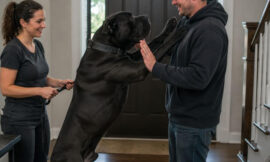
The home entryway is the most common place for guarding issues to explode. When a guest knocks or rings the bell, a Cane Corso naturally wants to rush the door to defend the home. If you let your dog handle the door entry without guidance, you invite dangerous guarding habits to form. Home Entry Guarding Management creates a strict routine that removes your dog’s self-appointed job of door guardian.
To set up this drill, designate a specific place for your dog that is at least ten to fifteen feet away from the front door. This place can be a sturdy dog bed, a heavy rug, or an open crate. Use a leash to guide your dog to this spot. Practice telling your dog to “go to your place” when the house is completely quiet. Reward them heavily for staying on the bed until you release them with a specific word.
Once your dog understands the place command, ask a family member to step outside and knock on the door. Your dog will likely jump up to guard. Immediately guide your dog back to their designated bed using a leash if necessary. Do not open the door until your dog is sitting or lying down quietly on their bed.
When your dog is calm, open the door to let the family member inside. The guest must completely ignore the dog, meaning no eye contact, no speaking, and no reaching out to pet them. This tells your dog that the arriving person is not a threat and is not an exciting playmate either. Keep your dog on their bed until the guest sits down, which lowers the overall energy in the room and keeps the environment safe for everyone.
6. Different Surface Confidence Training
Guarding behaviors often stem from hidden insecurities. A dog that is afraid of its surroundings is much more likely to lash out in defensive protection. Different Surface Confidence Training builds a deep sense of environmental confidence in your Cane Corso. By teaching your dog to navigate strange objects and odd walking surfaces, you reduce their overall anxiety levels in public.
Take your dog on specialized walks where the main goal is to step on unusual surfaces. Look for things like metal utility covers on sidewalks, gravel paths, wooden bridges, plastic tarps, or slick tile floors. Many large dogs are naturally afraid of placing their paws on textures that feel unstable or make strange noises under their heavy weight.
Approach a new surface slowly. Encouraging your dog with a happy voice, walk across the surface yourself first. If your dog hesitates, place a high-value treat directly on the edge of the new surface. Allow your dog to stretch their neck out to grab the treat without forcing them to step forward. When they place one paw on the surface, praise them enthusiastically.
Slowly lure them until all four paws are standing on the new material. Practice this drill across dozens of different locations and materials. As your Cane Corso learns that they can conquer any physical obstacle or strange walkway without getting hurt, their inner confidence will soar. A confident Cane Corso is a calm, predictable dog that does not feel the need to guard against every unknown element in the environment.
Frequently Asked Questions
What should I do if my dog lunges at a person during a parallel walk?
You must instantly increase the physical distance between your dog and the helper. Lunging means your dog has crossed its emotional comfort threshold and is now acting on its survival instincts. Do not yell at or punish your dog, as this will only increase their stress and confirm their belief that the stranger causes bad things to happen. Simply turn around calmly, shorten your grip on the safety leash, and walk away until your dog stops reacting. Once your dog settles down at a greater distance, you can restart the drill from that safer boundary line.
Can I use these socialization drills with an adult Cane Corso that already has a bite history?
You must hire a certified professional dog behaviorist before attempting any of these exercises if your dog has a history of biting. An adult protection dog with a bite history poses a serious safety risk to the public and to you. A professional trainer will help you introduce a basket muzzle safely before you even attempt to step into public spaces. The drills outlined in this article are highly effective, but an aggressive adult dog requires expert hands-on guidance to ensure no human or animal gets hurt during the training process.
How many times per week should I practice these intense guarding prevention drills?
Consistency is far more valuable than long, exhausting sessions. You should aim to practice these drills three to four times per week, keeping each session between ten and fifteen minutes long. Protection breeds possess immense physical power but can burn out mentally quite fast when dealing with stressful triggers. Short, positive sessions prevent your dog from becoming frustrated or overworked. If you train too often or for too long, your dog’s stress hormones will stay elevated, which actually makes their guarding tendencies worse over time.
Why does my Cane Corso behave perfectly on walks but guard the front door aggressively?
This happens because dogs do not generalize their training automatically, and their territorial instincts are tied directly to specific locations. A public park feels like neutral ground where your dog does not own the space, so they feel less need to protect it. Your house is their primary den, which their DNA tells them to protect at all costs. You must treat door guarding as a completely separate training issue and focus heavily on the Home Entry Guarding Management drill to change their deep-seated territorial habits.
Is it acceptable to use a prong collar or electronic collar during these socialization exercises?
You should avoid using painful or scary correction tools during socialization drills because they can easily backfire. If your Cane Corso looks at a stranger, feels a sharp pinch or a shock on its neck, its brain will connect that pain directly to the stranger. Your dog will think that strangers cause physical pain, which rapidly increases their desire to guard and attack to keep those people away. Stick to flat collars, head halters, or heavy-duty body harnesses paired with positive rewards to build a happy, safe association with the outside world.