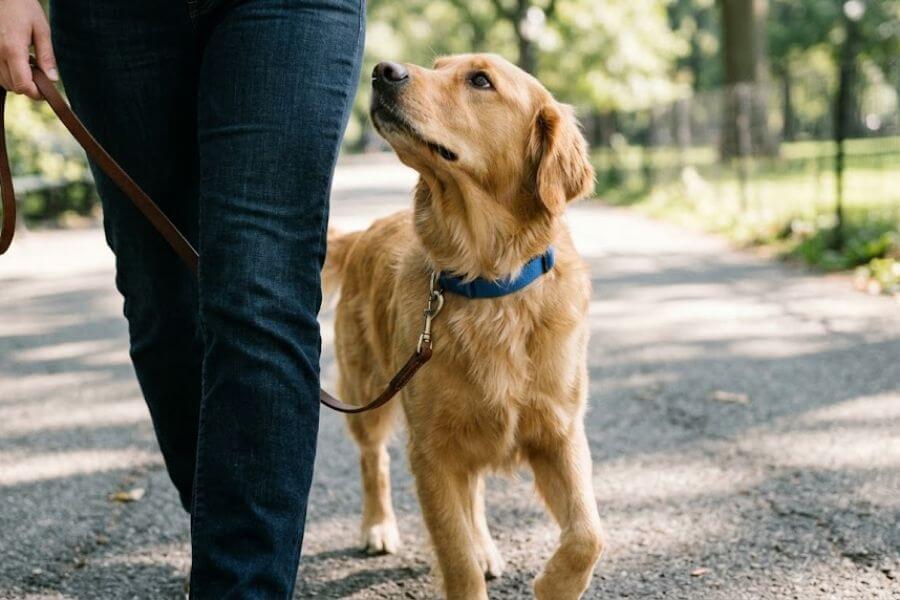
You love your dog, and you love your daily walks. But let us be honest for a moment. Are you actually walking your dog, or is your dog walking you? If your furry best friend spends the entire time pulling you down the sidewalk like a freight train, you are not alone. Many dog owners handle basic leash walking just fine, but they get stuck when they want something truly special. That special skill is the formal heel command.
We are not talking about a casual walk where your dog simply does not pull. We are talking about advanced leash training. This is a beautiful skill where your pup stays glued to your left or right side. Their shoulder lines up perfectly with your leg. When you speed up, they speed up. When you slow down, they slow down. When you stop, they sit down automatically without you even asking. It looks like magic, but it is actually the result of great communication.
Mastering this command changes everything. It turns your walks into a fun teamwork activity. It keeps your dog safe in busy places, crowded cities, or around other animals. It also gives your dog a great brain workout. Many people think only certain breeds like German Shepherds or Border Collies can learn this high-level skill. That is a big mistake. Whether you have a tiny chihuahua, a stubborn bulldog, or a giant mastiff, your dog can master this command. Let us jump into the ultimate guide to turning your dog into a sidekick on the leash.
The Secret Mindset of Advanced Training
Before you clip the leash to the collar, you need to change how you think about your walks. Advanced training is not about forcing your dog to obey you. It is about making yourself the most interesting thing in the world. To a dog, the world is full of amazing things. There are smelly trash cans, furry squirrels, friendly neighbors, and other dogs. Your goal is to make standing next to your leg more rewarding than any of those distractions.
Dogs learn through consequences. If they pull and get to sniff a tree, they learn that pulling works. If they look at you and get a delicious piece of chicken, they learn that focusing on you works. Advanced heel training relies completely on focus. Your pup needs to look up at your face while they walk. This is called an attention heel.
To get this focus, you must use high-value rewards. Plain old kibble might work inside your quiet living room, but it will fail the moment you step outside. You need treats that smell strong and taste amazing. Think about tiny pieces of hot dogs, freeze-dried liver, or cooked chicken. Keep these pieces smaller than a pencil eraser. You want to give rewards quickly without your dog spending five minutes chewing them up. Your energy matters just as much as the treats. If you act bored, your dog will get bored. You need to be happy, exciting, and ready to celebrate every small victory.
Choosing the Right Gear for Success
You do not need fancy gadgets to teach a perfect heel, but the right equipment makes a huge difference. Let us talk about what works and what gets in the way.
First, look at your leash. For advanced training, a standard six-foot leather or nylon leash is the best choice. It gives you enough length to move comfortably, but it is short enough to keep your dog close. Avoid retractable leashes at all costs. Those long, plastic cords teach dogs that pulling puts more distance between you and them. They also make it impossible to give precise signals.
Next, consider where you attach the leash. A flat buckle collar or a regular martingale collar is perfect for most dogs. Martingale collars tighten slightly when pulled, which prevents clever dogs from slipping their heads out backward. If you have a massive dog that pulls hard, a front-attachment harness can help you stay stable during the early steps. However, as your dog gets better, you want to transition back to a standard collar for the most precise communication.
You also need a good treat pouch. Do not try to stuff greasy hot dog pieces into your jeans pocket. You need to grab treats in less than a second to reward the exact moment your dog does something right. A pouch that clips to your waist keeps your hands completely free to hold the leash and guide your pup.
Building the Perfect Stationary Focus
You cannot expect your dog to walk perfectly next to you if they cannot even stand next to you while you are motionless. That is why our training starts completely still. We need to teach your dog the right position.
Pick a side. Traditionally, working dogs heel on the left side, but you can choose the right side if that feels better for you. Just stick to one side so your dog does not get confused. Let us assume you choose the left side.
Stand still with your dog on your left. Hold a treat in your left hand right against your hip or the seam of your pants. Your dog will naturally look at your hand. The moment they look up at your face instead of just staring at the treat, make a specific sound. This sound can be a word like “yes” or a click from a training device. This sound is a marker. It tells your dog that the exact thing they just did won them a prize.
Deliver the treat right next to your left leg. You want your dog to realize that the space next to your left leg is a magical zone where food appears. Repeat this exercise dozens of times. Stand still, wait for eye contact, mark with your word, and reward. Soon, your dog will walk up to your left side and look up at you automatically, begging for the game to start.
Turning the First Step into a Dance
Once your dog loves hanging out by your side while you are standing still, it is time to add movement. This is where many owners make a mistake. They try to walk a whole block right away. Instead, we are going to take exactly one step.
Start with your dog sitting perfectly on your left side. Hold your leash loosely in your right hand. Your left hand will hold the treats. Say your dog’s name, give your chosen command word, and take one step forward with your left foot. Moving your left foot first acts as a visual signal for your dog to move.
As you take that single step, lure your dog forward by holding a treat right in front of their nose. As soon as your left foot lands and your dog moves up beside you, mark with your word and feed them.
If your dog sat down or lagged behind, do not worry. Just reset and try again. If they successfully took that one step with you while looking up, do it again. Practice taking one single step forward, marking, and rewarding until it feels smooth. Once one step is flawless, move up to two steps. Then try three steps. You are slowly building a chain of behavior. You are teaching your dog that staying in that exact pocket while your feet are moving is the goal of the game.
The Art of the Automatic Sit
A true master of the heel command does not need to tell their dog to sit every time they stop walking. The dog just does it. This looks amazing, and it is incredibly useful when you are waiting at a crosswalk or stopping to talk to a neighbor.
Teaching this is much simpler than it looks. Walk a few steps with your dog in a heel. As you prepare to stop, slow down your pace for two steps to give your pup a hint. When you come to a complete stop, bring your hands up toward your chest with a treat. This naturally coaxes your dog’s nose upward. When a dog’s nose goes up, their bottom naturally goes down onto the ground.
The very millisecond their bottom touches the grass or pavement, mark with your word and give them the treat. Do not say the word “sit.” You want the stopping of your feet to become the actual command for the sit.
Keep practicing this over and over. Walk three steps, slow down, stop, and guide them into the sit. Soon, your dog will notice your feet stopping and will beat you to the punch. They will tuck their rear end down before you even have a chance to guide them.
Handling the Pesky Distractions
It is one thing to have a perfect heel inside your quiet kitchen or out in your empty backyard. It is a completely different story when a fluffy cat runs across the street or a loud delivery truck drives past. Distractions are the ultimate test of advanced leash training.
When you start adding distractions, you must follow the rule of distance. If your dog loses their mind when another dog is ten feet away, start training at thirty feet away. Find the distance where your dog notices the distraction but can still look at you and take a treat. This is called the threshold.
Work at this safe distance. Walk your dog in a heel, mark them for keeping their eyes on you while the distraction is visible, and reward heavily. If your dog pulls toward the distraction, do not yank the leash back. Simply turn around and walk the opposite way. By turning away, you teach your dog that pulling actually moves them further away from the thing they want to see.
Slowly, over several days or weeks, decrease the distance between you and the distraction. If your dog makes a mistake and lunges, do not get angry. It just means you moved too close, too fast. Back up to where they were successful and build their confidence up again.
Speed Changes and Quick Adjustments
A perfect heel is dynamic. It should look like a beautiful dance between you and your dog. To achieve this, your dog needs to pay attention to the speed of your body, not just the direction you are walking.
Once your pup can heel at a normal walking speed for ten paces, start changing your gears. Without warning, slow down into an ultra-slow motion walk. Your dog will probably overshoot you at first because they are used to a certain pace. The moment they realize you slowed down and they adjust their body to match yours, mark and reward.
Next, try a sudden jog. Fast movement is highly exciting for dogs, so they might get silly and try to jump or bite at the leash. Keep your hands calm, run forward for five steps, and reward them if they stay right by your leg.
Go back and forth between normal walking, fast running, and slow creeping. This unpredictable movement forces your dog to watch your hips and legs like a hawk. They can never zone out or daydream because they never know what wacky speed change you are going to throw at them next.
Navigating Sharp Turns and Pivots
Walking in a straight line is a great start, but real walks involve corners, obstacles, and sudden changes of direction. To master advanced heeling, your dog must learn how to handle turns. There are two main types of turns: about-turns and left-turns.
An about-turn means you turn one hundred eighty degrees to the right, reversing your direction completely. This turn is relatively simple for your dog. As you turn your body away from your dog, they have to speed up their pace to wrap around the outside of your body. Lure them around the turn with a treat held in your left hand, keeping them tight to your hip. Mark and reward as you complete the turn.
A left-turn is much trickier. When you turn to the left, you are turning directly into your dog’s space. If they do not move, you will step on their paws or bump into them. To do this correctly, your dog has to learn to pivot their rear end out of your way while keeping their front body aligned with you.
As you start to turn left, take a small step into your dog while using a treat to guide their nose slightly to the right. This pushes their rear end out to the left, clearing a path for your legs. It requires great body awareness from your pup. Practice this slowly, one quarter turn at a time, until your dog naturally tucks their hips out of your way whenever you steer into their space.
Fading Out the Tasty Treats
Right now, you are probably using a lot of treats to keep your dog motivated. That is exactly what you should be doing during the learning phase. But you do not want to carry a pouch full of greasy chicken pieces everywhere you go for the next ten years. You need to fade out the food rewards while keeping the high performance.
Start by switching from a continuous reward schedule to an intermittent reward schedule. This means you do not give a treat every single time your dog does something right. Instead, make it a surprise.
Think of it like a slot machine in a game room. If a machine pays out every single time, it gets boring quickly when it stops. But if it pays out randomly, people keep playing for a long time. Walk five steps, stop, and reward. Next time, walk fifteen steps, do a turn, stop, and reward. The time after that, walk three steps and reward.
Your dog will start working harder because they never know which step is going to win the jackpot. Eventually, you can replace many of the food rewards with real-world rewards. The permission to sniff a bush, a quick game with a favorite tennis ball, or a happy belly rub can become the ultimate prize for a beautiful heel sequence.
Troubleshooting Common Heeling Mistakes
Even with the best instructions, you will run into a few speed bumps along the way. Let us look at the most common problems dog owners face during advanced leash training and how to fix them easily.
The Dog Lags Behind Your Body
If your dog is walking behind you like a sad caboose on a train, they are likely bored, tired, or confused. First, make sure you are not training in extreme heat or for too long. Short sessions lasting three to five minutes are much better than a long, grueling half-hour session. If tiredness is not the issue, increase your energy. Speak in a high, squeaky voice, speed up your pace, and use better treats. Make the game exciting again.
The Dog Crabs Outward to the Side
Sometimes a dog stays parallel to you but walks three feet away from your leg. This is often called crabbing. It usually happens because you have been tossing treats out away from your body. To fix this, always deliver the reward right against the seam of your pants. You want your dog to hug your leg because that is where the food always appears. You can also practice heeling right next to a long brick wall or a chain-link fence. Put your dog between you and the wall. This physical barrier prevents them from drifting out and teaches them the correct spatial alignment.
The Dog Constantly Forges Ahead
If your dog’s shoulder is constantly passing your leg, they are eager and trying too hard. Do not pull back on the leash. Instead, use the penalty yardage trick. The moment their chest passes your leg, immediately do a sharp about-turn to the right or a left-turn into their path. This forces them to reset their position. They will quickly learn that pushing ahead causes them to lose their position and progress.
Breed Specific Tips for Every Size and Shape
Every dog breed is unique. They have different body shapes, history, and motivations. While the core steps of advanced leash training stay the same, you can tweak your approach to match your specific dog’s personality.
Working and Herding Breeds
Breeds like Labradors, Golden Retrievers, Border Collies, and Australian Shepherds love having a job to do. They usually learn the advanced heel very quickly because they naturally want to focus on humans. For these dogs, the challenge is keeping their giant brains busy. If you walk in a straight line for too long, they might get bored and start inventing their own games. Keep them guessing by constantly throwing in quick turns, sudden stops, and rapid speed adjustments.
Scent Hounds and Sight Hounds
Beagles, Bloodhounds, Greyhounds, and Whippets present a different challenge. Hounds are built to track smells or chase fast objects. To them, the ground is an amazing book that they want to read with their noses. For these dogs, you must become more interesting than the grass. Use smelly rewards like fish treats or cheese. Keep your training sessions very short, and use the permission to sniff as a reward. Tell them to heel for twenty paces, then give a release word like “free” and let them sniff a tree as their prize.
Toy and Miniature Breeds
Chihuahuas, Pomeranians, and Toy Poodles can learn a beautiful heel, but their tiny size makes mechanics a bit difficult. If you are tall, bending down to feed a tiny dog every three steps will hurt your back. To solve this, use a long wooden spoon smeared with a little bit of peanut butter or wet dog food. You can hold the spoon down by your leg to deliver rewards without bending over. Also, be extremely mindful of where your large human feet are landing. Tiny dogs can get scared of getting stepped on, so start very slowly and gently.
Stubborn or Independent Breeds
Bulldogs, Mastiffs, and Huskies are famous for asking “what is in it for me?” They are highly intelligent, but they do not live to please humans the way herding dogs do. If you have an independent breed, you must be extremely strict about your reward system. Never allow them to pull you toward anything they want. Make sure your treats are absolutely irresistible. Be patient, stay calm, and avoid getting into physical tug-of-war battles with the leash. When they realize that cooperating with you is the only path to getting what they want, they will buy into the game.
Making Heeling a Part of Your Daily Life
You do not need to set aside hours of dedicated training time every day to maintain a perfect heel. The best way to solidify this behavior is by weaving it into your regular daily routine.
Before you open the front door to go outside, ask your dog for a steady sit next to your side. Open the door. If they lunge forward, close the door and try again. They must heel out of the house.
When you cross a street, use that moment to practice your attention heel. It keeps them safe in the middle of traffic and reinforces the behavior in a real scenario. When you pass a mailbox, practice your automatic sit.
Remember to clearly separate advanced heeling time from casual walking time. Your dog cannot be expected to walk in a rigid, high-focus heel for a full two-mile journey. That would be like a human running a marathon while doing complex math equations. Use a specific cue like “heel” when you want total focus and precision. Use a different release cue like “go walk” or “break” when it is time for them to relax, sniff, and just enjoy being a dog. By creating clear boundaries, your dog will gladly give you their full attention when you ask for it.
Frequently Asked Questions
Can I teach my older dog how to heel if they have spent many years pulling on the leash?
You absolutely can teach an older dog this command. The old saying about not teaching an older dog new tricks is completely false. In fact, older dogs often have better attention spans than wild, goofy puppies. The only difference is that an older dog has spent a lot of time practicing bad habits. It will take a bit more patience to erase those old pathways in their brain. Start the process inside your house where there are no distractions. Use excellent treats to show them that this new walking game is much more fun and rewarding than their old pulling habit. As long as your dog is healthy and free of pain, they can learn to heel beautifully at any stage of life.
What should I do if my dog gets so excited during training that they start barking at me?
Barking during training is usually a sign of frustration or over-excitement. Your dog wants the treat so badly, but they do not understand exactly what they need to do to get it. When they get confused, they boil over and bark. If this happens, do not yell at them to be quiet. That just sounds like you are barking along with them. Instead, become a statue. Hide the treats behind your back, look away, and stand completely still. Wait for two seconds of absolute silence. The moment they quiet down and take a breath, mark with your word and give them a treat. To prevent it from happening again, make the game smaller. If they are barking after three steps, go back to rewarding them for just one step. Clear up your communication so they do not feel confused.
Is it acceptable to switch the heeling side depending on which hand I want to use?
It is highly recommended to pick one side and stick to it permanently during the learning phase. Dogs are very positional animals. They memorize the physical picture of your body relative to theirs. If you constantly flip them from your left side to your right side, they will get confused about where they are supposed to stand. It slows down their learning significantly. Once your dog is a total expert and can heel perfectly on their primary side for months under heavy distraction, you can introduce the opposite side using a completely different command word like “side” or “right.” But until they are a master, consistency is your best friend.
Why does my dog perform a perfect heel inside the house but completely ignore me in the yard?
This is a classic training hurdle known as a failure to generalize. Dogs are situational learners. Your pup might think the heel command only applies when they are standing on the kitchen rug. When they move out to the grass, the context changes completely. The grass smells like bugs, the wind is blowing, and the sky is bright. To your dog, it is a brand new world. When you move to a new location, you always need to drop your expectations down a few levels. Do not try to walk around the yard right away. Go back to the very first step. Stand still, build your stationary focus, and reward them for just looking at you on the grass. Build the behavior back up from scratch in the new environment. Soon, they will understand that “heel” means the same thing everywhere.
Should I use a clicker for advanced leash training or is my voice enough?
Both methods work well, but a mechanical clicker has a slight advantage during advanced training. A clicker makes the exact same sharp, clear sound every single time. It contains no human emotion. Your voice can sound tired, angry, or excited, which can sometimes confuse a sensitive dog. A clicker is also incredibly fast. You can click the exact millisecond your dog makes eye contact while walking. If you prefer to use your voice, just ensure your marker word is short, sharp, and consistent. Use a word like “yes” or “yip” rather than a long phrase like “good boy.” The faster and more consistent your signal is, the quicker your dog will connect their movement to the reward.