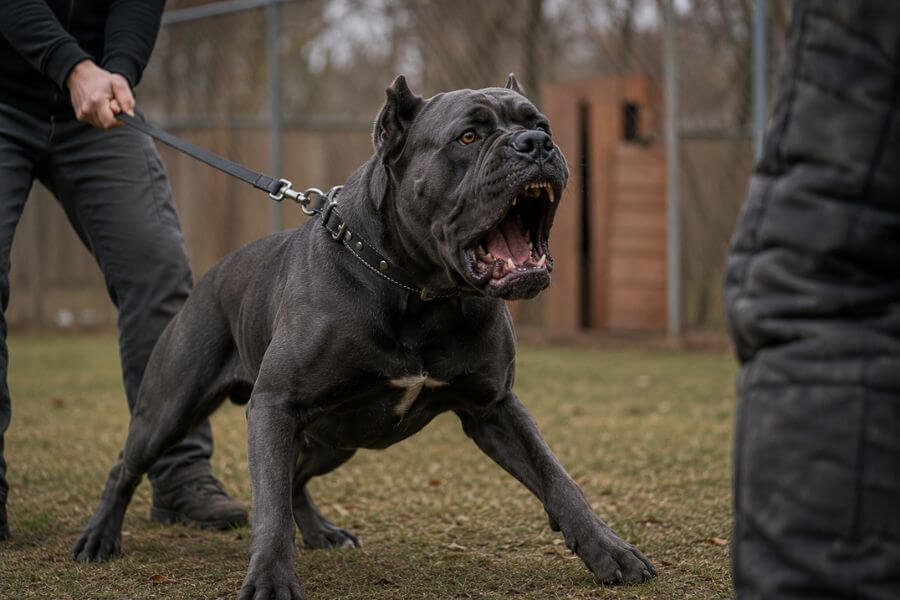
Quick Summary Table
| Rank | Method | Primary Goal | Commitment Level |
| 1 | Early and Continuous Socialization | Build positive associations with strangers | Very High (Daily) |
| 2 | Leadership and Consistent Boundaries | Establish clear rules and structure at home | High (Always) |
| 3 | Positive Reinforcement Training | Reward good choices around triggers | High (Daily) |
| 4 | Controlled Threshold Management | Keep the dog calm before they react | Medium (Per Walk) |
| 5 | Desensitization and Counter-Conditioning | Change the emotional response to visitors | High (Regularly) |
| 6 | Mental Stimulation and Physical Exercise | Drain excess energy that fuels guarding | Medium (Daily) |
| 7 | Secure Boundary Management | Prevent fence running and window barking | Medium (One-Time Setup) |
| 8 | Professional Behavioral Intervention | Get expert help for deep-seated aggression | Low to Medium |
How We Ranked These
To find the best ways to handle Cane Corso territorial aggression, we looked at how these dogs think, learn, and react. We chose methods that fix the root cause of the behavior rather than just stopping the symptoms.
Here are the key factors we used to rank these methods:
- Safety First: The method must keep you, your dog, and guests safe during the training process.
- Long-Term Success: The strategy must change how the dog feels about strangers, not just temporarily suppress their actions.
- Ease of Implementation: Regular dog owners must be able to practice these steps without needing advanced gear.
- Canine Welfare: The approach must use kind, humane methods that build trust instead of fear or pain.
1. Early and Continuous Socialization
Socialization is the most critical step in shaping a friendly Cane Corso. It means introducing your dog to new people, animals, places, and sounds in a positive way. Because this breed is a natural guardian, they will automatically view anything unknown as a threat. You must teach them from a very young age that new things are safe and normal.
Start this process the week you bring your puppy home. Invite friends over to meet them. Take them to different places like pet-friendly stores, parks, and busy sidewalks. Ensure every single interaction is happy and stress-free. If a stranger wants to pet your puppy, give the stranger a high-value treat to feed your dog. This teaches the pup that strangers bring good things.
Socialization does not stop when your dog turns one year old. A Cane Corso can develop territorial habits as they mature into adulthood around two or three years old. You need to keep taking your adult dog out into public spaces regularly. If you isolate them at home, their world shrinks, and their instinct to guard their space grows stronger. Make social trips a permanent part of their weekly routine.
2. Leadership and Consistent Boundaries
A Cane Corso is a strong-willed breed that needs a calm and capable leader. If they feel that nobody is in charge of the household, they will take over the role themselves. When a dog thinks they are the leader, they feel it is their job to protect the property and control who enters. You can change this dynamic by setting clear, everyday rules.
Establish boundaries inside the house to show that you own the space. For example, teach your dog that they must wait for permission before they get on the couch or bed. Make them sit and look at you before you put their food bowl down or open the door for a walk. This is often called the work-for-living method. It teaches your dog to look to you for direction before they act.
Consistency is key here. If you let them bark wildly at the window one day but yell at them the next, they will get confused and anxious. Everyone in your home must follow the exact same rules. When your Cane Corso realizes that you control the house, the doors, and the food, they will gladly give up the job of defending the home, which lowers their overall stress levels.
3. Positive Reinforcement Training
Positive reinforcement means rewarding your dog for doing the right thing instead of punishing them for making a mistake. Punishment-based training, like using choke chains or shouting, can make territorial aggression much worse. If a dog gets hurt or scared when a stranger approaches the house, they will connect that pain to the stranger, making them even more aggressive next time.
Instead, use high-value rewards like pieces of fresh chicken, cheese, or hot dogs. Carry these treats with you during training sessions. When your dog sees a person near your property line and looks at you calmly without growling, immediately give them a treat. Repeat this every single time they choose peace over aggression.
You should also teach alternative behaviors. For instance, train your dog to do a specific action when the doorbell rings, such as going to their bed and staying there. If they are busy walking to their bed to get a piece of cheese, they cannot physically rush the front door to attack a visitor. This shifts their mindset from guarding to performing a rewarding task.
4. Controlled Threshold Management
A threshold is the distance at which your dog starts to change their behavior. If a stranger is one hundred feet away, your Cane Corso might look closely but remain calm. This means they are below their threshold. If the stranger gets within twenty feet, your dog might start growling, lunging, and barking. This means they have crossed their threshold.
To train effectively, you must always keep your dog below their reaction threshold. Find out exactly how close a person can get before your dog reacts. Once you know that distance, practice training just outside of that zone. Stand at the distance where your dog knows the person is there but can still focus on you and take treats.
Slowly reduce the distance over many days or weeks. Move one step closer only when your dog is completely relaxed at the current distance. If your dog explodes into barking, you have moved too fast and crossed the threshold. Calmly back away to a safe distance and try again later. Managing this distance ensures your dog always practices calm habits.
5. Desensitization and Counter-Conditioning
Desensitization means exposing your dog to their trigger at a very low level so they do not react. Counter-conditioning means changing their emotional response from negative to positive. When you combine these two techniques, you can change how your Cane Corso feels about people entering their territory.
For example, if your dog hates the sound of the doorbell, record the sound on your phone. Play the sound at a very low volume while your dog is relaxing. If they stay quiet, give them a tasty treat. Slowly turn up the volume over several sessions, feeding them treats each time. Eventually, the sound of the ring will mean food is coming, not an enemy.
Next, apply this to actual visitors. Have a friend stand far outside your yard. Every time your dog looks at the friend, feed them a steady stream of treats. Have the friend take one step closer, stop, and toss a treat to the dog. By doing this, your dog learns to associate the arrival of people with a jackpot of rewards rather than an invasion of their home.
6. Mental Stimulation and Physical Exercise
A bored Cane Corso with a lot of trapped energy is far more likely to develop behavioral problems like territorial guarding. This is a working breed that was historically bred to hunt large animals and guard estates. They have a natural drive to do a job, and if you do not give them one, they will choose the job of patrolling the home and barking at neighbors.
Ensure your dog gets enough daily exercise. This means long walks, jogging, or playing fetch in a secure area. A tired dog has less energy to waste on pacing the fence line or stressing over noises outside. However, physical exercise is only half the battle. You must also exercise their brain.
Mental stimulation can tire a dog out faster than a long run. Use puzzle toys where your dog must figure out how to get treats out of a plastic game. Feed them their meals using toy dispensers or scatter their kibble in the grass for them to sniff out. Practice your basic obedience commands for fifteen minutes every day. Keeping their mind active builds confidence and reduces the anxiety that feeds aggression.
7. Secure Boundary Management
The physical layout of your home plays a large role in territorial behaviors. If your Cane Corso can look out the front window all day or look through a chain-link fence, they will spend hours watching for targets. Every time a postman walks by and then leaves, your dog thinks their barking made the person go away. This rewards and strengthens the bad behavior.
You need to change what your dog can see. Use privacy film on the lower half of your windows so your dog cannot look at the sidewalk. Keep curtains closed when you are not actively training them. Outside, replace open fences with a solid wood or vinyl privacy fence so your dog cannot see people or dogs walking past.
Never leave your Cane Corso alone in the yard for long periods. When they are left alone, they will naturally patrol the boundaries and practice aggressive displays. Only allow them outside when you are there to supervise. If they start running along the fence line or barking at the neighbor, immediately bring them inside the house. This breaks the habit before it becomes a permanent lifestyle.
8. Professional Behavioral Intervention
Territorial aggression in a massive, powerful breed like the Cane Corso can be dangerous if handled incorrectly. If your dog is actively trying to bite visitors, lunging violently at windows, or making you feel unsafe in your own home, it is time to stop trying to fix it alone. You need to hire a professional dog behaviorist.
Look for a specialist who uses force-free, positive methods. Avoid trainers who promise quick fixes using shock collars, as these tools often cause hidden anxiety that can lead to sudden, severe bites later on. A true professional will visit your home, look at your daily routine, and build a custom safety and training plan just for your situation.
Working with an expert gives you peace of mind. They can notice small signs of stress in your dog’s body language that you might miss, such as a stiff tail or a frozen posture. They will teach you how to handle the leash correctly and how to stay calm during tense moments. Getting professional help early can prevent dangerous accidents and save your dog’s life.
Frequently Asked Questions
Can a Cane Corso suddenly become territorially aggressive as they grow older even if they were friendly as a puppy?
Yes, this is very common for this specific breed. Puppies are naturally more open and less protective. However, as a Cane Corso matures between eighteen months and three years of age, their adult guarding instincts fully develop. Even a puppy that loved everyone can start guarding the home and showing aggression toward strangers once their adult protective drives kick in. This is why continuous training through adulthood is necessary.
Why does my Cane Corso only display territorial behavior when I am standing right next to them?
This happens because of a behavior called resource guarding, where the dog views you as a valuable resource that they must protect. When you are near, the dog feels a stronger need to control the space and keep others away from you. They might also feel more confident to act aggressively because they think you are backing them up in the defense of the home.
Should I let my visitors give commands to my aggressive Cane Corso to show who boss is?
No, you should never allow visitors to give commands to a territorial Cane Corso. An aggressive dog already views the visitor as an unwanted intruder. If that intruder starts shouting commands or trying to control the dog, it can feel like a direct challenge or threat, which can trigger a defensive bite. Only the family members should give commands, while visitors should remain calm and non-threatening.
Does spaying or neutering my Cane Corso instantly cure their territorial aggression?
No, spaying or neutering will not instantly cure territorial aggression. While altering your dog can reduce some hormone-driven behaviors like roaming or competing with other dogs, territorial guarding is a deeply ingrained breed trait and a learned habit. Once the behavior has started, you must use consistent training and behavior modification to fix it, as changing their hormones alone will not change their habits.
Is it a good idea to use a crate to manage my dog when guests come over?
Yes, using a crate is an excellent way to keep everyone safe while you are working on training. Put your dog in a crate in a quiet room with a high-quality chew toy before your guests arrive at the front door. This prevents the dog from rushing the door and practicing aggressive behaviors, and it allows your guests to enter the house without fear.