Welcome to life with a Boxer dog. If you already share your home with one of these beautiful, bouncy creatures, you know exactly what it feels like to live with a furry whirlwind. Boxers are famous for their endless energy, their expressive faces, and their silly antics. They are the true comedians of the dog world. But as any Boxer owner will tell you, a bored Boxer can quickly turn into a household demolition crew.
When a dog with this much muscle and intelligence does not have a job to do, they will invent their own job. Usually, that self-assigned job involves chewing up your favorite shoes, digging massive holes in the backyard, or barking at the wind.
How do you channel all that wonderful Boxer energy into good behavior? The secret does not just lie in long walks. It lies in mental stimulation. Brain exercise tires a dog out just as much as physical exercise, if not more.
This guide will show you exactly how to keep your Boxer dog mentally sharp, calm, and perfectly behaved. Whether you are a first-time owner or a lifelong Boxer lover, these practical strategies will help you build a deep bond with your dog and create a peaceful, happy home.
Understanding the Boxer Mind
To truly understand how to entertain a Boxer, you have to look back at their history. Boxers were originally bred in Germany to be working dogs. They were used for hunting large animals like wild boars and bears, and later, they worked as police dogs, guard dogs, and military messengers.
This history tells us two important things about your pet. First, they are incredibly strong and athletic. Second, they possess a high level of intelligence and problem-solving skills. They are hard-wired to look for tasks and solve puzzles.
When you bring a working dog into a modern home as a family pet, their natural instincts do not just vanish. They still have that burning desire to work. If you do not give them a constructive outlet for that desire, they will find their own outlets, which often look like bad behavior.
Boxers also experience a prolonged puppyhood. Many dog breeds mature and calm down around their first birthday. Boxers, however, often act like big, goofy puppies until they are three or four years old. This means you need a lot of patience and a solid plan for daily mental engagement.
Recognizing that your dog is not acting out to be mean or stubborn is the first step toward better behavior. They are simply bursting with energy and intellect that need a proper direction.
The Power of Mental Stimulation
Many people think that if a dog is misbehaving, they just need to run more. While physical exercise is crucial for a Boxer, it is only half of the puzzle. Imagine if you went to the gym and ran on a treadmill for an hour every day, but you never read a book, talked to friends, or solved a problem. Your body would be fit, but your mind would be incredibly frustrated. The exact same rule applies to your dog.
Brain games and mental challenges wear a dog out in a unique way. When a dog uses their brain to solve a puzzle, figure out a training cue, or sniff out a hidden treasure, their brain processes a massive amount of information. This mental effort actually lowers their stress levels and releases happy hormones in their body.
A dog that enjoys fifteen minutes of intense brain work will often curl up and take a deep, peaceful nap afterward, whereas a dog that just went for a frantic run might still be hyperactive and looking for trouble.
By focusing on mental stimulation, you can prevent a wide range of behavior problems before they even start. You can reduce excessive barking, stop destructive chewing, banish separation anxiety, and help your dog learn to relax when guests come over.
Interactive Puzzle Toys
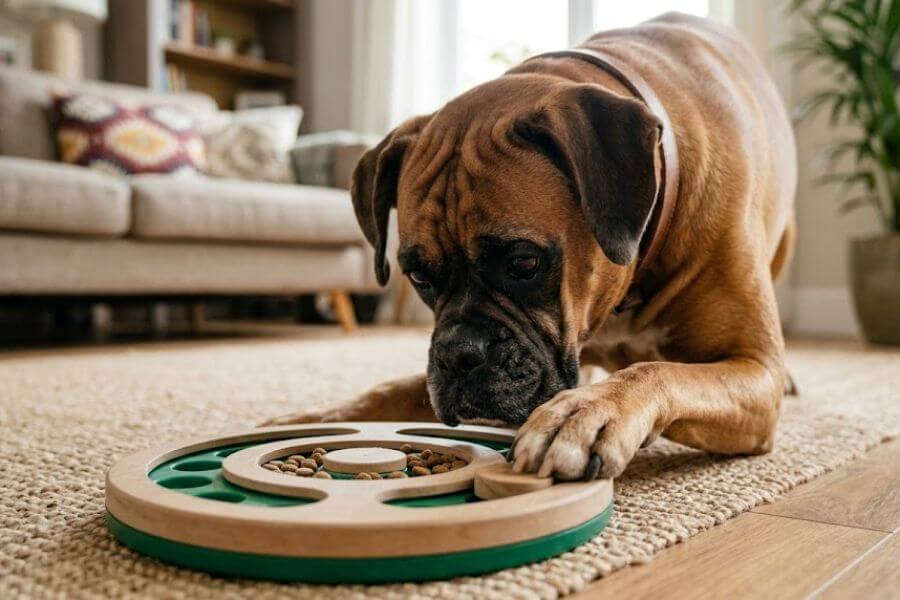
One of the easiest ways to start working your Boxer’s brain is by changing how you feed them. Throw away the standard plastic dog bowl. Eating out of a plain bowl requires zero brainpower. Your dog just gulps down their food in two minutes and walks away looking for something else to do. Instead, turn mealtime into a fun game with interactive puzzle toys.
Puzzle toys come in many shapes and sizes. Some are plastic boards with sliders, cups, and flaps. You hide small pieces of dry food or healthy treats underneath the moving parts, and your dog has to use their paws and nose to flip, slide, or lift the pieces to find the food.
For a clever Boxer, this is the perfect challenge. They have to think about which piece to move first and figure out the mechanics of the toy.
When you start using puzzle toys, always begin with a simple setup. If the puzzle is too hard right away, your dog might get frustrated and walk away, or worse, they might just chew up the entire toy to get to the food. Guide them through the process, show them how the sliders work, and praise them when they find a treat. As they get better at it, you can buy more advanced puzzles that require multiple steps to solve.
DIY Brain Games You Can Make at Home
You do not need to spend a fortune at the pet store to keep your Boxer entertained. You can create fantastic brain games using everyday items you already have around the house. These homemade games are wonderful because you can change them up constantly to keep your dog guessing.
The Muffin Tin Game
Take a standard metal or silicone muffin tin from your kitchen. Place a high-value treat inside a few of the muffin cups. Then, cover every single cup with a tennis ball. Hand the tin over to your Boxer.
Your dog will smell the treats hidden beneath the balls. They will have to figure out how to lift or roll the tennis balls out of the way with their nose or paws to claim their prize. This game tests their problem-solving skills and provides instant rewards.
The Towel Roll
Take an old bath towel and lay it flat on the floor. Scatter a handful of dry dog food or small treats across the surface of the towel. Next, tightly roll the towel up into a long cylinder shape. For an extra challenge, you can even tie the rolled towel into a loose knot.
Your Boxer will have to use their nose to unroll the towel inch by inch, snorting and sniffing along the way to find every single piece of food. The physical act of unrolling combined with the heavy sniffing is highly satisfying for them.
Cardboard Box Destruction
Boxers love to use their paws and teeth, and you can channel this safely using clean cardboard boxes, like empty cereal boxes or delivery packages. Make sure all plastic tape, staples, and labels are removed. Drop a few treats inside the box and fold the flaps closed.
Let your dog figure out how to rip, tear, and open the box to get the food inside. Ripping up cardboard is a wonderful, safe outlet for a dog’s natural tearing instincts, just make sure they only rip the cardboard and do not actually swallow any of the pieces. Clean up the mess afterward with a smile, knowing your dog had a blast.
The Art of Sniffing and Nose Work
A dog’s sense of smell is their superpower. While humans see the world primarily through sight, dogs experience the world through their noses. A Boxer has tens of millions of scent receptors, and the part of their brain dedicated to analyzing smells is huge.
When you allow your dog to use their nose intensely, you open up a whole new world of mental fulfillment for them.
You can practice scent work right in your living room or backyard. Start a game called “Find the Treats.” Have your dog sit and stay in one room while you walk into another room. Hide five or six smelly treats in semi-obvious places, like behind a chair leg, on the bottom shelf of a coffee table, or under the corner of a rug.
Walk back to your Boxer, give them a release cue like “Find it,” and watch them go to work.
At first, they might look around with their eyes, but soon, you will hear that deep, rhythmic snorting sound that means their nose has taken over. As they get better at this game, you can make the hiding spots much more difficult, like hiding treats inside a closed cabinet door that is cracked open just an inch, or burying them under a pile of dog toys. This game keeps them focused, builds confidence, and leaves them pleasantly exhausted.
Making Walks More Meaningful
Many dog owners view a walk as a purely physical chore. They lace up their shoes, march along a fixed route at a brisk pace, and pull their dog along whenever the dog stops to sniff a bush. This type of walk can actually make a high-energy dog more frustrated.
To transform your daily walks into a mental workout, you need to implement two specific types of walks: sniffaris and training walks.
A “sniffari” is a walk where your dog is the boss. You put them on a long, safe leash and let them set the pace and the direction. If your Boxer wants to spend three full minutes sniffing a single blade of grass, let them do it.
To a dog, that blade of grass is like a local newspaper. It tells them which other animals have passed by, how healthy they are, what they ate, and when they were there. Forcing a dog to pass by these scent markers without sniffing is like someone turning the pages of a book before you can read the words. A twenty-minute sniffari can tire a Boxer out much more than a fast two-mile run where they are not allowed to stop.
On the flip side, you should also have dedicated training walks. During these walks, you focus on precision and teamwork. Practice loose-leash walking, ask your dog to sit every time you reach a street corner, change your walking speed randomly, and make sudden left and right turns.
This forces your Boxer to keep one eye on you at all times, wondering what you are going to do next. Keeping their attention locked onto you requires real mental effort, which builds excellent outdoor manners.
Advanced Obedience Training
Basic training commands like sit, stay, and down are essential for safety, but once your Boxer knows them, do not stop there. Boxers love to learn new things, and advanced obedience training is an excellent way to challenge their intellect.
When you teach advanced concepts, you are teaching your dog how to focus through distractions and manage their own excitement levels.
Try teaching your dog the “place” command. This means teaching them to go to a specific mat, bed, or elevated platform and stay there until you say otherwise. This is not just a physical stay; it is a mental exercise in self-control.
Start by rewarding them just for stepping onto the mat, then for lying down, and then gradually increase the amount of time they must stay there while you walk around the room, bounce a ball, or open the front door.
You can also teach them to identify their toys by name. Gather three different toys, a ball, a squeaky duck, and a rope bone. Start with just the ball. Say “get your ball,” and reward them when they pick it up. Do this for a few days until they connect the word with the object.
Then introduce the duck and repeat the process. Eventually, place all three toys on the floor and ask them to fetch a specific one. Watching a Boxer pause, look at the toys, process the words you just said, and select the correct item is a beautiful demonstration of their mental capacity.
Trick Training for Fun and Focus
If formal obedience training feels a bit too rigid, dive into trick training. Teaching your Boxer tricks is an absolute joy because Boxers are natural performers. They thrive on the positive attention, laughter, and praise that come with showing off a cool trick.
Trick training keeps their brains flexible and improves their body awareness, which is important for a large, muscular breed that can sometimes be a bit clumsy.
Start with a classic trick like “shake hands” or “give paw.” Once they master that, move on to more complex physical movements. Teach them to “spin” in a circle, “weave” through your legs as you walk forward, or “play dead” when you make a finger-gun shape.
Each of these tricks requires your dog to figure out how to move their body in response to your hand signals and verbal cues.
You can also teach a trick called “leave it” with a fun twist. Place a treat on your dog’s paw or on the bridge of their nose and tell them to wait. They have to sit perfectly still, fighting every natural urge to eat the treat, until you give them the permission cue.
This specific type of impulse-control training builds a direct pathway in their brain between calm behavior and high rewards. It teaches them that waiting patiently is the fastest way to get what they want.
The Importance of High-Value Rewards
When you are asking your Boxer to do tough mental work or learn difficult new behaviors, you cannot expect them to work for free. Think of training like a job. If your boss offered to pay you in celery sticks, you probably would not work very hard. But if they offered you a gourmet steak dinner, you would put in maximum effort. Your dog thinks the exact same way.
For everyday tasks, standard dog kibble or simple crunchy biscuits might work fine. But when you are tackling brain games, advanced tricks, or behavior modifications, you need to bring out the high-value rewards. These are treats that are soft, moist, and incredibly smelly.
Excellent choices include small cubes of freeze-dried beef liver, cooked chicken breast, tiny pieces of cheese, or hot dog slices.
Keep these special treats tiny, about the size of a pea. You want to reward your dog instantly without filling their stomach too quickly or causing them to gain weight. The mere presence of these spectacular treats will immediately cause your Boxer to focus.
Their eyes will lock onto you, their ears will perk up, and their brain will go into overdrive trying to figure out exactly what they need to do to earn that delicious morsel.
Creating a Consistent Daily Routine
Dogs are creatures of habit. They find comfort and safety in knowing exactly what is going to happen next in their world. When a dog’s life is unpredictable, it can create underlying anxiety, which often manifests as hyperactive or destructive behavior.
By building a structured daily routine that balances sleep, physical exercise, mental work, and downtime, you set your Boxer up for total success.
A good routine does not mean you have to schedule every single minute of the day, but it does mean certain events should happen in the same general order. For example, your morning could look like a brisk walk followed by breakfast served in a puzzle toy.
After breakfast, your Boxer’s brain and body will be satisfied, making it the perfect time for them to rest quietly while you work or take care of household chores.
In the late afternoon, you can schedule a quick ten-minute trick-training session or a game of hide-and-seek in the house. Follow this with their evening meal, perhaps frozen inside a rubber chew toy to make it last longer, and a relaxing evening stroll.
By creating these predictable blocks of activity and rest, your Boxer learns when it is time to be active and, just as importantly, when it is time to turn off their motor and relax.
Socialization as Mental Exercise
Socialization is often misunderstood as simply letting your dog play with other dogs. True socialization is much broader than that. It means exposing your Boxer to a wide variety of people, animals, environments, sights, and sounds in a positive, controlled way.
Experiencing new environments is a massive workout for a dog’s brain, as they have to take in all the new data and learn how to behave appropriately.
Take your Boxer to new places as often as you can. Walk past a local school during recess so they can see and hear kids playing, visit a dog-friendly hardware store where they can walk on shiny concrete floors and hear carts rolling by, or sit on a bench near a busy cafe and watch the world go by.
During these outings, your goal is not necessarily to have your dog interact with everyone, but rather to have them remain calm and neutral in the presence of novelty.
Every single new sight, smell, and sound activates different parts of your Boxer’s brain. They are processing the environment and looking to you for guidance on how to react. Bring your high-value treats along and reward them every time they look at a strange object or person and choose to remain calm.
A trip to a bustling new outdoor location can make your dog just as tired as an afternoon at the dog park, without the risk of over-stimulation or conflicts with other animals.
Agility and Backyard Obstacle Courses
Because Boxers are naturally athletic and agile, physical activities that require precision and thought are perfect for them. Agility training is a sport where a dog runs through a complex obstacle course featuring tunnels, hurdles, weave poles, and seesaws, guided only by their owner’s body language and voice.
Agility is the ultimate combination of physical exertion and mental focus.
You do not need to join an official agility club to enjoy these benefits. You can easily build a DIY obstacle course right in your own backyard or living room using household items.
- Use orange traffic cones or plastic chairs as markers for your dog to weave through.
- Lay a broomstick across two plastic buckets to create a low hurdle for them to jump over.
- Open up a pop-up children’s play tunnel or drape a large bedsheet over two chairs to create a tunnel for them to crawl through.
- Place a sturdy wooden sturdy storage crate on the ground and teach them to jump up and pause on it.
Lead your Boxer through the course slowly using treats as a guide. Praise them heavily when they conquer a scary obstacle like the dark tunnel.
This type of play forces them to think carefully about where they are placing their paws, balances their muscle development, and builds immense trust between you and your dog. It transforms a simple backyard into an exciting adventure park.
Cracking Down on Separation Anxiety
Boxers are incredibly people-oriented dogs. They love their human families deeply and want to be involved in every single thing you do. Because they form such strong bonds, they can be prone to separation anxiety, a condition where a dog panics and becomes highly distressed when left home alone.
This distress often leads to frantic howling, accidents in the house, or destructive chewing near exit doors and windows.
Mental stimulation plays a vital role in preventing and managing separation anxiety. The key is to teach your Boxer that your departure is not a tragedy, but rather a time when wonderful things happen.
To achieve this, create a special “home-alone toy” that your dog only gets when you are walking out the door. A sturdy rubber toy stuffed with peanut butter, mashed banana, and wet dog food, then frozen solid overnight, is the perfect tool for this.
When you prepare to leave, hand your dog the frozen toy and quietly walk out the door without making a big fuss or saying an emotional goodbye.
Your Boxer will be so focused on the mental challenge of licking out the frozen food that they will barely notice you leaving. Licking actually releases calming chemicals in a dog’s brain, helping them self-soothe.
When you return home, immediately take the toy away so it keeps its special status. Over time, your dog will begin to associate your departures with a highly prized mental treat instead of fear.
Managing the Infamous Boxer Energy Bursts
Every single Boxer owner is familiar with the “zoomies.” This is when your otherwise peaceful dog suddenly gets a wild look in their eyes, tucks their hind end underneath themselves, and begins sprinting around the house or yard at top speed, looping around furniture and leaping over couches.
These sudden bursts of frantic energy are completely normal and are simply a way for your dog to release built-up tension or excitement.
While zoomies are hilarious to watch, they can sometimes happen at inconvenient times, like when you have guests over or when you are trying to relax at night. Instead of getting mad or trying to physically stop a charging fifty-pound dog, you can use mental stimulation to redirect that energy safely.
The moment you see the signs of an oncoming burst of energy, grab a handful of treats or a favorite toy and instantly request a known command, like “Sit” or “Down.” This sudden shift forces your dog to slam on their mental brakes.
They have to stop operating on pure adrenaline and switch over to their thinking brain to process your command.
Once they perform the behavior, reward them, and then immediately transition them into a calming brain game, like sniffing out hidden treats or chewing on a safe bone. You are essentially taking that massive wave of physical energy and funneling it straight into a focused mental task, allowing them to calm down naturally.
The Role of Crate Training
Some people view dog crates as a form of punishment, but when used correctly, a crate is an incredible tool for both mental wellness and good behavior. In the wild, dogs are den animals. They naturally seek out small, dark, enclosed spaces where they feel safe from predators and can fully relax.
A dog crate serves as your Boxer’s private bedroom.
Crate training teaches your dog the mental skill of relaxation. Boxers can easily become over-stimulated by everything happening around them, the television, the cat moving across the room, or cars driving past the window.
Placing your dog in their crate with a safe chew toy forces them to take a break from the constant stream of environmental input. It gives their brain a chance to rest and reset.
To make the crate a happy place, never use it as a place for time-outs or punishment. Feed them their meals inside the crate, line it with soft, cozy blankets, and cover the top and sides of the crate with a dark sheet to make it feel extra secure.
When your Boxer learns to love their crate, they have a portable safe space that can travel with them to the vet, the groomer, or on vacation, ensuring they can stay calm and well-behaved no matter where you go.
Clicker Training for Precision Learning
If you want to take your Boxer’s mental training to the absolute highest level, try clicker training. A clicker is a tiny plastic box with a metal button that makes a distinct, sharp “click” sound when pressed.
In clicker training, the sound of the click acts as a marker, telling your dog the exact millisecond they did something right, and signaling that a treat is on the way.
Dogs are incredibly fast learners, but humans are often clumsy with their timing. If you say “good boy” three seconds after your dog sits, your dog might think they are being praised for standing back up or wagging their tail. The clicker solves this problem by providing instant, precise feedback.
First, you have to load the clicker. Click it once, then immediately give your dog a treat. Repeat this twenty times until your Boxer’s brain connects the click sound with a guaranteed reward.
Once that connection is locked in, you can use it to shape complex behaviors.
For example, if you want your Boxer to close a cabinet door with their nose, place a piece of blue tape on the door. Every time they look at the tape, click and treat. Then, click only when they step toward it. Then, click only when their nose touches it.
This process forces your Boxer to think deeply, experiment with different actions, and actively figure out how to make you press that magic clicker button. It is an incredible mental workout that builds an analytical, attentive dog.
The Importance of Quality Chew Toys
Chewing is a natural, necessary behavior for all dogs, but especially for Boxers, who possess incredibly powerful jaws. Chewing serves several vital functions, it keeps their teeth clean, exercises their jaw muscles, and helps them relieve stress and boredom.
If you do not provide safe, appropriate things for your Boxer to chew, they will choose their own targets, which usually means your drywall, baseboards, or expensive electronics.
Investing in high-quality, durable chew toys is a non-negotiable part of Boxer ownership. Look for toys made from heavy-duty, non-toxic rubber or ultra-tough nylon designed specifically for aggressive chewers.
Avoid cheap plastic toys that can easily be shredded into sharp pieces, and stay away from animal rawhide, which can cause dangerous blockages in a dog’s stomach.
To keep chewing mentally engaging, do not leave all of your dog’s chew toys scattered across the floor all the time. If a toy is always available, it becomes boring background noise.
Instead, keep a basket of toys out of your dog’s reach and only give them two or three items at a time. Rotate the toys every few days. When an old toy reappears after being hidden away for a week, your Boxer’s brain will perceive it as a brand-new, exciting object, renewing their interest and keeping them happily occupied for hours.
Dealing with Common Boxer Behavior Issues
Even with plenty of brain games, your Boxer may still exhibit some classic breed-specific behavior challenges. Understanding why these behaviors happen allows you to address them using smart training techniques rather than frustration.
Jumping on People
Boxers are incredibly expressive and affectionate, and when they are happy to see you, their natural instinct is to launch their bodies into the air to greet you face-to-face. While this can be cute when they are puppies, a sixty-pound adult Boxer jumping on a guest or a young child can be dangerous.
To fix jumping, you must teach them that jumping results in the exact opposite of what they want. When your dog jumps up, instantly turn your back, cross your arms, look up at the ceiling, and become completely silent. Do not yell, do not push them down, and do not look at them, because even negative attention is still attention to a lonely dog.
The moment all four of their paws touch the floor, instantly turn around, praise them calmly, and hand them a treat.
You can also cross-train this by asking them to “Sit” before anyone greets them. By giving them an alternative, incompatible behavior to focus on, you take away the guesswork and teach them how to politely channel their excitement.
Mouthiness and Nipping
Because Boxers are so expressive with their front paws and mouths, they can sometimes be quite mouthy during play, gently grabbing your hands, sleeves, or ankles with their teeth. This is how puppies play with their littermates, but human skin is much more delicate.
Never use physical punishment for mouthiness, as this can make an excited Boxer think you are just playing a rough game, which increases their intensity. Instead, use a clear consequence.
The moment your Boxer’s teeth touch your skin or clothing, let out a sharp, high-pitched “Ouch!” signal, immediately stop moving, and walk out of the room, closing a door between you and your dog for thirty seconds.
This teaches them that using their mouth completely kills the fun. When you walk back in, offer them an appropriate toy to chew on instead, teaching them exactly what objects are allowed to go inside their mouth.
Frequently Asked Questions
How many hours of mental stimulation does a Boxer dog need every day?
A Boxer dog generally benefits from about thirty to forty-five minutes of dedicated mental stimulation each day, broken up into several short sessions. Dogs have short attention spans, so a single, long one-hour training session will likely cause them to become tired and lose focus.
Instead, aim for three or four mini-sessions lasting ten minutes each spread throughout the day.
For example, do ten minutes of puzzle toy feeding in the morning, ten minutes of sniffing games during your afternoon walk, and ten minutes of trick training before dinner. This keeps their brain active throughout the entire day and prevents boredom from building up.
Can a Boxer dog live happily in a small apartment?
Yes, a Boxer can live happily in an apartment, provided you are committed to meeting their physical and mental needs daily. While a large backyard is wonderful, a dog left alone in a huge yard will often just sit by the back door waiting for you, or engage in destructive behaviors out of boredom.
An apartment-living Boxer who enjoys regular sniffaris, indoor puzzle toys, trick-training sessions, and trips to local parks will often be much more content and well-behaved than a suburban dog who gets no mental engagement.
As long as you provide proper outlets for their energy, your Boxer will be perfectly happy snuggling up with you in a smaller living space.
Why does my Boxer dog chew things up only when I leave the house?
This behavior is usually a sign of either pure boredom or separation anxiety. When you are home, your presence provides entertainment and security. When you leave, the sudden silence can cause a Boxer to feel anxious or incredibly bored.
Because chewing is a natural way for dogs to soothe themselves and pass the time, they will seek out items that smell strongly of you, like your shoes, pillows, or remote controls, to chew on.
To solve this, ensure your Boxer gets a good physical and mental workout before you leave, and always provide a high-value, long-lasting item like a frozen food toy specifically when you walk out the door to keep them occupied and calm.
Are Boxer dogs easy to train compared to other dog breeds?
Boxers are highly intelligent and eager to please, which means they can learn new commands incredibly fast. However, they also possess a strong independent streak and a high level of goofy puppy energy that can make training a bit of a challenge if you are not prepared.
They do not do well with repetitive, boring drills, and they will quickly lose interest if training feels like a chore.
If you keep your training sessions upbeat, fun, creative, and packed with delicious rewards, your Boxer will learn very quickly and thrive on the challenge. They want to work with you, you just have to make the work feel like a game.
At what age do Boxer dogs finally calm down and stop acting hyper?
Boxers are notorious for their extended puppyhood. While many dog breeds mature around one or two years of age, Boxers often maintain their high-energy, goofy puppy behavior until they are three or four years old.
This slow maturity process is part of what makes the breed so charming, but it also means you must be consistent with your training and mental stimulation routines during those early years.
Even as they grow into older adults, they will always retain a playful, young-at-heart spirit, which is why keeping their brains engaged remains important throughout their entire lives.
Is it safe to use laser pointers to entertain my Boxer dog?
No, you should avoid using laser pointers to play with your Boxer. Laser pointers can cause a psychological issue called canine compulsive disorder. Because the red dot of a laser pointer is purely light, your dog can never physically catch it, hold it, or feel the satisfaction of winning the game.
This endless, unrewarded chase can cause immense mental frustration and anxiety.
Dogs can become obsessed with looking for the red dot, constantly staring at floors, walls, and shadows long after you have put the pointer away. Instead, stick to physical toys like balls, ropes, and puzzle games that provide a tangible reward your dog can actually catch and enjoy.
Can old Boxer dogs still participate in brain games and trick training?
Senior Boxers absolutely can, and should, participate in mental exercises. As Boxers age, their bodies may slow down due to arthritis or stiff joints, meaning they can no longer handle long runs or intense agility courses.
However, their minds remain sharp and still need engagement to prevent cognitive decline.
Brain games like scent work, gentle puzzle toys, and low-impact trick training are perfect for senior dogs because they provide fantastic stimulation without placing any stress on their aging joints. Keeping an older Boxer mentally active is one of the absolute best ways to keep them feeling young, happy, and vibrant during their golden years.