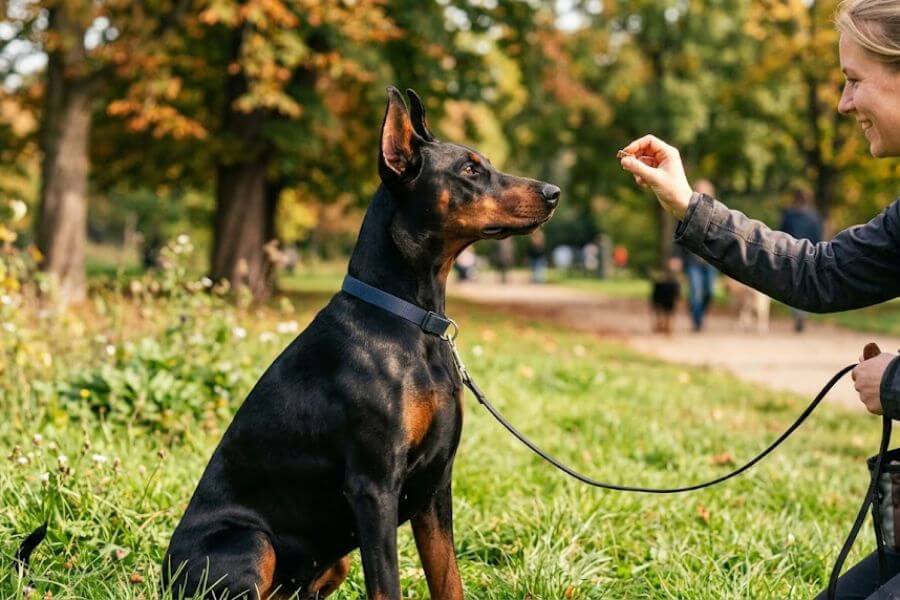
Welcome to the ultimate guide on training your new best friend! If you just brought home a Doberman Pinscher, or if you are planning to get one soon, you are in for a wonderful adventure. These dogs are beautiful, proud, and incredibly smart. They look strong and serious on the outside, but on the inside, they are often just big, loving goofballs who want to please their favorite humans.
Because Dobermans are so strong and intelligent, teaching them how to behave is one of the most important things you will ever do. Training is not about being a boss or forcing your dog to do things. It is about building a great relationship. It is about learning how to talk to each other so that your home stays peaceful and your dog stays safe.
This guide will walk you through everything you need to know from day one. We will cover the basics of how your dog thinks, how to teach the most useful commands, how to fix common behavior issues, and how to keep training fun for both of you. Grab some tasty treats, put on your patience hat, and let us dive into the world of Doberman training!
Understanding the Mind of a Doberman Pinscher
Before you can teach your dog, you need to understand how their brain works. Dobermans are not like every other dog breed. They were originally created in Germany by a man named Louis Dobermann, who needed a loyal, protective dog to keep him safe while he worked. Because of this history, Dobermans have specific traits built into their DNA.
High Intelligence Means Fast Learning
Dobermans are regularly ranked as one of the smartest dog breeds in the entire world. This is great news for you because it means they can learn a new command in just a few tries. However, high intelligence can also be a little tricky. If you do not give your Doberman a job to do, they will invent their own job. Usually, that invented job involves chewing up your favorite shoes or digging a giant hole in the backyard.
Smart dogs get bored very quickly. If you repeat the same simple exercise fifty times in a row, your Doberman will likely look at you and walk away. They need variety, challenges, and puzzles to keep their minds sharp.
The Working Breed Mentality
A Doberman is a working dog through and through. They thrive when they feel like they are contributing to the household. When you train a Doberman, you are giving them a sense of purpose. They love having structure, routines, and clear boundaries. When they know exactly what you expect from them, they feel calm and secure. If you are lazy with your rules, your Doberman might think they need to take charge of the house, which can lead to behavioral problems later on.
Extreme Loyalty and Sensitivity
Dobermans are often called velcro dogs. This is because they stick to their owners like glue. They want to be in the same room as you, sitting on your feet, or leaning against your legs. Because they love you so much, they are also highly sensitive to your moods and the tone of your voice.
If you yell, get angry, or use harsh methods, your Doberman will not learn better. Instead, they will become scared, stressed, or shut down completely. They respond best to kindness, praise, and rewards. Your goal is to be a leader they can trust, not a bully they fear.
Creating the Perfect Training Environment
Imagine trying to study for a difficult school test while standing in the middle of a noisy amusement park. You probably would not remember a single thing! Your dog feels the exact same way when they are trying to learn something new. Setting up the right environment is vital for your success.
Finding a Quiet Space
When you start teaching a brand-new skill, start inside your house in a room with no distractions. Turn off the television, put away noisy toys, and make sure other family members are not running around. You want your Doberman to focus entirely on you. Once your dog can perform the skill perfectly in the living room, you can slowly move to more challenging spots, like the kitchen, the backyard, and eventually the local park.
Keeping Sessions Short and Sweet
Dogs have short attention spans, especially when they are young puppies. A long, grueling hours-long session will just frustrate both of you. Instead, aim for multiple micro-sessions throughout the day. Three or four short sessions that last five to ten minutes each are much better than one long session. You want to stop training while your dog is still having fun and doing well. This leaves them excited for the next time you practice.
Gathering the Right Supplies
You do not need a lot of expensive gear to train your Doberman, but a few basic tools will make the process much smoother:
- A standard four-foot or six-foot flat nylon leash. Avoid retractable leashes because they teach dogs to pull.
- A flat nylon or leather collar that fits comfortably around your dog’s neck.
- A treat pouch that clips onto your waist so you can reward your dog instantly.
- High-value treats cut into tiny, pea-sized pieces.
The Power of Positive Reinforcement
Positive reinforcement is a fancy term for a very simple concept: rewarding your dog for doing the right thing. When your Doberman does something you like, you immediately give them something they love. This makes them want to repeat that good behavior in the future.
Choosing High-Value Treats
Not all treats are created equal in the mind of a dog. Dry, crunchy biscuits might work for a quick snack, but they usually are not exciting enough for training sessions. You want to use high-value treats that smell strong and taste amazing. Good examples include small pieces of cooked chicken, tiny cubes of cheese, or soft training treats from the pet store.
Because you will be giving your dog a lot of treats during training, make sure the pieces are very small. This keeps your dog from getting full too quickly or gaining too much weight.
The Importance of Perfect Timing
Dogs live in the present moment. They connect your reward with whatever action they are doing at the exact split-second they receive it. If you tell your dog to sit, and they sit down, but you wait thirty seconds to look for a treat in your pocket, your dog might stand up or bark in the meantime. When you finally hand over the treat, the dog thinks they are being rewarded for standing or barking!
You must deliver the treat within one or two seconds of the correct action. To help with this, use a marker word like “Yes!” or a clicker the exact moment your dog performs the behavior. This tells the dog, “That exact thing you just did earned you a reward.”
Praise, Toys, and Real-Life Rewards
While food is a great motivator, it is not the only way to reward your Doberman. Some dogs are obsessed with toys. A quick game of tug-of-war or a brief fetch session can be an incredible reward for a job well done.
You can also use verbal praise in a happy, high-pitched voice, along with gentle chest scratches. Real-life rewards work beautifully too. For example, making your dog sit before you open the door to go for a walk teaches them that polite behavior unlocks the fun things in life.
Teaching the Essential Foundation Commands
Every well-behaved dog needs to know a few basic commands. These foundational skills are the building blocks for all advanced training, and they can even save your dog’s life in a dangerous situation.
The Name Game
Before your dog can learn commands, they need to know that their name means they should look at you.
- Sit with your dog in a quiet room while they are looking away from you.
- Say your dog’s name clearly in a cheerful voice.
- The moment they turn their head to look at your face, say “Yes!” and give them a treat.
- Repeat this exercise ten times.
Soon, your Doberman will realize that hearing their name means something awesome is about to happen, and they will snap their attention to you instantly.
Look or Focus
This command teaches your Doberman to make eye contact with you on purpose, which is helpful when you need to distract them from something else.
- Hold a tasty treat right in front of your dog’s nose.
- Slowly bring the treat up toward your own eyes. Your dog’s gaze will follow the treat.
- As soon as your dog makes eye contact with you, say “Yes!” and give them the treat.
- Once they understand the movement, add the verbal cue “Look” right before you move your hand.
Sit
This is usually the very first command people teach, and it is a wonderful foundation for good manners. We use a method called luring.
- Hold a piece of food right in front of your dog’s nose while they are standing up.
- Slowly lift your hand up and back over your dog’s head, keeping the treat close to their muzzle.
- To keep their eyes on the food, your dog will naturally lift their chin up and lower their bottom to the floor.
- The exact moment their bottom touches the ground, say “Yes!” and deliver the treat.
- Do not say the word “Sit” yet. Just practice the hand movement until your dog sits quickly.
- Once they do it smoothly, say the word “Sit” just as you begin to lift your hand.
Down
Teaching a Doberman to lie down on command is excellent for helping them calm down when they are overly excited.
- Start with your dog in a sitting position.
- Hold a treat in your hand and place it right in front of their nose.
- Slowly lower your hand straight down to the floor between your dog’s front paws. Your dog’s nose should follow your hand.
- Once your hand hits the floor, slowly pull it along the ground away from your dog, creating an L-shape path.
- Your dog should slide their body forward onto the floor to follow the food.
- The millisecond their chest and belly touch the ground, say “Yes!” and reward them.
- Once they get the hang of it, add the verbal command “Down” before you guide them to the floor.
Stay
The stay command teaches your dog self-control. It tells them to remain exactly where they are until you give them permission to move.
- Ask your Doberman to sit or lie down.
- Hold your open hand out toward their face like a stop sign and say “Stay.”
- Wait just two seconds. If your dog does not move, say “Yes!” and feed them a treat.
- Give them a release word like “Free!” or “Okay!” so they know they can get up.
- Slowly increase the time they have to wait. Move from two seconds to five seconds, then ten seconds.
- Once they can stay for a short time, start taking one step backward, then immediately step back to them and reward them. Slowly build up the distance.
Come or The Recall
A reliable recall is the most important safety skill your Doberman can ever learn. It ensures that if they ever slip out of the front door or run off their leash, they will sprint right back to you when you call them.
- Start in a small room or hallway with your dog on a short leash.
- Squat down to your dog’s level, open your arms wide, and say “Come!” in an incredibly happy, exciting voice.
- You can gently guide them toward you with the leash if needed.
- When they reach you, celebrate like they just won a gold medal. Give them multiple high-value treats and lots of love.
- Never use the “Come” command to call your dog over for something unpleasant, like a bath, nail trimming, or leaving a fun park. If you do, they will learn that coming to you means the fun ends.
Advanced Leash Manners and Walking Politely
Dobermans grow up to be large, heavy, powerful dogs. If you do not teach them how to walk nicely on a leash while they are young, they will end up dragging you down the street like a rag doll. Loose-leash walking takes plenty of practice, but it makes daily exercise a total joy.
Stopping the Pulling Routine
Dogs pull on the leash because they want to go forward, and pulling gets them to the fun smells faster. To stop this habit, you have to change the rules of the game. You must teach your Doberman that pulling actually makes all forward movement stop completely.
- Attach the leash to your dog’s collar and start walking down the sidewalk.
- The moment your Doberman pulls and the leash goes tight, stop dead in your tracks. Become a heavy stone statue. Do not yank the leash back; just hold your ground.
- Wait patiently. Your Doberman will eventually get confused about why you stopped moving. They will turn around, look at you, or take a step back to put slack in the leash.
- The instant the leash goes loose, say “Yes!” and start walking forward again.
- If they pull again two steps later, stop again. This requires a lot of patience, but your dog will quickly learn that a tight leash means stopping, while a loose leash means walking.
The Red Light Green Light Method
This is a fun variation of the stopping technique. Think of a tight leash as a red light and a loose leash as a green light. When the light is green, you move forward and praise your dog. When the light turns red, you freeze.
To make it even more effective, you can reward your dog with a piece of food whenever they choose to walk right next to your hip and look up at you. Walking next to you should be the most rewarding spot in the entire world.
Socialization: The Key to a Confident Doberman
Socialization is a word trainers use to describe introducing your dog to the world in a positive way. Because Dobermans are natural guard dogs, they can become overly suspicious, nervous, or aggressive toward strangers and new things if they are not socialized properly. A well-socialized Doberman is friendly, relaxed, and confident in any situation.
Introducing New Sights, Sounds, and Surfaces
Socialization does not just mean playing with other dogs. It means exposing your puppy to everything they might encounter during their life. You want to show them that new things are safe and normal. Try to let your Doberman experience these things while pairing them with delicious treats:
- Different types of people: Toddlers, older adults, people wearing big hats, people with umbrellas, people using wheelchairs, and people of all shapes and sizes.
- Varying sounds: Vacuum cleaners, low-flying airplanes, thunderstorms, hair dryers, and honking car horns.
- Unique surfaces: Shiny wooden floors, wet grass, crinkly plastic tarps, gravel paths, and metal grates.
- Vehicles: Bicycles, skateboards, strollers, and delivery trucks.
Positive Experiences Over Direct Contact
A common mistake is forcing your Doberman to interact with every single person or dog they see. This can overwhelm them and cause fear. True socialization means your dog can look at a strange person or a noisy truck, feel perfectly calm, and then look back at you for a treat.
If your dog seems scared, backs away, or growls, you are too close to the object. Move farther away until your dog feels relaxed again, and reward them for being brave.
House-Training and Crate Mastery
Bringing a dog inside means teaching them where it is appropriate to go to the bathroom and how to respect your living space. Potty training and crate training go hand-in-hand to make this process simple.
Setting Up a Strict Potty Routine
Dogs thrive on routines, and their bodies run like little clocks. To prevent accidents inside the house, you need to take your Doberman outside to their designated potty spot very frequently. Take them out:
- First thing when they wake up in the morning.
- Immediately after they eat a meal or drink a lot of water.
- Right after a vigorous play session or a nap.
- At least once every single hour when they are young puppies.
When you take them outside, stand quietly in the grass and give them a few minutes. The moment they do their business, throw a mini-party. Give them three treats in a row and tell them what a good dog they are. If they have an accident inside, do not yell at them or rub their nose in it. That just teaches them to be afraid of you. Simply clean it up thoroughly with an enzymatic cleaner to remove the smell, and try to watch them more closely next time.
Why the Crate Is Your Best Friend
Some people think putting a dog in a crate is mean, but when done correctly, a crate becomes your dog’s favorite place. It mimics a cozy animal den in the wild. It gives your Doberman a safe, private bedroom where they can relax, rest, and sleep without being disturbed.
Because dogs naturally do not like to go to the bathroom where they sleep, a crate is also an incredible tool for house-training. Ensure the crate is large enough for your Doberman to stand up, turn around, and lie down comfortably, but not so giant that they can use one corner as a bathroom and sleep in the other.
Making the Crate a Happy Place
Never throw your dog into the crate and lock the door right away. You need to introduce it slowly and build positive associations.
- Leave the crate door wide open and toss some ultra-tasty treats inside. Let your dog wander in and out to get the food on their own.
- Feed your dog their daily breakfast and dinner inside the crate with the door wide open.
- Give your dog a special toy, like a rubber toy stuffed with peanut butter, only when they are hanging out inside the crate.
- Slowly practice closing the door for just a few seconds while you stand right there, then open it and reward them. Gradually increase the time the door stays closed while you sit in the room, and then while you step out of the room.
Handling Common Behavioral Challenges
Even the smartest Dobermans will run into a few behavior issues as they grow up. Understanding why they do these things helps you solve the problems gently and effectively.
Biting and Nipping
Doberman puppies explore the world with their mouths. They have sharp little teeth and love to nip at your hands, clothes, and ankles. While this is natural puppy play, you must teach them that human skin is far too sensitive for teeth.
- Whenever you are playing with your puppy and their teeth make contact with your skin, make a sharp “Ouch!” sound.
- Immediately stop moving, hide your hands away, and turn your back to the puppy for about twenty seconds. Ignore them completely.
- This teaches the puppy that biting makes the fun human go away.
- Turn back around and offer them a proper chew toy instead. When they bite the toy, praise them enthusiastically.
Excessive Barking
Dobermans are natural watchdogs, so they like to alert you when they hear a strange noise outside or see someone walking past the window. While a little bit of alerting is fine, non-stop barking can drive your family and neighbors crazy.
- Identify what is making your dog bark. If they bark at people walking past the window, close the blinds or move your dog to another room.
- Teach your dog a “Quiet” command. When they bark, wait for them to pause to take a breath. The exact second they are silent, say “Quiet,” count to three, and hand them a treat.
- Never yell at your dog to shut up. When you yell, your Doberman just thinks you are barking along with them, and they will likely bark even louder.
Jumping Up on People
A bouncy, sixty-pound Doberman jumping up to greet you can easily knock a child or an elderly person over. Dogs jump up because they want to greet you face-to-face and get attention.
- When you walk through the front door and your dog jumps on you, cross your arms, turn your body away, and look at the ceiling. Do not touch them, do not talk to them, and do not look at them.
- The moment your dog gets frustrated and puts all four paws flat on the floor, turn back around, squat down, and give them calm praise and love.
- If they jump again, turn away again. They will quickly figure out that jumping makes you look away, while staying flat on the floor gets them the attention they crave.
Separation Anxiety
Because Dobermans love their humans so intensely, they can sometimes panic when they are left home alone. They might bark, cry, pace around, or chew on furniture and door frames.
- Practice leaving your dog alone for very short periods while you are still in the house. Go into another room and close the door for thirty seconds, then come back out. Slowly build up to five minutes, then ten minutes.
- Keep your departures and arrivals very calm and low-key. Do not make a huge deal out of saying goodbye or saying hello. If you act like leaving is a casual, normal event, your dog will feel relaxed about it too.
- Give your Doberman a long-lasting treat puzzle right before you leave the house to keep their brain busy while you are away.
Exercise, Mental Stimulation, and Preventing Boredom
A tired Doberman is a good Doberman. This is a golden rule for owning this breed. If you do not burn off your dog’s physical and mental energy, that energy will turn into bad behavior inside your home.
Physical Exercise Needs
Dobermans are athletic powerhouses. They need much more than a quick walk around the block to satisfy their bodies. Depending on their age, an adult Doberman usually needs around one to two hours of exercise every single day. Great ways to exercise your Doberman include:
- Long, brisk walks or jogs through your neighborhood.
- Safe, off-leash running in a securely fenced area.
- Playing fetch with a ball or a flying disc.
- Going for hikes on nature trails.
- Participating in dog sports like agility, flyball, or tracking.
Brain Games for Mental Fitness
Physical exercise is only half of the puzzle. Mental exercise can tire out a high-energy Doberman just as much as a long run. You can work your dog’s brain by introducing fun games and puzzles:
- Food puzzle toys: Use toys where your dog has to slide panels, flip lids, or roll a ball around to get their dinner out.
- The shell game: Place a treat under one of three plastic cups, shuffle them around, and let your dog sniff out the correct cup.
- Hide and seek: Have a family member hold your dog while you hide in another room. Call your dog’s name once and let them use their nose to track you down. Celebrate wildly when they find you!
Frequently Asked Questions
At what age should I begin training my Doberman Pinscher puppy?
You can start training your Doberman puppy the very day you bring them home, which is usually around eight weeks of age. Puppies are like little sponges, and they are constantly learning from their environment whether you are actively teaching them or not. Starting early with simple things like their name, the sit command, house-training, and gentle socialization sets them up for a lifetime of success. Just keep the sessions very brief, positive, and fun.
Are male or female Dobermans easier to train for a beginner?
Both male and female Dobermans are highly trainable, but they do have slight personality differences. Female Dobermans tend to mature a bit faster, which can make them seem easier to focus at a younger age. They are often very detail-oriented and serious about their work.
Male Dobermans tend to stay silly and puppy-like for a longer time. They are incredibly loving and eager to please, but they might need a little more patience when it comes to keeping their attention. Ultimately, your individual training consistency matters much more than the gender of the dog.
How do I stop my Doberman from being aggressive toward strangers?
Preventing aggression comes down to early, thorough socialization. You need to show your Doberman that strangers are not threats, but rather a source of good things like treats and praise. If your dog is already showing signs of growling or lunging at new people, it is usually because they are feeling fearful or protective.
You must keep your dog at a safe distance from strangers where they feel comfortable, and reward them for looking calmly at the person. Never punish your dog for growling, because growling is their warning system. If you punish the growl, they might bite next time without warning. If you feel overwhelmed by this behavior, it is a smart idea to hire a certified positive-reinforcement professional trainer to help you safely work through it.
How long does it take to fully train a Doberman Pinscher?
Training is not a race with a specific finish line. It is a lifelong journey that you embark on with your dog. While your Doberman can learn basic commands like sit and down in just a couple of weeks, achieving advanced obedience, perfect leash walking, and bulletproof behavior under heavy distractions can take anywhere from several months to a couple of years.
Consistency is the secret ingredient. Even after your dog is well-behaved, continuing to practice their skills throughout their life keeps their brain sharp and maintains your strong bond.
Why does my Doberman listen to me inside the house but ignore me outside?
This is a very common issue that happens because of a concept called generalization. Dogs do not naturally understand that a command like “Sit” means the exact same thing in every location. Inside your living room, the command is simple because it is quiet and familiar. Outside, the world is filled with amazing distractions like blowing leaves, running squirrels, barking neighborhood dogs, and exciting new smells.
To fix this, you need to slowly build up the distraction level. Practice in your backyard first, then on your driveway, then on a quiet sidewalk, and eventually at a busy park. Always use higher-value treats when you are working in environments with lots of distractions to compete for your dog’s attention.